Small Munsterlander

FCI standard Nº 102

Origin
Germany
Translation
Elke Peper
Revised by Ken Bremer
Official language (DE)
Group
Group 7 Pointing Dogs
Section
Section 1.2 Continental Pointing Dogs. Spaniel Type
Working
With Working Trial
Acceptance on a definitive basis by the FCI
Monday 14 February 1955
Publication of the official valid standard
Wednesday 04 September 2019
Last update
Thursday 14 November 2019
En français, cette race se dit
Petit Epagneul de Münster
Diese Norm ist in deutscher Sprache sichtbar
Kleiner Münsterländer
En español, esta raza se dice
Pequeño Münsterländer
In het Nederlands, wordt dit ras gezegd
Kleine Munsterlander

Usage

Versatile working gundog.

Brief historical summary

The breeding of the Kleiner Münsterländer in the north German Münsterland has been documented since around 1870. The blood of hundreds of years of old flushing and pointing dogs flowed in the Kleiner Münsterländer. In 1912, the "Association for Kleine Münsterländer Poining Dogs (Heidewachtelhunde)" was founded in the parent country Germany to preserve and promote these dogs as an independent hunting breed. Hunters were to be provided with a medium-sized, passionate, intelligent and affectionate, fully versatile hunting dog in the field, forest and water. In 1921, Dr. Friedrich Jungklaus created the first breed standard, which has been regularly enhanced since then. Today, the Kleiner Münsterländer is a versatile hunting dog that is very popular with hunters worldwide because of its performance capabilities.

General appearance

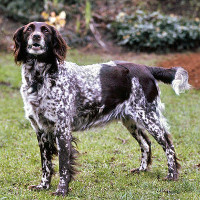
Strong and harmonious build of medium size, showing balanced proportions with a lot of quality and elegance. Distinguished head. In upright posture the dog displays flowing outlines with horizontally carried tail. Its front legs are well feathered, the hind legs with breeches, the tail has a distinct flag.
Its glossy coat should be straight or slightly wavy, dense and not too long. Its movement is harmonious and far reaching. The overall appearance of the breed must always show its utility as a hunting dog.

Important proportions

The length of the body, measured from the prosternum to the point of the buttock, should exceed the height at the withers. The goal is a ratio 1 to 1.1.
The length of the skull from the occiput to the stop is equal to the length of the muzzle from the stop to the nose.

Behaviour / temperament

The Kleiner Münsterländeris intelligent and capable of learning, full of temperament but even, with steady character; its attitude towards people is alert and friendly (suitable for family life), with good social behaviour and keeps close contact with his master (team spirit); with passionate, persevering predatory instinct, versatile hunting aptitudes and strong nerves and keenness for game. The dog must have the natural abilities required to hunt in close cooperation with its handler in the field, forest and water (versability), and to retrieve game to the hunter.

Head

Cranial region

Head
The expression of the head is part of the type.
Skull
Distinguished, lean, flat to slightly arched. 
Stop
Only slightly pronounced but distinctly recognizable.

Facial region

Nose
Whole coloured brown.
Muzzle
Powerful, long, straight.
Lips
Short, tight closing, well pigmented – whole coloured brown.
Jaws and teeth
Large white teeth. Powerful jaws with regular and complete scissor bite with the upper teeth closely overlapping the lower teeth and set square to the jaws. 42 teeth according to the dentition formula.
Cheeks
Strong, well-muscled.
Eyes
Of medium size, neither protruding nor deep set. As dark brown as possible. Eyelids tight fitting to the eyeballs, covering the haws.
Ears
Broad, set on high, lying close to the head, tapering towards the tips, ear leather should not reach beyond the corner of the mouth.

Neck

Its length in balance with the general appearance; gradually widening towards the body. Napeline slightly arched, very muscular. Tight fitting throat skin.

Body

Topline
Slightly sloping in a straight line.
Withers
Pronounced.
Back
Firm, well-muscled. The spinal processes should be covered by the musculature.
Loin
Short, broad, muscular.
Croup
Long and broad, not short slanting, only slightly sloping towards the tail; well-muscled. Broad pelvis.
Chest
Rather deep than broad, breastbone reaching as far backwards as possible. Ribs well arched.
Underline and belly
Slight tuck-up towards the rear in an elegant curve; lean.

Tail

Set on high, with long flag following the topline, strong at the base, then tapering. Of medium length. Carried downwards in repose, horizontally and not too high above the level of the topline with a slight sweep when in action. In the lower third it may be curved slightly upwards.

Limbs

Forequarters

Generality
Viewed from the front straight and rather parallel, viewed from the side legs set well under the body. The distance from the ground to the elbows should be approximately equal to the distance from the elbows to the withers.
Shoulders
Shoulder blades lying close to the body, strongly muscled. Shoulder and upper arm forming a good angle of approximately 110°.
Upper arm
As long as possible, well-muscled.
Elbows
Close to the body, neither turning in nor out. The upper arm forming a good angle with the forearm.
Forearm
Strong bones, perpendicular to the ground.
Carpal
Strong.
Pastern
Very slightly sloping.
Forefeet
Round and arched with well-knit toes and sufficiently thick, tough, robust pads. Not too heavy coat. Parallel in stance or in movement, neither turning in nor out.

Hindquarters

Generality
Viewed from the rear straight and parallel. Correct angulation in stifles and hocks. Strong bones.
Upper thigh
Long, broad, muscular; forming a good angle with the pelvis.
Lower thigh
Long, muscular and sinewy.
Stifle
Strong, upper and lower thigh forming a good angle.
Metatarsus
Short, perpendicular to the ground.
Hock
Strong.
Hind feet
Round and arched with well-knit toes and sufficiently thick, tough, robust pads; not too heavy coat. Parallel in stance or in movement, neither turning in nor out.

Gait and movement

Ground covering, with good drive and appropriate reach, straight forward and parallel coming and going, with well upstanding posture. Pacing gait is undesirable.

Skin

Tight fitting, without folds.

Coat

Hair
Dense, of medium length, not or only slightly wavy, close lying, water-repellent. The outlines of the body may not be hidden by too long coat. By its density it should provide as good a protection against weather, unfavourable terrain conditions and injuries as possible. Short smooth coat on the ears is faulty.
Forelegs feathered, hindlegs with breeching down to the hocks, tail with a long flag and white tip, abundant coat on the fore chest is undesirable.
Colour
Brown-white or brown roan with brown patches, brown mantle or brown ticking; blaze permitted. Tan coloured markings on the muzzle, the eyes and around the anus, and on the ears, tail and legs are permissible („Jungklaus markings“).

Size and weight

Height at withers
Dogs : 54 cm. Bitches: 52 cm. A deviation of +/- 2 cm is within the standard.

Faults

• Any departure from the foregoing points should be considered a fault and the seriousness with which the fault should be regarded should be in exact proportion to its degree and its effect upon the health and welfare of the dog and its ability to perform its traditional work.
• Faults listed should be in degree of seriousness.

Serious faults

 Clumsy, big-boned conformation.
 Serious deviations from the correct proportions of body, neck and height and withers.
 More than 50 % of the nose flesh-coloured or spotted.
 Pointed muzzle.
 Dished nose bridge.
 Eyes too light.
 Light yellow hawk eyes.
 Serious lack of depth of chest or too flat sided brisket.
 Barrel shaped brisket.
 Elbows heavily turning out or in.
 Steep pasterns.
 Strongly cow hocked or barrel legged, in stance as well as in movement.
 Splayed toes; flat feet.
 Clumsy movement.
 Smooth hairless ears or too long and curled fringes on the ears.
 Coat too curled.
 Deviation of the size limits between +/-2cm and +/- 4cm.

Disqualifying faults

 Aggressive or overly shy dogs.
 Fearfulness, aggressiveness, game or gun shyness.
 Gross deviations.
 From the gender type, sexual malformations.
 Completely depigmented nose.
 All deviations from the correct scissor bite except the lack or excess of two P1.
 Split jaw or split lip.
 Bird’s eye.
 Ectropion, entropion, distichiasis, (double eyelash line).
 Pronounced dewlap.
 Distinct roach back.
 Pronounced swayback; crooked spine.
 Malformation of the ribcage, eg sternum cut off.
 Kinky tail, ring tail, other tail abnormalities eg too short or too long tail.
 Whole coloured dogs.
 Deviation in height of more than +/-4 cm.
 Lack of hunting suitability due to the absence of the required natural abilities for use in versatile hunting activities before and after the shot.
 Silent or voiceless and/or Waidlaut (barking when no game is present).

NB :

• Any dog clearly showing physical or behavioural abnormalities shall be disqualified.
• The above mentioned faults when occurring to a highly marked degree or frequently are disqualifying.
• Male animals should have two apparently normal testicles fully descended into the scrotum.
• Only functionally and clinically healthy dogs, with breed typical conformation should be used for breeding.

Bibliography

https://www.fci.be/


Detailed history

When German peddlers are spoken, we think first of Braques, German, of Weimar, with a hard coat (Drahthaar). It should not be forgotten that there are beautiful and good Spaniels in Germany.

Between the end of the nineteenth and the beginning of the twentieth century, it is true, most of the hunters from across the Rhine turned to the Braques and somewhat abandoned their ancestral Spaniels.

The Great or Small Spaniels of Mûnster undeniably evoke the French Spaniel or the Breton Spaniel, but it should not be inferred that they came from it. Indeed, German hunters have never hunt. Also, for centuries, they have devoted themselves exclusively to hunting shooting, nets or panels; their Spaniels, first known as "Oysel dogs" and "wearing dogs", are therefore undeniably very old. As in France, there was a great variety, small and tall, whose dresses were of various colors. Several crosses, especially with English Setters or German Pointers, had made these dogs quite heterogeneous.

In Westphalia, a very game-rich and very dog-friendly region, two local types were selected.

By 1870, however, Germanic cynophiles were concerned with specifying the characteristics of the various German pointers, and so in 1878 it was recommended to avoid dresses variegated with black for the reproduction of Langhaar; they were even banned in 1908. This exclusion is at the origin of the birth of the Grand Mûnsterländer.

Indeed, some breeders of Münster and its surroundings decided to breed this type of Spaniel as a separate breed. In 1919, to promote and select it, they created an association called "Verein für die Reinzucht des langhaarigen grossen Schwarzweissen Münsterländer", and in 1922 the Grand Mûnsterländer began to be officially registered in Germany.

As for the Petit Mûnsterlânder, it was a typical dog from the region of Münster, but at the beginning of this century, it was found that it was about to disappear: a few examples at most could be enumerated. Several breeders endeavored to revive it, among which we must mention mainly Edmond Lons. Between 1925 and 1935, this stubborn cynophile managed to stabilize the characteristics of the Petit Münsterlânder, not without some contributions from other races. It is often said that this dog was created from Breton Spaniels settled in the region as early as 1910. However, this assertion suffers from a serious defect, because, at that time, the Breton Spaniel had just begun to leave his native Brittany and therefore could not have already crossed the Rhine.

Small and Great Mûnsterländer undeniably have Langhaar blood in their veins, and this is quite explicable: both are from local selections of the German Spaniel, which, it, enjoyed a national diffusion, and it is understandable that breeders have used it to regenerate and perfect their favorite dogs. In any case, it should not be believed that the Greater Münsterländer is an avatar of the selection of the Small, appeared during mating between Breton Spaniel and Langhaar, and could, because of its large size, be registered as Small Münsterländer. Its existence is attested before the period 1925 - 1935.

The two breeds were finally recognized by the International Cynological Federation in 1936. Since then, they have spread to many parts of Germany, but also to Switzerland, the Netherlands, Belgium and Alsace. The Petit, especially, begins to be known throughout France, where amateurs discover its qualities.

The French hunters have excellent races of Spaniels: would the choice of a Miillerlandcr be only snobbery, or at least a manifestation of originality?

Admittedly, these two races benefit from the quality reputation of everything that is made in Germany, and it must be said that, as far as they are concerned, this reputation is perfectly justified. German hunters, who are relatively few in number, are highly motivated, passionate and demanding. Their dogs can not be mediocre.

First, they must know how to do everything: the stop on the feather or the hair, obviously, but also the report in plain, the tracking of the hare. They are highly regarded bushmen, but their users are still particularly interested in their services in the aquatic environment, particularly research and reporting, including in deep water. Swimming is for these dogs a second nature.

The Little can lead the hare, the Big is used for the quest of big game. Admittedly, these last two specialties are of little interest to French hunters; they allow, however, to affirm that the Mûnsterländer are really perfectly versatile hunting dogs. With a subtle sense of smell, conducting a very active and methodical search without getting too far from the hunter or imposing a train of hell, specialists in the search for wounded game, these dogs are potentially excellent retrievers.

In short, they are "serious" dogs, shaped by a very varied environment (Westphalia offers very diverse landscapes where crops alternate, meadows, woods, marshes) and a rigorous selection, which can only be appreciated in France. The Petit Mûnsterländer, in particular, who hunts under the gun, has become in a few years, in the south of France, a specialist in the hunting of rabbits, where he shows the qualities of a Spaniel, stopping moreover.

Miinsterlanders have temperament; that is, they need a master without weakness. Not that they are hard; the "hardness" of the German races is a legend, and in any case a Spaniel can not be a difficult dog; but their sharp intelligence makes them quickly discover the slightest fault in the education which is dispensed to them.

Extremely resistant to the weather and to fatigue, they have no less class and elegance: we will admire, for example, their elongated bevel head, without heaviness, finely chiseled.

Le Grand is reputed to be a very devoted, kind, brave, even cheerful dog. The Petit is also endowed with a good naturalness, but its temperament is often more incisive. Some make very safe guardians. Both are excellent house dogs, affectionate and attached to their family. If, wrongly, it has been claimed that they lacked passion, it is because they are above all two wise and naturally submissive dogs.

In France, currently, the Petit Mûnsterlânder, who is present in the exhibitions and who participates in some competitions of work, is already favorably welcomed by the amateurs. The Grand, meanwhile, although still discreet, should also find its place. This growing success is not due to a passing fad, but to strong practical qualities. even if the style of these dogs is very different from that of the French breeds.

Comments

Latest page updates

  • Samusky

    Samusky He is not recognized by the F.C.I. Origin Northern Russia and Siberia <> Siberia -> North America Translation Francis Vandersteen En français, cette race se dit Samusky Diese Norm ist in deutscher Sprache sichtbar Samusky En español, esta raza se dice Samusky In het Nederlands, wordt dit ras gezegd Samusky This breed is also known as SamhuskySamsky     A...
  • Agouti Husky

    Agouti Husky FCI standard Nº 270 Origin Siberian Translation Francis Vandersteen En français, cette race se dit Husky Agouti Diese Norm ist in deutscher Sprache sichtbar Agouti-Husky En español, esta raza se dice Husky Agouti In het Nederlands, wordt dit ras gezegd Agouti Husky   The "Agouti" Husky is not a distinct breed but a rare color variant...
  • White Husky

    White Husky   FCI standard Nº 270       Origin Siberia Translation Francis Vandersteen En français, cette race se dit Husky blanc Diese Norm ist in deutscher Sprache sichtbar Weißer Husky En español, esta raza se dice Husky blanco In het Nederlands, wordt dit ras gezegd Witte Husky   The white Husky is not a distinct breed, but rather a rare and striking...
  • Taimyr Wolf

    Taimyr Wolf He is not recognized by the F.C.I. Origin Siberia Translation Francis Vandersteen En français, cette race se dit Loup de Taïmyr Diese Norm ist in deutscher Sprache sichtbar Taimyr-Wolf En español, esta raza se dice Lobo de Taimyr In het Nederlands, wordt dit ras gezegd Taimyr-wolf   The Taimyr Wolf is no longer an extant breed, but it...
  • Manchurian Spitz

    Manchurian Spitz He is not recognized by the F.C.I. Origin Manchuria and Siberia region Translation Francis Vandersteen En français, cette race se dit Spitz de Mandchourie Diese Norm ist in deutscher Sprache sichtbar Mandschurischer Spitz En español, esta raza se dice Spitz de Manchuria In het Nederlands, wordt dit ras gezegd Mantsjoerije-spits   The...
  • White Swedish Elkhound

    White Swedish Elkhound He is not recognized by the F.C.I. Origin Sweden Translation Francis Vandersteen En français, cette race se dit Chien d'élan suédois blanc Diese Norm ist in deutscher Sprache sichtbar Schwedischer weißer Elchhund En español, esta raza se dice Perro de alce sueco blanco In het Nederlands, wordt dit ras gezegd Witte Zweedse...
  • Turkish Spitz

    Turkish Spitz He is not recognized by the F.C.I. Origin Turkey Translation Francis Vandersteen En français, cette race se dit Spitz turc Diese Norm ist in deutscher Sprache sichtbar Türkischer Spitz En español, esta raza se dice Spitz turco In het Nederlands, wordt dit ras gezegd Turkse spits This breed is also known as Tonya FinosuFino TonyaKobi   The Tonya...
  • Hunters Creek Feist

    Hunters Creek Feist He is not recognized by the F.C.I. Origin U.S.A. Translation Francis Vandersteen En français, cette race se dit Hunters Creek Feist Diese Norm ist in deutscher Sprache sichtbar Hunters Creek Feist En español, esta raza se dice Hunters Creek Feist In het Nederlands, wordt dit ras gezegd Hunters Creek Feist   The Hunters Creek Feist is...
  • Gray’s Mountain Feist

    Gray’s Mountain Feist He is not recognized by the F.C.I. Origin U.S.A. Translation Francis Vandersteen En français, cette race se dit Gray’s Mountain Feist Diese Norm ist in deutscher Sprache sichtbar Gray’s Mountain Feist En español, esta raza se dice Gray’s Mountain Feist In het Nederlands, wordt dit ras gezegd Gray’s Mountain Feist   The Gray’s...
  • Thornburg Feist

    Thornburg Feist He is not recognized by the F.C.I. Origin U.S.A. Translation Francis Vandersteen En français, cette race se dit Thornburg Feist Diese Norm ist in deutscher Sprache sichtbar Thornburg Feist En español, esta raza se dice Thornburg Feist In het Nederlands, wordt dit ras gezegd Thornburg Feist   The Thornburg Feist is a specialized line of...
  • Mullins Feist

    Mullins Feist He is not recognized by the F.C.I. Origin U.S.A. Translation Francis Vandersteen En français, cette race se dit Mullins Feist Diese Norm ist in deutscher Sprache sichtbar Mullins Feist En español, esta raza se dice Mullins Feist In het Nederlands, wordt dit ras gezegd Mullins Feist   The Mullins Feist is an American hunting dog breed...
  • Kemmer Stock Hybrid Squirrel Dog

    Kemmer Stock Hybrid Squirrel Dog He is not recognized by the F.C.I. Origin U.S.A. Translation Francis Vandersteen En français, cette race se dit Kemmer Stock Hybrid Squirrel Dog Diese Norm ist in deutscher Sprache sichtbar Kemmer Stock Hybrid Squirrel Dog En español, esta raza se dice Kemmer Stock Hybrid Squirrel Dog In het Nederlands, wordt dit...
  • Buckley Mountain Feist

    Buckley Mountain Feist He is not recognized by the F.C.I. Origin U.S.A. Translation Francis Vandersteen En français, cette race se dit Buckley Mountain Feist Diese Norm ist in deutscher Sprache sichtbar Buckley Mountain Feist En español, esta raza se dice Buckley Mountain Feist In het Nederlands, wordt dit ras gezegd Buckley Mountain Feist   The...
  • Charlie Feist

    Charlie Feist He is not recognized by the F.C.I. Origin United Kingdom, U.S.A. Translation Francis Vandersteen En français, cette race se dit Charlie Feist Diese Norm ist in deutscher Sprache sichtbar Charlie Feist En español, esta raza se dice Charlie Feist In het Nederlands, wordt dit ras gezegd Charlie Feist   The charming Charlie Feist is one of...
  • Barger Stock Feist

    Barger Stock Feist He is not recognized by the F.C.I. Origin U.S.A. Translation Francis Vandersteen En français, cette race se dit Barger Stock Feist Diese Norm ist in deutscher Sprache sichtbar Barger Stock Feist En español, esta raza se dice Barger Stock Feist In het Nederlands, wordt dit ras gezegd Barger Stock Feist   The Barger Stock Feist is a...
  • Toy Manchester Terrier

    Toy Manchester Terrier He is not recognized by the F.C.I. Origin U.S.A. Translation Francis Vandersteen En français, cette race se dit Manchester Terrier miniature Diese Norm ist in deutscher Sprache sichtbar Miniatur-Manchester-Terrier En español, esta raza se dice Manchester Terrier miniatura In het Nederlands, wordt dit ras gezegd Miniatuur-Manchesterterriër   The Toy...
  • Donggyeongi

    Donggyeongi He is not recognized by the F.C.I. Origin South Korea Translation Francis Vandersteen En français, cette race se dit Donggyeongi Diese Norm ist in deutscher Sprache sichtbar Donggyeongi En español, esta raza se dice Donggyeongi In het Nederlands, wordt dit ras gezegd Donggyeongi This breed is also known as Daeng GyeonDonggyeong Gae   The...
  • Mackenzie River Husky

    Mackenzie River Husky He is not recognized by the F.C.I. Origin Canada, U.S.A. Translation Francis Vandersteen En français, cette race se dit Husky du fleuve Mackenzie Diese Norm ist in deutscher Sprache sichtbar Mackenzie-River-Husky En español, esta raza se dice Husky del río Mackenzie In het Nederlands, wordt dit ras gezegd Mackenzie-rivier...
  • Danish Spitz

    Danish Spitz He is not recognized by the F.C.I. Origin Denmark Translation Francis VandersteenAuthoritative language (DK) Working No working trial required En français, cette race se dit Spitz danois Diese Norm ist in deutscher Sprache sichtbar Dänischer Spitz En español, esta raza se dice Spitz danés In het Nederlands, wordt dit ras gezegd Deense...
  • Hällefors Elkhound

    Hällefors Elkhound He is not recognized by the F.C.I. Origin Sweden Translation Francis Vandersteen En français, cette race se dit Chien d'élan de Hällefors Diese Norm ist in deutscher Sprache sichtbar Hällefors Elchhund En español, esta raza se dice Elkhound de Hällefors In het Nederlands, wordt dit ras gezegd Hällefors Elkhound   The Hällefors...
  • Great Fauve of Brittany

    Great Fauve of Brittany He is not recognized by the F.C.I. Origin France Translation Francis Vandersteen En français, cette race se dit Grand Fauve de Bretagne Diese Norm ist in deutscher Sprache sichtbar Großer Fauve der Bretagne En español, esta raza se dice Gran Fauve de Bretaña In het Nederlands, wordt dit ras gezegd Grote Fauvist van...
  • Timmon’s Biter Herding Dog

    Timmon’s Biter Herding Dog He is not recognized by the F.C.I. Origin Australia Translation Francis Vandersteen En français, cette race se dit Chien de berger Timmon’s Biter Diese Norm ist in deutscher Sprache sichtbar Timmon’s-Biter-Schäferhund En español, esta raza se dice Perro pastor Timmon’s Biter In het Nederlands, wordt dit ras gezegd Timmon’s...
  • Montemboeuf Dog

    Montemboeuf Dog He is not recognized by the F.C.I. Origin France Translation Francis Vandersteen En français, cette race se dit Chien Montemboeuf Diese Norm ist in deutscher Sprache sichtbar Montemboeuf-Hund En español, esta raza se dice Perro Montemboeuf In het Nederlands, wordt dit ras gezegd Montemboeuf-hond   The Montemboeuf is an extinct dog breed, developed...
  • Leauvenaar Dog

    Leauvenaar Dog He is not recognized by the F.C.I. Origin Belgium Translation Francis Vandersteen En français, cette race se dit Chien Leauvenaar Diese Norm ist in deutscher Sprache sichtbar Leauvenaar-Hund En español, esta raza se dice Perro Leauvenaar In het Nederlands, wordt dit ras gezegd Leauvenaar Hond   The Leauvenaar is an extinct dog breed that...
  • Larye Dog

    Larye Dog He is not recognized by the F.C.I. Origin France Translation Francis Vandersteen En français, cette race se dit Chien de Larye Diese Norm ist in deutscher Sprache sichtbar Larye-Hund En español, esta raza se dice Perro de Larye In het Nederlands, wordt dit ras gezegd Larye-hond This breed is also known as Layrre   The Larye is a...
  • Happa Dog

    Happa Dog He is not recognized by the F.C.I. Origin China Translation Francis Vandersteen En français, cette race se dit Chien Happa Diese Norm ist in deutscher Sprache sichtbar Happa-Hund En español, esta raza se dice Perro Happa In het Nederlands, wordt dit ras gezegd Happa-hond   The Happa Dog was a dog breed originating in China. Closely...
  • Han Epoch Dog

    Han Epoch Dog He is not recognized by the F.C.I. Origin China Translation Francis Vandersteen En français, cette race se dit Chien de l'époque Han Diese Norm ist in deutscher Sprache sichtbar Hund der Han-Zeit En español, esta raza se dice Perro de la época Han In het Nederlands, wordt dit ras gezegd Hond uit de Han-periode This breed is also known...
  • Stable Griffon

    Stable Griffon He is not recognized by the F.C.I. Origin Belgium Translation Francis Vandersteen En français, cette race se dit Griffon d’écurie Diese Norm ist in deutscher Sprache sichtbar Stallgriffon En español, esta raza se dice Grifón de establo In het Nederlands, wordt dit ras gezegd Stalgriffon   The Stable Griffon was developed to hunt rats...
  • Red Decoy Dog

    Red Decoy Dog He is not recognized by the F.C.I. Origin England Translation Francis Vandersteen En français, cette race se dit Chien d'appel rouge Diese Norm ist in deutscher Sprache sichtbar Roter Lockhund En español, esta raza se dice Perro de reclamo rojo In het Nederlands, wordt dit ras gezegd Lokjachthond This breed is also known as Decoy...
  • Coton from Réunion

    Coton from Réunion He is not recognized by the F.C.I. Origin Réunion Island En français, cette race se dit Coton de Réunion Diese Norm ist in deutscher Sprache sichtbar Coton von Réunion En español, esta raza se dice Cotón de Reunión In het Nederlands, wordt dit ras gezegd Coton van Réunion This breed is also known as Réunion Dog   The Coton from...
  • Céris Dog

    Céris Dog He is not recognized by the F.C.I. Origin France Translation Francis Vandersteen En français, cette race se dit Chien Céris Diese Norm ist in deutscher Sprache sichtbar Céris Hund En español, esta raza se dice Perro Céris In het Nederlands, wordt dit ras gezegd Céris Hond   The Céris is an extinct dog breed, created in France by Monsieur de...
  • Roulers Cattle Dog

    Roulers Cattle Dog He is not recognized by the F.C.I. Origin Belgium Translation Francis Vandersteen En français, cette race se dit Bouvier des Roulers Diese Norm ist in deutscher Sprache sichtbar Roulers Treibhund En español, esta raza se dice Boyero de Roulers In het Nederlands, wordt dit ras gezegd Roulers Koehond   The Roulers Cattle Dog was...
  • Paret Cattle Dog

    Paret Cattle Dog He is not recognized by the F.C.I. Origin Belgium Translation Francis Vandersteen En français, cette race se dit Bouvier des Paret Diese Norm ist in deutscher Sprache sichtbar Paret Treibhund En español, esta raza se dice Boyero de Paret In het Nederlands, wordt dit ras gezegd Paret Koehond   The Paret Cattle Dog was one of five...
  • Moerman Cattle Dog

    Moerman Cattle Dog He is not recognized by the F.C.I. Origin Belgium Translation Francis Vandersteen En français, cette race se dit Bouvier des Moerman Diese Norm ist in deutscher Sprache sichtbar Moerman Treibhund En español, esta raza se dice Boyero de Moerman In het Nederlands, wordt dit ras gezegd Moerman Koehond   The Moerman Cattle Dog was...
  • Blanquito de la Habana

    Blanquito de la Habana He is not recognized by the F.C.I. Origin Cuba Translation Francis Vandersteen En français, cette race se dit Blanquito de la Habana Diese Norm ist in deutscher Sprache sichtbar Blanquito de la Habana En español, esta raza se dice Blanquito de La Habana In het Nederlands, wordt dit ras gezegd Blanquito de la Habana   The...
  • Black and Tan Terrier

    Black and Tan Terrier He is not recognized by the F.C.I. Origin United Kingdom Translation Francis Vandersteen En français, cette race se dit Terrier noir et feu Diese Norm ist in deutscher Sprache sichtbar Schwarzer und feuriger Terrier En español, esta raza se dice Terrier Negro y Fuego In het Nederlands, wordt dit ras gezegd Zwart-bruine...
  • Saintonge Hound

    Saintonge Hound He is not recognized by the F.C.I. Origin France Translation Francis Vandersteen En français, cette race se dit Chien de Saintonge Diese Norm ist in deutscher Sprache sichtbar Saintonge-Laufhund En español, esta raza se dice Perro de Saintonge In het Nederlands, wordt dit ras gezegd Saintonge-hond   The Saintonge Hound is an extinct breed that...
  • Basset Saintongeois

    Basset Saintongeois He is not recognized by the F.C.I. Origin France Translation Francis Vandersteen En français, cette race se dit Basset saintongeois Diese Norm ist in deutscher Sprache sichtbar Basset Saintongeois En español, esta raza se dice Basset saintongeois In het Nederlands, wordt dit ras gezegd Basset Saintongeois   The Basset...
  • Basset Normand

    Basset Normand He is not recognized by the F.C.I. Origin France Translation Francis Vandersteen En français, cette race se dit Basset normand Diese Norm ist in deutscher Sprache sichtbar Basset Normand En español, esta raza se dice Basset normando In het Nederlands, wordt dit ras gezegd Basset Normand   The Basset Normand was a Basset-type hound...
  • Basset d'Artois

    Basset d'Artois He is not recognized by the F.C.I. Origin France Translation Francis Vandersteen En français, cette race se dit Basset d'Artois Diese Norm ist in deutscher Sprache sichtbar Basset d’Artois En español, esta raza se dice Basset de Artois In het Nederlands, wordt dit ras gezegd Basset d'Artois   The Basset d’Artois was a basset-type hound...
  • Tenerife Dog

    Tenerife Dog He is not recognized by the F.C.I. Origin Island of Tenerife (Canary Islands) Translation Francis Vandersteen En français, cette race se dit Chien de Tenerife Diese Norm ist in deutscher Sprache sichtbar Teneriffa-Hund En español, esta raza se dice Perro de Tenerife In het Nederlands, wordt dit ras gezegd Tenerife-hond This breed is also known...
  • Welsh Hillman

    Welsh Hillman He is not recognized by the F.C.I. Origin Wales Translation Francis Vandersteen En français, cette race se dit Welsh Hillman Diese Norm ist in deutscher Sprache sichtbar Welsh Hillman En español, esta raza se dice Welsh Hillman In het Nederlands, wordt dit ras gezegd Welsh Hillman   The Welsh Hillman was an old local breed or type of...
  • Turnspit Dog

    Turnspit Dog He is not recognized by the F.C.I. Origin United Kingdom Translation Francis Vandersteen En français, cette race se dit Chien de tournebroche Diese Norm ist in deutscher Sprache sichtbar Rotisserie-Hund En español, esta raza se dice Perro asador In het Nederlands, wordt dit ras gezegd Turnspit-hond   The Turnspit dog was a...
  • Toy Trawler Spaniel

    Toy Trawler Spaniel He is not recognized by the F.C.I. Origin United Kingdom Translation Francis Vandersteen En français, cette race se dit Epagneul Miniature Trawler Diese Norm ist in deutscher Sprache sichtbar Miniatur-Trawler-Spaniel En español, esta raza se dice Spaniel de Trawler en miniatura In het Nederlands, wordt dit ras gezegd Miniatuur...
  • Cão de Fila da Terceira

    Cão de Fila da Terceira He is not recognized by the F.C.I. Origin Terceira Island in the Azores Translation Francis Vandersteen The Terceira Mastiff (Portuguese : Cão de Fila da Terceira) is a local Portuguese dog breed, also known as the Rabo Torto (rabo = tail, torto = twisted). Neither the Fédération Cynologique Internationale nor the Local...
  • Talbot Hound

    Talbot Hound He is not recognized by the F.C.I. Origin France Translation Francis Vandersteen En français, cette race se dit Chien de Talbot Diese Norm ist in deutscher Sprache sichtbar Talbot-Hund En español, esta raza se dice Sabueso Talbot In het Nederlands, wordt dit ras gezegd Talbot-hond This breed is also known as Talbot BloodhoundFrench...
  • English Staghound

    English Staghound He is not recognized by the F.C.I. Origin England Translation Francis Vandersteen En français, cette race se dit Staghound anglais Diese Norm ist in deutscher Sprache sichtbar Englischer Staghound En español, esta raza se dice Staghound inglés In het Nederlands, wordt dit ras gezegd Engelse Staghound   The Staghound is an extinct...
  • Southern Hound

    Southern Hound He is not recognized by the F.C.I. Origin Great Britain Translation Francis Vandersteen En français, cette race se dit Chien du Sud Diese Norm ist in deutscher Sprache sichtbar Südlicher Laufhund En español, esta raza se dice Sabueso del sur In het Nederlands, wordt dit ras gezegd Zuidelijke Hond   The Southern Hound was a large...
  • St. John's Water Dog

    St. John's Water Dog He is not recognized by the F.C.I. Origin Canada Translation Francis Vandersteen En français, cette race se dit Chien d’eau de St. John's Diese Norm ist in deutscher Sprache sichtbar St. John's Wasserhund En español, esta raza se dice Perro de aguas de San Juan In het Nederlands, wordt dit ras gezegd St. John's Water Dog The St...
  • Rache Hound

    Rache Hound He is not recognized by the F.C.I. Origin Middle Ages Translation Francis Vandersteen En français, cette race se dit Chien courant Rache Diese Norm ist in deutscher Sprache sichtbar Rache-Laufhund En español, esta raza se dice Sabueso Rache In het Nederlands, wordt dit ras gezegd Rache-hond This breed is also known as RacchRachRatch   The term...
  • Welsh Grey Sheepdog

    Welsh Grey Sheepdog He is not recognized by the F.C.I. Origin Wales Translation Francis Vandersteen En français, cette race se dit Chien de berger gallois gris Diese Norm ist in deutscher Sprache sichtbar Waliser Grauer Schäferhund En español, esta raza se dice Pastor Gris Galés In het Nederlands, wordt dit ras gezegd Welsh Grey Herdershond This breed is...
  • Old Croatian Sighthound

    Old Croatian Sighthound He is not recognized by the F.C.I. Origin Croatia Translation Francis Vandersteen En français, cette race se dit Lévrier croate ancien Diese Norm ist in deutscher Sprache sichtbar Alter kroatischer Windhund En español, esta raza se dice Viejo lebrel croata In het Nederlands, wordt dit ras gezegd Oude Kroatische Windhond This...
  • Norman Hound

    Norman Hound He is not recognized by the F.C.I. Origin France Translation Francis Vandersteen En français, cette race se dit Chien normand Diese Norm ist in deutscher Sprache sichtbar Normannischer Laufhund En español, esta raza se dice Sabueso Normando In het Nederlands, wordt dit ras gezegd Normandische Brak   Little is known about the origins of...
  • Moscow Water Dog

    Moscow Water Dog He is not recognized by the F.C.I. Origin Russia Translation Francis Vandersteen En français, cette race se dit Chien d'eau de Moscou Diese Norm ist in deutscher Sprache sichtbar Moskauer Wasserhund En español, esta raza se dice Perro de agua de Moscú In het Nederlands, wordt dit ras gezegd Moskou-waterhond This breed is also...
  • Tracking Hound

    Tracking Hound He is not recognized by the F.C.I. Origin Middle Ages Translation Francis Vandersteen En français, cette race se dit Chien pisteur Diese Norm ist in deutscher Sprache sichtbar Spürhund En español, esta raza se dice Sabueso de rastro In het Nederlands, wordt dit ras gezegd Speurhond This breed is also known as LimerLymerLyam...
  • Laconian

    Laconian He is not recognized by the F.C.I. Origin Ancient Laconia, Greece Translation Francis Vandersteen En français, cette race se dit Laconien Diese Norm ist in deutscher Sprache sichtbar Lakonier En español, esta raza se dice Laconio In het Nederlands, wordt dit ras gezegd Laconisch This breed is also known as SpartanCastorian   The Laconian is an...
  • Halls Heeler

    Halls Heeler He is not recognized by the F.C.I. Origin Australia Translation Francis Vandersteen En français, cette race se dit Halls Heeler Diese Norm ist in deutscher Sprache sichtbar Halls Heeler En español, esta raza se dice Halls Heeler In het Nederlands, wordt dit ras gezegd Halls Heeler   The Halls Heeler is the presumed ancestor of two...
  • Dogo Cubano

    Dogo Cubano He is not recognized by the F.C.I. Origin Cuba Translation Francis Vandersteen The Dogo Cubano, also known as the Cuban Dogue, Cuban Bloodhound and Cuban Mastiff, is an extinct breed of dog from Cuba. It was of the Bullmastiff type and was used for bull and dog fighting. The breed was introduced to Cuba to capture runaway slaves...
  • Dalbo Dog

    Dalbo Dog He is not recognized by the F.C.I. Origin Sweden Translation Francis Vandersteen En français, cette race se dit Chien de Dalbo Diese Norm ist in deutscher Sprache sichtbar Dalbo-Hund En español, esta raza se dice Perro Dalbo In het Nederlands, wordt dit ras gezegd Dalbo-hond This breed is also known as DalbohundDalsland Mastiff   Icelandic...
  • Cordoba Fighting Dog

    Cordoba Fighting Dog He is not recognized by the F.C.I. Origin Argentina Translation Francis Vandersteen En français, cette race se dit Chien de combat de Cordoue Diese Norm ist in deutscher Sprache sichtbar Córdoba-Kampfhund En español, esta raza se dice Perro de pelea de Córdoba In het Nederlands, wordt dit ras gezegd Cordoba-vechthond This breed is...
  • Celtic Greyhound

    Celtic Greyhound He is not recognized by the F.C.I. Origin Celtic Mythology Translation Francis Vandersteen En français, cette race se dit Lévrier celte Diese Norm ist in deutscher Sprache sichtbar Keltische Windhund En español, esta raza se dice Lebrel celta In het Nederlands, wordt dit ras gezegd Keltische windhond   The Celtic Greyhound is an...
  • Belgian Mastiff

    Belgian Mastiff He is not recognized by the F.C.I. Origin Belgium Translation Francis VandersteenOrigin SRSH-KMSH - Belgian Royal Canine SocietyAuthentic language FR Group Group 2 : Pinscher and Schnauzer - Molossoid and Swiss Mountain and Cattle Dogs Section Section 2.1 : Molossoids, mastiff type Working Without working trial En français, cette...
  • Argentine polar dog

    Argentine polar dog He is not recognized by the F.C.I. Origin Argentina Translation Francis Vandersteen The Argentine polar dog (perro polar argentino) was a breed of Argentine dog that is now extinct. Argentine polar dogs were developed by the Argentine army to provide sled dogs for their Antarctic bases. The breed was the result of a cross...
  • Alaunt

    Alaunt He is not recognized by the F.C.I. Origin Central Asia Translation Francis Vandersteen This breed is also known as Kavkaz AlauntCaucasian AlauntAlan DoggePersian AlauntContinental AlauntEnglish AlauntFrench AlauntSpanish AlauntAlan DogArnaut Dogge The legendary Alaunt is one of the most important Molosse breeds in history, but also one of...
  • Small Dutch Hound

    Small Dutch Hound He is not recognized by the F.C.I. Origin The Netherlands Translation Francis Vandersteen En français, cette race se dit Petit Chien courant néerlandais Diese Norm ist in deutscher Sprache sichtbar Kleiner niederländischer Brackenhund En español, esta raza se dice Sabueso holandés pequeño In het Nederlands, wordt dit ras gezegd Kleine...
  • Sri Lankan Hound

    Sri Lankan Hound He is not recognized by the F.C.I. Origin Sri Lankan Translation Francis Vandersteen En français, cette race se dit Chien courant du Sri Lanka Diese Norm ist in deutscher Sprache sichtbar Sri-Lanka-Hund En español, esta raza se dice Sabueso de Sri Lanka In het Nederlands, wordt dit ras gezegd Sri Lankaanse Brak This breed is also...

© 2026 Groupe Milouchouchou ASBL. Tous droits réservés. En savoir plus

Protected by Copyright01

