
 |
Puma |
|
He is a wild animal |
Origin |
North and South America | |
Translation |
Francis Vandersteen |
| The possession of this animal is not authorized Royal Decree establishing the list of mammals not kept for production purposes that may be kept (M.B. 24.08.2009) |
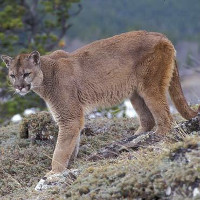
| The puma, also known as the mountain lion or cougar, is a carnivorous mammal belonging to the felidae family. It is a solitary animal that lives in North and South America. Difficult to observe, it resembles a leopard without spots, which explains why it is sometimes also referred to as a panther. The puma's coat is uniform (concolor means "of a single color"), although stripes can sometimes be seen on its forelegs. Its color remains in tawny tones, varying from reddish-brown in tropical regions to yellow-gray in arid regions. The underside is lighter, ranging from cream to white. Hair length depends on the natural environment in which the animal lives: rough and short in warm regions, long in cold. Albinism is rare, but melanism is common. On average, the male measures between 1 and 2.30 meters in length, the record being 2.90 meters including tail. The tail represents a third of the animal's size. The puma's weight averages between 53 and 72 kg for males; the largest known individual weighed 120 kg. Shoulder height varies from 60 to 76 cm. Females are smaller (around 35 to 48 kg). In addition, puma subspecies differ in size: the largest specimens live in the Rocky Mountains and Patagonia, while the smallest evolve in regions close to the equator. Size increases with distance from the equator. The puma's silhouette is slender and muscular, and its hindquarters are higher than its head, enabling it to jump easily. Its long tail (between 53 and 81 cm), darker at the tip, is one of the puma's distinguishing features. Finally, it has four toes equipped with long, sharp, retractile claws. Its hind legs are wider and more powerful than its front ones, enabling it to pounce efficiently and advance easily in snow or on steep terrain. Pumas are carnivores, generally attacking large mammals such as deer or elk, but also smaller animals if necessary, even fishing or feeding on insects or lizards. On average, a North American puma will consume a deer every seven to ten days, sometimes more in the case of a female with young. Finally, pumas can kill livestock (horses, sheep, cows, goats, etc.). Pumas hunt alone, at dawn or dusk, during the day in the mountains. They stalk their prey and approach it from behind. Pumas can swoop down on an animal from the top of a branch: this is called stalking. They kill their prey by biting the base of the skull, breaking the victim's neck. In this way, they can attack animals much larger than themselves. They then bury the carcass or partially cover it to protect it from scavengers for a few days, before returning to feed on it. Like all predators, they change their prey depending on its abundance. In an area where a species of Canadian bighorn sheep had been reintroduced, it was found that pumas had increased their predation on this species, while deer populations (their preferred food) had decreased. |



 English (United Kingdom)
Comments