
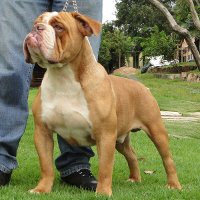
 |
Brazilian Campeiro Bulldog |
|
FCI standard Nº 374 |
||
Origin |
Brazil | |
Translation |
Ricardo Torre Simões (Official language EN) |
|
Group |
Group 2 Pinscher and Schnauzer – Molossoid and Swiss Mountain and Cattledogs | |
Section |
Section 2.1 Molossian type - Mastiff type | |
Working |
Without working trial. | |
Acceptance on a provisional basis by the FCI |
Wednesday 6 August 2025 | |
Publication of the official valid standard |
Wednesday 6 August 2025 | |
Last update |
Monday 25 August 2025 | |
En français, cette race se dit |
 |
Bulldog Campeiro Brésilien |
Diese Norm ist in deutscher Sprache sichtbar |
 |
Brasilianischer Campeiro Bulldog |
En español, esta raza se dice |
 |
Bulldog Campeiro Brasileño |
In het Nederlands, wordt dit ras gezegd |
 |
Braziliaanse Campeiro Bulldog |
This breed is also known as |
Campeiro Bulldog
|
Usage |
| A livestock guarding dog, watchdog and companion dog. |
Brief historical summary |
| The Campeiro Bulldog has its genesis through the bulldogs brought to Brazil by European immigrants, being developed in the south of the country. The word “Campeiro” refers to the countryside, relating the breed to its environment of origin. They were used during the capture of stray cattle raised in a hostile environment of the field and native forest, helping to locate, capture and drive these animals, in addition of being companions and guardians of the countryman. Also used in old slaughterhouses to contain animals for slaughter. It is a strong and powerful dog, with broad head, strong jaws, with the lower jaw projected beyond the upper just enough for the dog to hold the ox. It has a broad and strong muzzle, not too short or too long, to make possible to grab an ox regardless of its size and weight. In addition to a vigilant and calm temperament, it has a brave spirit and companionship. This temperament must be firm and controlled to always obey the commands of its owner. |
General appearance |
| It is a medium-sized, shorthaired dog, with imposing appearance, compact and robust, with a powerful and broad constitution, indicating strength and agility. It has a slightly rectangular body shape, the females being slightly longer than males. Viewed from above, it should be broad in the shoulders and comparatively narrow in the loin. The Campeiro Bulldog is vigorous, muscular, with strong-boned limbs. Bulky head and broad chest. The Campeiro Bulldog should not be stocky or excessively heavy or too light, lacking in substance or wading. |
Important proportions |
| • Body length / height at withers ratio of 11:10. • Length of head /length of muzzle ratio: minimum of 4:1, maximum 3:1. • Length of legs from ground to elbow is 50% of high at withers. |
Behaviour / temperament |
| Versatile, with guardian characteristics. It stands out for its fidelity to its owner, tenacity and courage. His temperament is vigilant, calm and persevering, with a brave spirit and companionship. Very docile, is an easily adaptable dog. Controllable without being shy, barks little and is calm. |
Head |
||
| Ample, wide, with strong jaws, without excess wrinkles or loose skin. In females, the head has a more delicate appearance than in males. | ||
Cranial region |
||
Skull |
Rather broad and slightly rounded. Viewed from the front, it forms a straight line between the ears when attentive. | |
Stop |
Well defined. | |
Facial region |
||
Nose |
Broad and well pigmented, with well-opened nostrils. Colours : black, blue or brown. | |
Muzzle |
Short, approximately 1/4 of the length of the skull. Wide below the eyes with the side lines parallel, as square as possible when viewed from above. | |
Lips |
Thick and pendulous, not exceeding the lower jaw line by more than 50% of the depth of the muzzle. The lip should be as fully pigmented as possible. | |
Jaws and teeth |
Broad, massive and square. The lower jaw should advance beyond the upper jaw and rise slightly at the tip of the mandible, forming a mild to moderate undershot. Strong teeth, with canines well developed for gripping, and well spaced apart. Preference is given to incisors that are well aligned to the canines. The bite formula must be as complete as possible. | |
Cheeks |
Prominent, due to strong development of facial muscles. | |
Eyes |
Oval of medium size, neither deep nor prominent. Eyelids should be well pigmented. Lower eyelids in contact with the eyeball are preferred. Eyes colour that range from black, dark brown or brown, allowing for lighter shades in dogs with dilute colours. | |
Ears |
Set high, as far apart as possible. Small, pendant, triangular; facing backwards (rose ears) are also accepted. | |
Neck |
| Strong, of moderate length, very muscular, with loose skin forming a dewlap that should not be excessive. |
Body |
||
Topline |
Firm and muscular. Slightly rising towards the croup and arched over the loin. | |
Withers |
Must be marked. | |
Back |
Moderately short and straight. | |
Loin |
Wide, fairly short, firm and strong. | |
Croup |
Slightly rounded and arched. | |
Chest |
Of notable amplitude, almost round, and the depth must necessarily reach down to the elbows. | |
Ribs |
Ribs well sprung. | |
Underline and belly |
Neither pendulous nor too tucked up. | |
Tail |
| Naturally short, not straight, set low and thick at the root, and tapering at the end. The length must not exceed two-thirds of the distance from the tail set to the hocks. It is carried low even in action and preferably not rising above the line of the back. |
Limbs |
Forequarters |
||
Generality |
Vigorous, muscular and strong-boned. Straight when viewed from the front. | |
Shoulders |
Broad, muscular and oblique. In relation to the horizontal, they should be 45° while the scapulo-humeral angulation should be just more than 90°. | |
Upper arm |
Strong and muscular. | |
Elbows |
Strong, free from the ribs. | |
Forearm |
Well developed and with strong, straight bones. | |
Carpal |
Straight, parallel, robust and firm. | |
Pastern |
Slightly flat, firm, with good bones. Seen in profile with a slight inclination, but never sagging. | |
Forefeet |
Following the forearm. Slightly facing outwards is tolerated. With fingers slightly separated and slightly arched. Strong pads. Strong and dark nails, in accordance with the colour of the coat, which may be white when the corresponding finger is also white. | |
Hindquarters |
||
Generality |
Muscular and strong. Parallels, when viewed from behind. | |
Upper thigh |
Well developed. | |
Lower thigh |
Moderate length, parallel to each other. With powerful muscles on strong bones. | |
Stifle |
With good angulation. | |
Metatarsus |
Perpendicular to the ground, when viewed in profile. Strong bones and good skin adhered. | |
Hock |
Moderate angle, parallel. | |
Hind feet |
They are straight, parallel to each other, with fingers slightly separated and arched; with thick and elastic pads. Strong and dark nails, in accordance with the colour of the coat, which may be white when the corresponding finger is also white. | |
Gait and movement |
| Balanced, free, with good ground coverage, head preferred carried low when moving. |
Skin |
| Tight to the body, except for the dewlap. |
Coat |
||
Hair |
Short, smooth, of medium texture, neither soft nor wiry to the touch. | |
Colour |
All colours are allowed, except merle. | |
Size and weight |
||
Height at withers |
The balance of weight and height that give the specimen a vigorous appearance must be respected. Males : 51-58 cm. Females : 49-56 cm. |
|
Weight |
The individual should look strong and robust. | |
Faults |
| • Any departure from the foregoing points should be considered a fault and the seriousness with which the fault should be regarded should be in exact proportion to its degree and its effect upon the health and welfare of the dog and its ability to perform its traditional work. • Faults listed should be in degree of seriousness. |
General faults |
 Lack of premolar teeth (P1). Ears too short, narrow, too wide or long. Neck too short. Neck without dewlap or with excessive dewlap. Fronts or hindquarters with little or no angulation. Loose metacarpals, splashed feet. Excessively turned out front feet. Atypical coat. Any deviation in the height x weight proportion that gives the dog characteristics incompatible with those described in the item general appearance. Lack of premolar teeth (P1). Ears too short, narrow, too wide or long. Neck too short. Neck without dewlap or with excessive dewlap. Fronts or hindquarters with little or no angulation. Loose metacarpals, splashed feet. Excessively turned out front feet. Atypical coat. Any deviation in the height x weight proportion that gives the dog characteristics incompatible with those described in the item general appearance. |
Serious faults |
| Level, roach or saddle top line. Slightly open nostrils. Semi-erect or erect ears. Excessive undershot, from more than1cm to 2cm. Permanently exposed tongue or canines when mouth is closed. Lower eyelids drooping, allowing visualization of a large portion of the conjunctiva (ectropion). Round or very large eyes or bulging. Top line not firm enough. Weak, narrow, shallow chest (not reaching elbow height). Tip of tail exceeding point of the hock. Excessive angulations in front or rear. Arched forelegs. Cow hocks. Very heavy or difficult movement, with short steps or continuous pace step. |
Disqualifying faults |
| Aggressive or overly shy dogs. Head/Nose proportion less than 1:4 and more than 1:3. Respiratory distress. Blue eyes, porcelain (prey eyes), eyes of different colours. Excessive undershot bigger than 2cm. Wry mouth or twisted jaw. Missing canines or incisors or missing more than 2 molars. Depigmentation exceeding 25% of the nose in dogs over one year of age. Any bite other than undershot. Unmarked stop (absent). Descending top line. Taillessness or ingrown tail. Merle colour.• Atypical dog. |
NB : |
| • Any dog clearly showing physical or behavioural abnormalities shall be disqualified. • The above mentioned faults when occurring to a highly marked degree or frequently are disqualifying. • Male animals should have two apparently normal testicles fully descended into the scrotum. • Only functionally and clinically healthy dogs, with breed typical conformation should be used for breeding. |
Bibliography |
| https://www.fci.be/ |



 Español (España)

Comentarios / Calificaciones