 |
Talbot Hound |
|
He is not recognized by the F.C.I. |
Origin |
France | |
Translation |
Francis Vandersteen | |
This breed is also known as |
Talbot Bloodhound
|
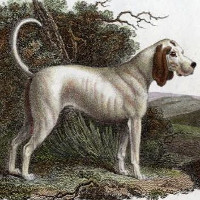
| The Talbot was a type of white hunting dog. It is now extinct and has been credited with being an ancestor of the modern beagle and bloodhound. The term Talbot is used in heraldry to refer to a well-mannered hunting dog. The breed is said to have originated in Normandy, perhaps as the white dog of St. Hubert, and to have been brought to England by William the Conqueror, but this is not supported by evidence. There are no known references to the Talbot as a hunting dog breed in medieval French, and none were found in English before the mid-16th century. In medieval times, "Talbot" was a common name for a particular dog, used before 1400 in Chaucer's Priest's Tale, and used as an example of a dog name in a 16th-century hunting book. By the 17th century, it clearly existed as a breed or type. Big, heavy, slow dogs were "Talbot-like", whatever their color, although the "white-milk" was "the real Talbot". William Somervile in his poem "The Chase", published in 1735, describes the earlier use of "lime-hounds" (leashe hounds) on the Scottish Borders to catch thieves, obviously referring to the bloodhound, but adding that the Talbot (white) was the "prime" example of this type of dog. The origin of the name and the animal is uncertain. In a quotation from around 1449, the King referred to John Talbot, 1st Earl of Shrewsbury as "Talbott, our good dogge", perhaps as a play on his name, or in allusion to the family badge. In a British Library manuscript, John Talbot is shown presenting a romance book to Queen Margaret, with a white dog behind him, which symbolically serves to identify him. It's obviously a small dog, and it seems unlikely that it could have been used in this way if "Talbot" had been associated in the minds of people of the time with a large animal. The Talbot and Greyhound were, apparently, the only dogs used in English heraldry, and it could be that the Talbot originated from an emblematic or heraldic dog. References to this heraldic Talbot seem to be earlier than references to a real dog. The Talbot appears in many coats of arms, for example in the late Earls of Shrewsbury, in which two Talbots appear as supporters. It's an entirely plausible idea that since those early days, the name "Talbot" has been extended to any large, white, fragrant dog, and from there helped establish a breed or type. It was certainly similar to the bloodhound (and "white" is given as one of the bloodhound's colors around the 16th and 17th centuries) in size, and use as a hunting dog. As the earliest references to this dog are much later than those to bloodhounds, it cannot be considered an ancestor of the bloodhound. The Talbot seems to have existed as a breed, somewhat distinct from the bloodhound, until the late 18th century, after which, like two other large breeds to which it may have been related, the Northern and Southern Hounds, became extinct. Some early dog shows apparently offered classes for Talbots, but they were never entered, and so were abandoned. "The Talbot" (or "Talbot Arms") is best known as the name of some English inns or public houses, and is usually depicted on signs as a large white dog with hanging ears, sometimes with spots. This suggests that the Talbot was fairly well known at one time, as part of the idea of a sign was that it helped identify the inn for the illiterate. An inn called The Talbot in Iwerne Minster, Dorset, UK, showed as a sign a black dog, apparently the crest of the Bower family, who owned the manor from the late Middle Ages until 1876. The market town of Sudbury, in Suffolk, in the east of the UK, has a Talbot on its town crest, which is also used for a local school and many local sports clubs. The dog is always depicted with its tongue protruding. The arms of the Carter family of Castle Martin (see Possil's Carter-Campbell) include a Talbot. The arms of the Waldegrave Earls are supported by two Talbots. Adding to this, Hampton High School, a Hampton Township school in the small town of Allison Park, Pennsylvania, is the only high school in the United States to have the Talbot as its mascot. |



 English (United Kingdom)
Comments