Tamaskan Dog

He is not recognized by the F.C.I.

Origin
Finland
Translation
Francis Vandersteen

A brief presentation of the Tamaskan Dog

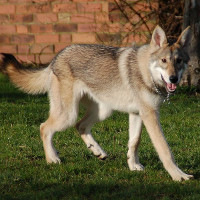
Apart from the Inuit of the North and a few other selected breeds, there are few wolf-like dogs as close as the Tamaskan. Originating in Finland, this large dog has been specially designed to resemble a wolf and have the same traditional training as Siberian Huskies, while maintaining a temperament that makes it ready for companionship and family. Apart from a few peculiarities, the look is almost uncanny, so much so that the Tamaskan has been used as a wolf in films, television, music videos, mascots and even Broadway. Of course, their excellent temperament doesn't hurt their cause either. But even though they've rapidly gained in popularity since their inception in the 1980s, they're still considered a relatively rare breed, although breed clubs have sprung up in many North American and European countries in recent years, increasing the likelihood that their numbers will continue to grow at a steady pace.

History of the Tamaskan Dog

Given that the breed was developed in the 1980s, its history is fairly short. During this time, Finnish breeders imported a handful of Siberian Huskies with the aim of breeding them with others to create a dog with a wolf-like appearance and a hard-working drive, but possessing sufficient temperament to be easily trained and kept as a pet. Huskies from the USA have been crossed with other Siberian Huskies, as well as Alaskan Malamutes and German Shepherds. There seems to be at least some discussion of the final influences, which might include the more lupine-like Czech Wolfhound, to add to its true wolf-like traits. Since the 2000s, these dogs have been featured in many forms of visual media, acting as realistic representatives of the wolf. Their growing popularity has helped them expand internationally, with breed clubs established in many countries, including the USA, Canada, France, Germany, the Netherlands, Croatia and the UK.

Appearance of the Tamaskan Dog

It's safe to say that the Tamaskan is easily one of the most wolf-like dogs in existence. Standing at 84 centimetres tall at the withers and weighing almost 45 kilos, this breed may not reach a gray wolf in full size, but still boasts considerable overall size. Their head is long and somewhat narrow, with a slight stop and a skull almost as long as their black-nosed muzzle. Their eyes are almond-shaped and come in a variety of colors, although lighter eyes are considered rare. Their ears are relatively small and erect, somewhat triangular in shape. They have long necks, flat backs, short, rapidly falling croup and tucked-up bellies. Their frame is relatively light but athletic and muscular, which shows especially in the thighs. Their tails are long and bushy, hanging at rest and almost vertical at play. Their coats are long and dense, available in three colors: red gray, wolf gray and black gray.

Temperament of the Tamaskan Dog

Although they look like one of the greatest hunters nature has to offer, Tamaskans are actually quite gentle, friendly and affectionate dogs. Probably due to their pack-breeding heritage, they are very social and like to be part of a family, whether primarily canine or human. Because of this, however, they generally don't do well as they tend to get frustrated or bored and can become destructive or try to escape. They are exceptionally intelligent, which allows them to excel at almost anything they attempt, from simple training to agility to work and even sledging. They are known to accept other dogs, be patient with children, and be either relaxed or a little aloof with strangers, and generally maintain a rather relaxed attitude at home. However, they need a considerable amount of exercise and will remain restless if they don't get the right amount, which can sometimes result in bad behavior. They therefore generally do best with larger homes, preferably with a large yard and an active family environment. But given their general temperament, intelligence and social nature, they always make good companions and working dogs, no matter what.

Needs and activities of the Tamaskan Dog

Due to their sled and working dog lineage, Tamaskans not only have a ton of stamina, but also a good amount of muscle, both of which require a high level of exercise. As such, they need at least 18 km of walking or running a week, if not more, or around 70 minutes of physical activity a day. Because of their intelligence, they also need to be mentally stimulated. Therefore, giving them work, teaching them commands or even playing the game will go a long way in helping them stay both healthy and tired. Not destined for apartment living, this breed needs plenty of space and activity.

Maintenance of the Tamaskan Dog

Even with their longer coats, Tamaskans are considered low-maintenance dogs. Their coats should be brushed several times a week with a fine bristle brush or paintbrush, except during periods of heavy shedding, when they need to be brushed more frequently, otherwise they take little care. They generally keep themselves clean, and their coats contain natural oils that should not be disturbed by bathing, unless they become offensive. If they get enough exercise, their nails will wear a little, but they'll still need to be monitored and trimmed to avoid problems such as cracking or breaking. Especially given their high food intake, their teeth also need to be brushed regularly to maintain good oral health.

Comments

Latest page updates

  • Telomian

    Telomian He is not recognized by the F.C.I. Origin Malaysia Translation Francis Vandersteen A brief presentation of the Telomian The Telomian is a very rare breed of dog, and the only one native to Malaysia to have been bred outside the country. They were originally bred by the indigenous people of Malaysia to combat parasites such as snakes, rats,...
  • King Wheaten -- Cavalier King Charles Spaniel X Irish Soft Coated Wheaten Terrier

    King Wheaten He is not recognized by the F.C.I. Origin Great Britain <> Ireland -> U.S.A. Translation Francis Vandersteen A brief presentation of the King Wheaten The King Wheaten is a small dog with a heart this big and a playful disposition. Borrowing the energy and soft-coated waves of the Irish Soft Coated Wheaten Terrier and the size and...
  • Spanierd -- English Springer Spaniel X German Shepherd

    Spanierd He is not recognized by the F.C.I. Origin Great Britain <> Germany -> U.S.A. Translation Francis Vandersteen A brief presentation of the Spanierd The Spanierd is a hybrid dog. Its parent breeds are the English Springer Spaniel and the German Shepherd. They have an affable personality. He's known for entertaining family and friends with his...
  • Alaskan Goldenmute -- Alaskan Malamute X Golden Retriever

    Alaskan Goldenmute He is not recognized by the F.C.I. Origin U.S.A. <> Great Britain -> U.S.A. Translation Francis Vandersteen This breed is also known as Alaskan GoldenGoldenmuteAlaskan Gold Retriever     A brief presentation of the Alaskan Goldenmute The Alaskan Goldenmute is a descendant of two great dog breeds: the Alaskan Malamute and the Golden...
  • French pointing dog Pyrenean type

    French pointing dog Pyrenean type FCI standard Nº 134 Origin France Translation Mrs. Peggy Davis Group Group 7 Pointing Dogs Section Section 1.1 Continental Pointing Dogs « Braque » Type Working With working trial Acceptance on a definitive basis by the FCI Tuesday 18 January 1955 Publication of the official valid standard Tuesday 01 August 2023 Last...
  • French pointing dog Gascogne type

    French pointing dog Gascogne type FCI standard Nº 133 Origin France Translation Mrs. Peggy Davis Group Group 7 Pointing Dogs Section Section 1.1 Continental Pointing Dogs « Braque » Type Working With working trial Acceptance on a definitive basis by the FCI Monday 17 January 1955 Publication of the official valid standard Tuesday 01 August 2023 Last...
  • Vucciriscu

    Vucciriscu He is not recognized by the F.C.I. Origin Sicily Translation Francis Vandersteen En français, cette race se dit Vucciriscu Diese Norm ist in deutscher Sprache sichtbar Vucciriscu En español, esta raza se dice Vucciriscu In het Nederlands, wordt dit ras gezegd Vucciriscu This breed is also known as Sicilian Vucciriscu Sicilian Butcher...

© 2026 Groupe Milouchouchou ASBL. Tous droits réservés. En savoir plus

Protected by Copyright01
We use cookies

We use cookies on our website. Some of them are essential for the operation of the site, while others help us to improve this site and the user experience (tracking cookies). You can decide for yourself whether you want to allow cookies or not. Please note that if you reject them, you may not be able to use all the functionalities of the site.

Ok