
 |
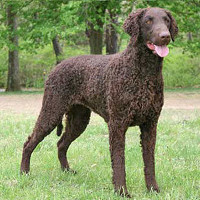
Curly Coated Retriever |
|
FCI standard Nº 110 |
||
Origin |
Great Britain | |
Group |
Group 8 Retrievers, Flushing Dogs, Water Dogs | |
Section |
Section 1 Retrievers | |
Working |
With working trial | |
Acceptance on a definitive basis by the FCI |
Friday 10 December 1954 | |
Publication of the official valid standard |
Tuesday 28 July 2009 | |
Last update |
Monday 23 November 2009 | |
En français, cette race se dit |
 |
Retriever à poil bouclé |
Diese Norm ist in deutscher Sprache sichtbar |
 |
Curly Coated Retriever |
En español, esta raza se dice |
 |
Retriever de pelo rizado |
In het Nederlands, wordt dit ras gezegd |
 |
Curly Coated Retriever |
Usage |
| Retriever. |
General appearance |
| Strong, upstanding dog with a degree of elegance. Distinctive coat. |
Important proportions |
| Slightly longer in body, measured from point of shoulder to point of buttock, than in height from withers. |
Behaviour / temperament |
| Intelligent, steady, reliable. Bold, friendly, self confident and independent. May seem aloof. |
Head |
||
Cranial region |
||
Head |
Wedge-shaped in both side and front profiles. In proportion to body size. | |
Skull |
Foreface and skull equal length. Planes of skull and muzzle parallel. | |
Stop |
Slight. | |
Facial region |
||
Nose |
Black in blacks and brown in livers. | |
Jaws and teeth |
Jaws strong, with perfect, regular and complete scissor bite, i.e. upper teeth closely overlapping lower teeth and set square to the jaws. | |
Eyes |
Large, not prominent, oval-shaped and obliquely set. Dark brown in blacks; in livers brown tone to blend with coat colour. | |
Ears |
Rather small, set slightly above level of eye; lying close to head, covered with small curls. | |
Neck |
| Strong and slightly arched, of medium length, free from throatiness and flowing freely into well laid back shoulders. |
Body |
||
Topline |
Strong and level. | |
Loin |
Short, deep and powerful. | |
Chest |
Deep with well sprung ribs, oval in cross section with brisket reaching elbow. Forechest visible. Ribs extend well back. | |
Underline and belly |
Slight tuck up. | |
Tail |
| Flows from topline. Should reach approximately to hock, carried straight on a level with topline when moving. |
Limbs |
Forequarters |
||
Generality |
Forelegs straight, set well under body. | |
Shoulders |
Well laid back and muscular. | |
Upper arm |
Upper arm and shoulder blade approximat ely equal in length. | |
Pastern |
Strong. | |
Hindquarters |
||
Generality |
Strong, muscular. | |
Stifle |
Moderate turn of stifle. | |
Hock |
Well let down and well bent. | |
Feet |
| Round, tight with well-arched toes. |
Gait and movement |
| Effortless, powerful gait with good extension and drive. Parallel movement. At speed, legs tend to converge. |
Coat |
||
Hair |
Body coat a thick mass of small tight, crisp curls lying close to skin, extending from occiput to tip of tail; without undercoat or bare patches. Elsewhere smooth hair. | |
Colour |
Black or liver. | |
Size and weight |
||
Height at withers |
Dogs: 67,5 cm (27 ins), Bitches : 62,5 cm (25 ins). | |
Faults |
| • Any departure from the foregoing points should be considered a fault and the seriousness with which the fault should be regarded should be in exact proportion to its degree and its effect upon the health and welfare of the dog and its ability to perform its traditional work. • Faults listed should be in degree of seriousness. |
Disqualifying faults |
 Aggressive or overly shy. Aggressive or overly shy. |
NB : |
| • Any dog clearly showing physical or behavioural abnormalities shall be disqualified. • The above mentioned faults when occurring to a highly marked degree or frequently are disqualifying. • Male animals should have two apparently normal testicles fully descended into the scrotum. • Only functionally and clinically healthy dogs, with breed typical conformation should be used for breeding. |
Bibliography |
| https://www.fci.be/ |
Detailed history |
| The Curly is of British origin, it is the oldest of the retrievers and its origins are very uncertain. English writings mention the contribution of extinct breeds today such as Large Rough Water Dog, Tweed Water Spaniel, 16th Century English Water Spaniel, St John's Newfoudland, Setter Retriever, Lesser Newfoundland. Then came Wetterhound, Barbet and in the 19th century the Poodle (who was a hunting dog before he moved into the 9th group). The first presentation of a Curly in show dates back to 1860. At the time, the Wavy Coated and the different versions of dogs resembling Curly were presented together. It was not until about 1865 that the Curly was presented as a single race. As we said before, the Curly was very popular but the appearance of the 1st World War and the introduction of Labrador as a relationship dog have brought down its popularity and hence the number of births. Today, the Curly is considered, worldwide, as a vulnerable breed. The Curly is the oldest of the retrievers. This breed first appeared at the Brighton Canine Show in 1859 (Kennel Club dog) and the first club of the breed was founded in 1896. Since then, the club has continued and bears the name Curly Coated Retriever Club. The Curly is predominantly black in color but there are subjects of color liver. Her curly dress can be likened to a poodle for neophytes but it is not. He is the greatest of the retrievers, he is very athletic and does not leave indifferent when we see him for the first time. Originally, the Curly is a dog designed to report ducks in the water which explains its selection on a short hair, which does not take water, dries quickly and has no grip with the brambles and herbs that may be found on hunting areas. Note that the Curly has no undercoat. In the United States, the Curly that are used for geese hunting wear "neoprene jackets" to avoid colds and often negative temperatures. It should also be noted that the American Curly are larger, more robust than their European counterparts. When comparing Curly photos of the 1900s with those of today, we see that the model remains virtually identical. There was no excess or drift in the conservation of the model compared to the standard. The Curly is an active dog, enduring, with bone but without excess, harmonious in its model. It is sensitive and its character can not be compared with that of other retrievers. It is by nature reserved, and there also point of comparison with the other retrievers who celebrate the strangers of the house as soon as they arrive. It is a dog that does not support the kennel and a family life with good socialization is imperative. The Curly, when it was created was intended for the game report and the crossbreeding between several breeds was intended to have the best relationship dog. If the Curly was very fashionable in the early 1900s, its popularity began to decline thereafter. One of the explanations would be the diversity of the atypical breeds used to "build" the Curly, some of which had a bad reputation for the time, which explains why hunters have turned away from it in favor of other breeds of retrievers. This breed is not very widespread, even in England. However, it is very popular in New Zealand, Australia and USA where breeders obtain remarkable results in "field trial" In time, the curly has by necessity become a family dog, except for a few hunters in North America. The Curly is an excellent family dog. Loyalty is one of his weapons and he needs to live as a family to best express his abilities. But it's not a dog to put in all hands. He is sensitive, delicate, somewhat independent, and does not tolerate the vagaries and errors of education. He does not forgive anything. Curly are found in agility tests, tracking (especially in the Nordic countries), competition obedience. |



 English (United Kingdom)

Comments