
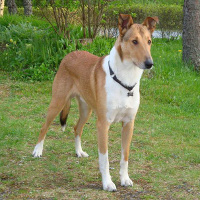
 |
Collie Smooth |
|
FCI standard Nº 296 |
||
Origin |
Great Britain | |
Group |
Group 1 Sheepdogs and Cattle Dogs (except Swiss Cattle Dogs) | |
Section |
Section 1 Sheepdogs | |
Working |
Without working trial | |
Acceptance on a definitive basis by the FCI |
Wednesday 18 December 1974 | |
Publication of the official valid standard |
Tuesday 27 July 2021 | |
Last update |
Wednesday 15 September 2021 | |
En français, cette race se dit |
 |
Collie à poil court |
Diese Norm ist in deutscher Sprache sichtbar |
 |
Kurzhaariger Schottischer Schäferhund |
En español, esta raza se dice |
 |
Collie de pelo corto |
In het Nederlands, wordt dit ras gezegd |
 |
Schotse Herdershond Korthaar |
Usage |
| Sheepdog. |
General appearance |
| Appears as gifted with intelligence, alertness and activity. Stands with dignity governed by perfect anatomical formation, with no part out of proportion, giving appearance of working capability. Physical structure on lines of strength and activity, free from cloddiness and with no trace of coarseness. Expression most important. In considering relative values, it is obtained by perfect balance and combination of skull and foreface, size and shape, colour and placement of eye, correct position and carriage of ears. |
Important proportions |
| Viewed in profile, top of skull and top of muzzle lie in two parallel, straight lines of equal length divided by a slight, but perceptible stop or break. Body slightly long compared with height. |
Behaviour / temperament |
| Friendly disposition with no trace of nervousness or aggressiveness. |
Head |
||
Cranial region |
||
Head |
Head properties of great importance, must be considered in proportion to size of dog. Viewed from front or side, head resembles a well-blunted, clean wedge, being smooth in outline. A mid-point between inside corners of eyes (which is centre of a correctly placed stop) is centre of balance in length of head. | |
Skull |
Flat. Sides taper gradually and smoothly from ears to end of nose. Depth of skull from brow to underpart of jaw never excessive (deep through). | |
Stop |
Slight, but perceptible. The mid-point between inside corner of eyes is centre of a correctly-placed stop or break. | |
Facial region |
||
Nose |
Always black. | |
Muzzle |
End of smooth, well rounded muzzle blunt, never square. Muzzle not pinched. | |
Jaws and teeth |
Teeth of good size. Jaws strong with a perfect, regular and complete scissor bite, i.e. upper teeth closely overlapping lower teeth and set square to the jaws. Underjaw strong, clean cut. | |
Cheeks |
Cheek bones not prominent. | |
Eyes |
Very important feature, giving sweet expression. Medium size ( never very small ), set somewhat obliquely, of almond-shape and dark brown colour, except in case of Blue Merles, when eyes are frequently ( one or both, or part of one or both) blue or blue-flecked. Expression full of intelligence, with quick, alert look when listening. | |
Ears |
Moderately large, wider at base, and placed not too close together nor too much on side of head. When in repose carried thrown back, but on alert brought forward and carried semi-erect, that is, with approximately two-thirds of ear standing erect, top third tipping forward naturally, below horizontal. | |
Neck |
| Muscular, powerful, of fair length, well arched. |
Body |
||
Back |
Level and firm. | |
Loin |
With slight rise. | |
Chest |
Deep and fairly broad behind shoulders. Ribs well sprung. | |
Tail |
| Long with bone reaching at least to hock joint. To be carried low when quiet but with a slight upward swirl at tip. May be carried gaily when excited, but never over back. |
Limbs |
Forequarters |
||
Generality |
Forelegs straight and muscular. Moderate bone. | |
Shoulders |
Sloping shoulders, well laid back. Good return of upper arm placing elbow below withers. | |
Elbows |
Turning neither in nor out. | |
Forearm |
Somewhat fleshy. | |
Pastern |
Showing flexibility without weakness. | |
Forefeet |
Oval soles well padded. Toes arched and close together. | |
Hindquarters |
||
Upper thigh |
Muscular. Hindlegs clean and sinewy below thighs. | |
Stifle |
Well bent. | |
Metatarsus |
Well let down and powerful. | |
Hind feet |
Oval soles well padded. Toes arched and close together. Hindfeet slightly less arched. | |
Gait and movement |
| Distinctly characteristic of this breed. A sound dog is never out at elbow, yet moves with front feetcomparatively close together. Plaiting, crossing or rolling are hightly undesirable. Hindlegs, from hock joint to ground, when viewed from rear, parallel. Hindlegs powerful and full of drive. Viewed from side, action is smooth. A reasonably long stride is desirable and should be light and appear quite effortless. |
Coat |
||
Hair |
Short, flat, top coat of harsh texture, with very dense undercoat. Not trimmed or clipped. | |
Colour |
Three recognized colours : Sable and white, Tricolour and Blue Merle. . Sable : Any shade of light gold to rich mahogany or shaded sable. Light straw or cream colour highly undesirable. . Tricolour : Predominantly black with rich tan markings about legs and head. A rusty tinge in top coat highly undesirable. . Blue Merle : Predominantly clear, silvery blue, splashed and marbled with black. Rich tan markings preferred, but absence should not be penalised. Large black markings, slate colour, or rusty tinge in top or undercoat are highly undesirable. All colours above may carry typical white Collie markings to a greater or lesser degree. Following markings are favourable : white collar, full or part; white front, legs and feet; white tail tip. A blaze may be carried on muzzle or skull. White markings not to extend behind withers or above the hock. All white or predominantly white is most undesirable. |
|
Size and weight |
||
Height at withers |
Males : 56-61 cm. Females : 51-56 cm. | |
Weight |
Males : 20,5-29,5 kg. Females : 18,0-25,0 kg. | |
Faults |
| • Any departure from the foregoing points should be considered a fault and the seriousness with which the fault should be regarded should be in exact proportion to its degree and its effect upon the health and welfare of the dog and its ability to perform its traditional work. • Faults listed should be in degree of seriousness. |
Disqualifying faults |
 Aggressive or overly shy. Aggressive or overly shy. |
NB : |
| • Any dog clearly showing physical or behavioural abnormalities shall be disqualified. • The above mentioned faults when occurring to a highly marked degree or frequently are disqualifying. • Male animals should have two apparently normal testicles fully descended into the scrotum. • Only functionally and clinically healthy dogs, with breed typical conformation should be used for breeding. |
Bibliography |
| https://www.fci.be/ |



 English (United Kingdom)

Comments