 |
Lancashire-Heeler |
|
FCI standard Nº 360 |
||
Origin |
England, patronage : FCI | |
Group |
Group 1 Sheepdogs and Cattle Dogs (except Swiss Cattle Dogs) | |
Section |
Section 1 Sheepdogs | |
Working |
Without working trial | |
Acceptance on a provisional basis by the FCI |
Sunday 01 May 2016 | |
Publication of the official valid standard |
Monday 04 April 2016 | |
Last update |
Monday 30 May 2016 | |
En français, cette race se dit |
 |
Lancashire-Heeler |
Diese Norm ist in deutscher Sprache sichtbar |
 |
Lancashire-Heeler |
En español, esta raza se dice |
 |
Lancashire-Heeler |
In het Nederlands, wordt dit ras gezegd |
 |
Lancashire-Heeler |
Usage |
| Herding & companion dog. |
Brief historical summary |
| The origins of the Lancashire Heeler are not clearly defined, but it has been suggested that when cattle were herded from Wales by Corgis to slaughter in the Ormskirk area, the ‘Welsh heeler’ met the Manchester Terrier, with obvious results. Certainly, the breed is found in that area and has been bred there for many generations. The Heeler is an intelligent, eager-to-please fellow, with a love of people. The breed is trainable but does best under a firm, kindly owner. He is possessed of a prodigious amount of energy in his small frame. |
General appearance |
| Small, powerful, sturdily built, alert and energetic worker. |
Important proportions |
| Body approximately 2.5 cm longer than height at withers (measured from withers to set on of tail). |
Behaviour / temperament |
| Works cattle but has terrier instincts when rabbiting and ratting. Courageous, happy and affectionate to owner. |
Head |
||
Cranial region |
||
Head |
In proportion to body. | |
Skull |
Skull and muzzle to be on parallel planes. Skull flat and wide between ears, tapering towards eyes which are set wide apart. |
|
Stop |
Moderate, equidistant between nose and occiput. | |
Facial region |
||
Nose |
Black or brown, in accordance to coat colour. | |
Muzzle |
Tapering towards the nose. | |
Lips |
Firm. | |
Jaws and teeth |
Scissor bite – jaws strong with a perfect, regular and complete scissor bite, i.e. upper teeth closely overlapping lower teeth and setsquare to the jaws. Under or overshot to be discouraged. | |
Eyes |
Almond-shaped, medium size, dark colour except in liver brown where they may be lighter to match coat colour. | |
Ears |
Showing alert lift, or erect. Drop ears showing no lift undesirable. | |
Neck |
| Moderate length, well set into shoulders. |
Body |
||
Topline |
Firm and level, never dipping at withers or falling at croup. | |
Loin |
Short. | |
Chest |
Well sprung ribbing, extending well back with close coupling. | |
Tail |
| Set on high, left natural. Carried over back in a slight curve when alert, but not forming a complete ring. |
Limbs |
Forequarters |
||
Shoulders |
Well laid. | |
Elbows |
Firm against ribs. | |
Forearm |
Amply boned. | |
Pastern |
Pasterns allow feet to turn slightly outwards, but not enough to cause weakness or affect freedom of movement. | |
Forefeet |
Small, firm and well padded. | |
Hindquarters |
||
Generality |
Muscular. From rear should be parallel, when moving or standing. | |
Stifle |
Well turned. | |
Metatarsus |
Never bandy or cow hocked. | |
Hock |
Well let down. | |
Hind feet |
Small, firm and well padded. | |
Gait and movement |
| Smart and brisk. Natural, free movement. |
Coat |
||
Hair |
Fine undercoat is covered throughout by weather resistant, short, thick, hard, flat topcoat. Topcoat is slightly longer on neck. Undercoat should not show through topcoat nor allow any longer hair at the mane to stand off. Long, or excessively wavy coat is highly undesirable. | |
Colour |
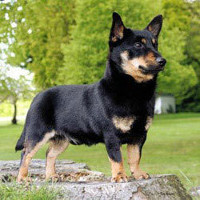
Black and tan or liver brown and tan with pigment to tone with coat colour, with rich tan spots on cheeks and often above eyes. Rich tan on muzzle and chest and from knees downwards, inside hind legs and under tail. A distinct black or liver mark (thumb mark), according to coat colour, immediately above front feet is desirable. Richness of tan may fade with age. White to be discouraged. A small white spot on fore-chest -although permissible is undesirable. | |
Size and weight |
||
Height at withers |
Ideal: Males 30 cm, females 25 cm. | |
Faults |
| • Any departure from the foregoing points should be considered a fault and the seriousness with which the fault should be regarded should be in exact proportion to its degree and its effect upon the health and welfare of the dog and its ability to perform its traditional work. • Faults listed should be in degree of seriousness. |
Disqualifying faults |
 Aggressive or overly shy dogs. Aggressive or overly shy dogs. |
NB : |
| • Any dog clearly showing physical or behavioural abnormalities shall be disqualified. • The above mentioned faults when occurring to a highly marked degree or frequently are disqualifying. • Male animals should have two apparently normal testicles fully descended into the scrotum. • Only functionally and clinically healthy dogs, with breed typical conformation should be used for breeding. |
Bibliography |
| https://www.fci.be/ |



 English (United Kingdom)

Comments