
 |
Mastiff |
|
FCI standard Nº 264 |
||
Origin |
Great Britain | |
Group |
Group 2 Pinscher and Schnauzer – Molossoid breeds - Swiss Mountain and Cattle Dogs | |
Section |
Section 2.1 Molossoid breeds, Mastiff Type | |
Working |
Without working trial | |
Acceptance on a definitive basis by the FCI |
Thursday 05 November 1964 | |
Publication of the official valid standard |
Wednesday 13 October 2010 | |
Last update |
Wednesday 02 March 2011 | |
En français, cette race se dit |
 |
Mastiff |
Diese Norm ist in deutscher Sprache sichtbar |
 |
Mastiff |
En español, esta raza se dice |
 |
Mastiff |
In het Nederlands, wordt dit ras gezegd |
 |
Mastiff |
Usage |
| Watch and security dog. |
Brief historical summary |
| The Mastiff, perhaps not in exactly the form as we know it today, has been with us for many hundreds of years, and played its part in history since well before the Battle of Agincourt, in the early fifteenth century. Even then the Mastiff was known for his courage and guarding instincts. It is recorded that when the Romans invaded Britain they found a mastiff type dog already here, and were so impressed that they took some back to fight in the arenas of Rome. When the Normans came to Britain the mastiff type was so common that the French word dogue found its way into the English language. The breed almost became extinct in Britain after the Second World War. Stock was then imported, and since that time the numerical strength and quality of the breed have taken an upsurge. Combining grandeur with good nature, he is an extremely large dog in both height and girth, broad and deep in body, full of substance, with large strong bones. |
General appearance |
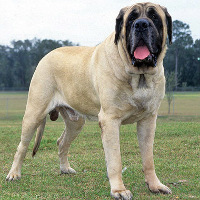
| Head, in general outline, giving a square appearance when viewed from any point. Breadth desired and in ratio to length of whole head and face as 2:3. Body broad, deep, long, powerfully built, on legs wide apart and set. Muscles sharply defined. Size is desirable, but only if combined with quality and if absolute soundness is maintained. Height and substance important if both points are proportionately combined. Large, powerful, well-knit frame. |
Important proportions |
| Length of body taken from point of shoulder to point of buttock greater than height at withers. |
Behaviour / temperament |
| A combination of grandeur and courage. Calm, affectionate to owners, but capable of guarding. Usually indifferent with strangers; timidity is unacceptable. |
Head |
||
Cranial region |
||
Skull |
Skull broad between ears, forehead flat, but wrinkled when attention is excited. Brows (superciliary ridges) slightly raised. Arch across skull of a flattened curve, with depression up centre of forehead from median line between eyes, to halfway up sagittal suture. | |
Stop |
Stop between eyes well marked but not too abrupt. | |
Facial region |
||
Nose |
Black. Broad, with widely spreading nostrils when viewed from front, flat (not pointed or turned up) in profile. | |
Muzzle |
Short, broad under eyes, and keeping nearly parallel in width to end of nose; truncated, i.e. blunt and cut off squarely, thus forming a right-angle with upper line of face, of great depth from point of nose to under-jaw. Length of muzzle to whole head and face as 1 :3. Circumference of muzzle (measured mid-way between eyes and nose) to that of head (measured before the ears) as 3 : 5. Whilst in repose, any exaggeration of wrinkle or excess of skin is unacceptable in mature adults. | |
Lips |
Lips diverging at obtuse angles with septum and slightly pendulous so as to show a square profile. | |
Jaws and teeth |
Under-jaw broad to end. Canine teeth healthy; powerful and wide apart. Incisors level (pincer bite, edge to edge) or lower projecting beyond upper (reversed scissor bite) but never so much as to become visible when mouth is closed. | |
Cheeks |
Muscles of temples and cheeks (temporal and masseter) well developed. | |
Eyes |
Moderate size, wide apart. Colour hazel brown, darker the better, showing no haw. Loose eyelids highly undesirable. Free from obvious eye problems. | |
Ears |
Small, thin to touch, wide apart, set on at highest points of sides of skull, so as to continue outline across summit and lying flat and close to cheeks when in repose. | |
Neck |
| Slightly arched, moderately long, very muscular, and measuring in circumference about 2,5 – 5 cms less than skull before ears. |
Body |
||
Topline |
Level. | |
Back |
Wide and muscular. | |
Loin |
Wide and muscular; flat and very wide in bitch, slightly arched in dog. | |
Chest |
Wide, deep and well let down between forelegs. Ribs arched and well rounded. False ribs deep and well set back to hips. | |
Underline and belly |
Great depth of flanks. | |
Tail |
| Set on high, and reaching to hocks, or a little below them, wide at its root and tapering to end, hanging straight in repose, but forming a curve with end pointing upwards, but not over back, when dog is excited. |
Limbs |
Forequarters |
||
Generality |
Balanced and in harmony with hindquarters. | |
Shoulders |
Slightly sloping, heavy and muscular. | |
Upper arm |
Slightly sloping, heavy and muscular. | |
Elbows |
Elbows square. | |
Forearm |
Legs straight, strong and set wide apart; bones being large. | |
Pastern |
Pasterns upright. | |
Hindquarters |
||
Generality |
Broad, wide and muscular. Strength in hindquarters is of paramount importance, cow hocks in mature adults is unacceptable. | |
Lower thigh |
Well developed. | |
Hock |
Hocks bent, wide apart, and quite squarely set when standing or walking. | |
Feet |
| Large, round and tight. Toes well arched. Nails black. |
Gait and movement |
| Powerful, easy extension, driven from the rear, fluent, sound, with ground-covering strides. Level topline maintained whilst on the move. Tendency to pace is undesireable. Absolute soundness essential. |
Coat |
||
Hair |
Short and close-lying, but coarse over neck and shoulders. | |
Colour |
Apricot, fawn or brindle. In any case, muzzle, ears and nose should be black with black around eye rims, and extending upwards between them. Excessive white on body, chest or feet is unacceptable. | |
Size and weight |
Faults |
| • Any departure from the foregoing points should be considered a fault and the seriousness with which the fault should be regarded should be in exact proportion to its degree and its effect upon the health and welfare of the dog and its ability to perform its traditional work. • Faults listed should be in degree of seriousness. |
Disqualifying faults |
 Aggressive or overly shy. Aggressive or overly shy. |
NB : |
| • Any dog clearly showing physical or behavioural abnormalities shall be disqualified. • The above mentioned faults when occurring to a highly marked degree or frequently are disqualifying. • Male animals should have two apparently normal testicles fully descended into the scrotum. • Only functionally and clinically healthy dogs, with breed typical conformation should be used for breeding. |
Bibliography |
| https://www.fci.be/ |



 English (United Kingdom)

Comments