
 |
Deerhound |
|
FCI standard Nº 164 |
||
Origin |
Great Britain | |
Group |
Group 10 Sighthounds | |
Section |
Section 2 Rough-haired Sighthounds | |
Working |
Without working trial | |
Acceptance on a definitive basis by the FCI |
Friday 29 April 1955 | |
Publication of the official valid standard |
Monday 08 October 2012 | |
Last update |
Wednesday 05 December 2012 | |
En français, cette race se dit |
 |
Deerhound |
Diese Norm ist in deutscher Sprache sichtbar |
 |
Deerhound |
En español, esta raza se dice |
 |
Deerhound |
In het Nederlands, wordt dit ras gezegd |
 |
Deerhound |
Usage |
| Racing dog, hunting dog, companion. |
Brief historical summary |
| The Deerhound, known at one time as the Scottish Deerhound, has mystery surrounding his origins, but there are grounds for thinking the Deerhound may have been introduced to Scotland by Phoenician traders. Certainly there were running hounds there when the Romans arrived. The breed has hunted the red deer for a thousand years, and although today more accustomed to the show ring, he has remained similar in type over the centuries. |
General appearance |
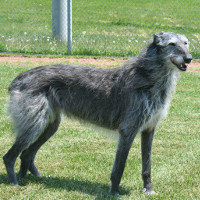
| Resembles a rough-coated greyhound of larger size and bone. |
Behaviour / temperament |
| The build suggests the unique combination of speed, power and endurance necessary to pull down a stag, but general bearing is one of gentle dignity. Gentle and friendly. Obedient and easy to train because eager to please. Docile and good tempered, never suspicious, aggressive or nervous. Carries himself with quiet dignity. |
Head |
||
Cranial region |
||
Head |
Long. | |
Skull |
Flat rather than round, with very slight rise over eyes. Broadest at ears, tapering slightly to eyes. Skull coated with moderately long hair, softer than rest of coat. | |
Stop |
No stop. | |
Facial region |
||
Nose |
Slightly aquiline and black. | |
Muzzle |
Tapering more decidedly to nose. In lighter coloured dogs black muzzle preferred. | |
Lips |
Good moustache of rather silky hair and some beard. | |
Jaws and teeth |
Jaws strong, with a perfect, regular and complete scissor bite, i.e. upper teeth closely overlapping lower teeth and set square to the jaws. | |
Eyes |
Dark. Generally dark brown or hazel. Light eyes undesirable. Moderately full with a soft look in repose, but keen, far-away look when dog is roused. Rims black. | |
Ears |
Set on high and in repose folded back. In excitement raised above head without losing the fold and in some cases semi-erect. A big thick ear hanging flat to the head or a prick ear most undesirable. Ear soft, glossy and like a mouse’s coat to the touch; the smaller the better, no long coat or fringe. Ears black or dark coloured. | |
Neck |
| Very strong with good reach sometimes disguised by mane. Nape of neck very prominent where head is set on, no throatiness. |
Body |
||
Body |
Body and general formation that of a greyhound of larger size and bone. | |
Back |
Flat topline undesirable. | |
Loin |
Well arched and drooping to tail. | |
Croup |
Drooping, broad and powerful. Hipbones set wide apart. | |
Chest |
Deep rather than broad, not too narrow and flat-sided. | |
Tail |
| Long, thick at root, tapering and reaching almost to ground. When standing dropped perfectly straight down or curved. Curved when moving, never lifted above line of back. Well covered with hair; on upper side thick and wiry, on under side longer, and towards end a slight fringe is not objectionable. A curl or ring tail undesirable. |
Limbs |
Forequarters |
||
Generality |
Forelegs straight, broad and flat. | |
Shoulders |
Well laid, not too far apart. Loaded and straight shoulders undesirable. | |
Elbows |
Good breadth desirable. | |
Forearm |
Good breadth desirable. | |
Hindquarters |
||
Generality |
With great length from hip to hock. Bone broad and flat. | |
Stifle |
Well bent. | |
Feet |
| Compact and well knuckled. Nails strong. |
Gait and movement |
| Easy, active and true, with a long stride. |
Coat |
||
Hair |
Shaggy, but not over-coated. Woolly coat unacceptable. The correct coat is thick, close-lying, ragged; harsh or crisp to the touch. Hair on body, neck and quarters harsh and wiry about 8 cms to 10 cms long; that on head, breast and belly much softer. A slight hairy fringe on inside of fore- and hindlegs. | |
Colour |
Dark blue-grey, darker and lighter greys or brindles and yellows, sandy-red or red fawns with black points. A white chest, white toes and a slight white tip to stern are permissible but the less white the better, since it is a self-coloured dog. A white blaze on head or white collar unacceptable. | |
Size and weight |
||
Height at withers |
Males: minimum desirable height at the withers 76 cms. Females: minimum desirable height at the withers 71 cms. | |
Weight |
Males: about 45.5 kgs. Females: about 36.5 kgs. | |
Faults |
| • Any departure from the foregoing points should be considered a fault and the seriousness with which the fault should be regarded should be in exact proportion to its degree and its effect upon the health and welfare of the dog and its ability to perform its traditional work. • Faults listed should be in degree of seriousness. |
Disqualifying faults |
 Aggressive or overly shy dogs. Aggressive or overly shy dogs. |
NB : |
| • Any dog clearly showing physical or behavioural abnormalities shall be disqualified. • The above mentioned faults when occurring to a highly marked degree or frequently are disqualifying. • Male animals should have two apparently normal testicles fully descended into the scrotum. • Only functionally and clinically healthy dogs, with breed typical conformation should be used for breeding. |
Bibliography |
| https://www.fci.be/ |



 English (United Kingdom)

Comments