
 |
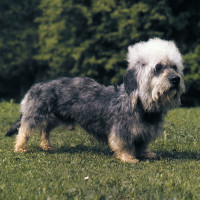
Dandie Dinmont Terrier |
|
FCI standard Nº 168 |
||
Origin |
Great Britain | |
Group |
Group 3 Terriers | |
Section |
Section 2 Small-sized Terriers | |
Working |
Without working trial | |
Acceptance on a definitive basis by the FCI |
Thursday 12 May 1955 | |
Publication of the official valid standard |
Tuesday 22 August 2017 | |
Last update |
Tuesday 03 October 2017 | |
En français, cette race se dit |
 |
Dandie Dinmont Terrier |
Diese Norm ist in deutscher Sprache sichtbar |
 |
Dandie Dinmont Terrier |
En español, esta raza se dice |
 |
Dandie Dinmont Terrier |
In het Nederlands, wordt dit ras gezegd |
 |
Dandie Dinmont Terrier |
Usage |
| Terrier. |
Brief historical summary |
| The Dandie Dinmont is named after the farmer's novel by Sir Walter Scott. Guy Mannering had dogs resembling the Terriers that bear his name today. They are incomparable rabbit hunters, otters and badgers. It grew on the border of Scotland and England, and became a separate species in the early 17th century. The Otterhounds, Bassets and a wide variety of Terriers can share a common ancestor, but the thick edge of the Dandie Dinmont differentiates it from others. These are companion dogs can live in small apartments or countryside. They love outdoor activities and indoor and children of all ages. |
General appearance |
| Distinctive head with beautiful silky covering, with large, wise intelligent eyes offsetting long, low weaselly body. Short, strong legs ; weatherproof coat. |
Behaviour / temperament |
| Game, workmanlike Terrier. Independant, highly intelligent, determined, persistent, sensitive, affectionate and dignified. |
Head |
||
Cranial region |
||
Head |
Head strongly made, large but in proportion to dog’s size, muscles showing extraordinary development, especially the maxillary. | |
Skull |
Broad, narrowing torwards eye, measuring about the same from inner corner of eye to back of skull, as from ear to ear. Forehead well domed ; head covered with very soft, silky hair not confined to mere « topknot ». | |
Facial region |
||
Nose |
Black. | |
Muzzle |
In proportion to skull as three is to five. Top of muzzle has triangular bare patch pointing backwards to eyes from nose about 2,5 cm ( 1 in.) broad. | |
Jaws and teeth |
Jaws strong with a perfect, regular and complete scissor bite, i.e. upper teeth closely overlapping the lower teeth and set square to the jaws. Any deviation highly undesirable. Teeth very strong, especially canines which are extraordinary in size for a small dog. Canines fit well against each other, to give greatest available holding and punishing power. Inside of mouth black or dark coloured. | |
Cheeks |
Gradually tapering towards deep and strongly made muzzle. | |
Eyes |
Rich dark hazel; set wide apart and low, large for a small dog, bright, full and round but not protruding. | |
Ears |
Pendulous, set well back, wide apart, low on skull, hanging close to cheek with very slight projection at base ; broad at junction of head and tapering almost to a point, fore part of ear coming almost straight down from its junction with head to tip. Cartilage and skin of ear very thin. Length of ear, from 7 ½ -10 cm (3-4 ins). Ears harmonise in colour with body colour. In a pepper dog, covered with soft, straight, dark hair (in some cases almost black). In a mustard dog, hair mustard in colour, a shade darker than body but not black. Both should have a thin feather of light hair starting about 5 cm (2 ins) from the tip, and of nearly the same colour and texture as « topknot », giving ear appearance of a distinct point. This may not appear until after age of two years. | |
Neck |
| Very muscular, well developed and strong, showing great power. Well set into shoulders. |
Body |
||
Body |
Long, strong and flexible. | |
Back |
Rather low at shoulders having slight downward curve and corresponding arch over loins, slight gradual drop from top of loin to root of tail. Backbone well muscled. | |
Chest |
Well developed and well let down between forelegs. | |
Ribs |
Well sprung and round. | |
Tail |
| Rather short from 20-25 cm (8-10 ins), rather thick at root, getting thicker for about 10 cm ( 4 ins ) and tapering off to a point. Not twisted or curled in any way but with a curve like a scimitar, the tip when excited being in a perpendicular line with root of tail, set neither too high nor too low. When not excited carried gaily a little above body level. |
Limbs |
Forequarters |
||
Generality |
Forelegs short with immense muscular development and bone, set wide apart and chest coming well down between them. Bandy legs highly undesirable. | |
Shoulders |
Well laid back but not heavy. | |
Forearm |
To follow line of chest. | |
Forefeet |
Pointing forward or slightly outward when standing. | |
Hindquarters |
||
Generality |
Hindlegs a little longer than forelegs ; set rather wide apart, but not spread out in an unnatural manner. | |
Upper thigh |
Well developed. | |
Stifle |
Angulated. | |
Hock |
Well let down. Dewclaws, if present, customarily removed. | |
Hind feet |
Round and well padded. Hindfeet smaller than forefeet. Nails dark but varying in shade according to colour of body. Flat or open feet highly undesirable. | |
Gait and movement |
| Strong, straight impulsion from rear, giving a fluent free and easy stride, reaching forward at the front. A stiff, stilted, hopping or weaving gait highly undesirable. |
Coat |
||
Hair |
Very important feature of the breed. Double coat with a soft linty undercoat and a harder topcoat, not wiry but giving crisp feel to the hand. The coat should not « shed » down the back, but should lie in pencils caused by the harder hair coming through the softer undercoat. The forelegs have feather about 5 cm (2 ins) long. Upper side of tail covered with wiry hair, underside not so wiry with neat feathering of softer hair. | |
Colour |
Pepper or mustard. · Pepper : Ranges from dark bluish black to light silvery grey, intermediate shades preferred. Body colour coming well down shoulder and hips gradually merging into colour of legs and feet which varies according to body colour from rich tan to pale fawn. Profuse silvery white « topknot ». · Mustard : Varies from reddish brown to pale fawn. Profuse creamy white « topknot », legs and feet of a darker shade than head. In both colours feather on forelegs rather lighter than hair on fore part of leg. Some white hair on chest and white nails permissible. White feet undesirable. Hair on underside of tail lighter than on upperside which should be darker colour than body. |
|
Size and weight |
||
Weight |
8-11 kg ( 18-24 lbs) for dogs in good working condition. The lower weights preferred. | |
Faults |
| • Any departure from the foregoing points should be considered a fault and the seriousness with which the fault should be regarded should be in exact proportion to its degree and its effect upon the health and welfare of the dog and its ability to perform its traditional work. • Faults listed should be in degree of seriousness. |
Disqualifying faults |
 Aggressive or overly shy dogs. Aggressive or overly shy dogs. |
NB : |
| • Any dog clearly showing physical or behavioural abnormalities shall be disqualified. • The above mentioned faults when occurring to a highly marked degree or frequently are disqualifying. • Male animals should have two apparently normal testicles fully descended into the scrotum. • Only functionally and clinically healthy dogs, with breed typical conformation should be used for breeding. |
Bibliography |
| https://www.fci.be/ |



 English (United Kingdom)

Comments