 |
Tibetan Mastiff |
|
FCI standard Nº 230 |
||
Origin |
Tibet (China) Patronage FCI |
|
Group |
Group 2 Pinscher and Schnauzer- Molossoid breeds- Swiss Mountain and Cattle Dogs | |
Section |
Section 2.2 Molossoid breeds, Mountain type | |
Working |
Without working trial | |
Acceptance on a definitive basis by the FCI |
Tuesday 22 August 1961 | |
Publication of the official valid standard |
Wednesday 18 March 2015 | |
Last update |
Wednesday 24 June 2015 | |
En français, cette race se dit |
 |
Dogue du Tibet |
Diese Norm ist in deutscher Sprache sichtbar |
 |
Do Khyi |
En español, esta raza se dice |
 |
Dogo del Tibet |
In het Nederlands, wordt dit ras gezegd |
 |
Tibetaanse Mastiff |
Usage |
| A companion, watch and guard dog. |
Brief historical summary |
| The Tibetan Mastiff (Do Khyi) is an ancient working breed of the nomad herders of the Himalaya and a traditional guardian of the Tibetan monasteries. It has been surrounded by great myth since its first discovery in antiquity. From the mentioning by Aristoteles (384-322 b.C.) to the famous writings of Marco Polo, who went to Asia in 1271, all historical reports praise the natural strength and impressiveness of the Tibetan Mastiff-both physically and mentally. Even its bark has been described as a unique and highly treasured feature of the breed. Leading European cynologists of the past, like Martin and Youatt, Megnin, Beckmann, Siber as well as Strebel and Bylandt have intensively covered the Tibetan Mastiff, as they had been fascinated by its origin and function in the Tibetan culture. Some even considered the breed to be the very forefather of all large mountain and mastiff breeds. One of the first known Tibetan Mastiffs to reach Western shores was a male sent to Queen Victoria by Lord Hardinge (then Viceroy of India) in 1847. Later in the 1880s, Edward VII (then Prince of Wales) took two dogs back to England. An early recorded litter of Tibetan Mastiffs was born in 1898 in the Berlin Zoo. |
General appearance |
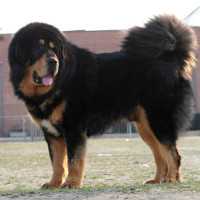
| Powerful, heavy, well built, with good bone. Impressive; of solemn and earnest appearance. Combines majestic strength, robustness and endurance; fit to work in all climate conditions. Slow to mature, only reaching its best at 2-3 years in females and at least 4 years in males. |
Important proportions |
| • Skull measured from occiput to stop equal to muzzle from stop to end of nose but muzzle may be a little shorter. • Body slightly longer than height at withers. |
Behaviour / temperament |
| Independent. Protective. Commands respect. Most loyal to his family and territory. |
Head |
||
Cranial region |
||
Head |
Broad, heavy and strong. In adults a wrinkle may extend from above the eyes down to the corner of mouth. | |
Skull |
Large, very slightly rounded, with strongly pronounced occiput. | |
Stop |
Well defined. | |
Facial region |
||
Nose |
Broad, as dark as possible depending on coat colour, well opened nostrils. | |
Muzzle |
Fairly broad, well filled and deep. End of muzzle square. | |
Lips |
Well developed and covering the underjaw. | |
Jaws and teeth |
Jaws strong with perfect, regular and complete scissor bite, i.e. upper incisors closely overlapping the lower incisors and set square to the jaws. Level bite acceptable. Dentition fits tightly. | |
Eyes |
Medium size, any shade of brown and in accordance with coat colour, the darker the better. Set well apart, oval and slightly slanting. Eyelids tightly fitting the eyeball. Expression of dignity. | |
Ears |
Medium size, triangular, pendant, set between the level of the skull and the eye, dropping forward and hanging close to head; carried forward when alert. Ear leathers covered with soft, short hair. | |
Neck |
| Strong, well muscled, arched. Not too much dewlap. Covered by thick upstanding mane, not so pronounced in bitches. |
Body |
||
Body |
Strong. | |
Back |
Straight, muscular. | |
Croup |
Broad and rather flat. | |
Chest |
Rather deep, of moderate breadth, with good spring of rib, to give heart-shaped ribcage. Brisket reaching to below elbows. | |
Tail |
| Medium length. Set high on line with top of back, carried high, loosely curled over back, when dog alert or in motion; well feathered. |
Limbs |
Forequarters |
||
Generality |
Straight, well angulated, well covered all over with strong hair. | |
Shoulders |
Well laid, muscular. | |
Elbows |
Neither turned in nor out. | |
Forearm |
Straight. Strong bone. | |
Pastern |
Strong, slightly sloping. | |
Hindquarters |
||
Generality |
Powerful, muscular, with good angulation. Seen from behind, hindlegs parallel. | |
Upper thigh |
Rather long; strong, with good hard muscles, but not bulging. | |
Stifle |
Well bent. | |
Hock |
Strong, low set. Dewclaws optional. | |
Feet |
| Fairly large, strong, round and compact, with good feathering between well-arched toes. |
Gait and movement |
| Powerful, but always light and elastic: with good reach and drive. When speed increases tends to single track. When walking appears very deliberate. Capable of functioning over a varied terrain with stamina and suppleness. |
Coat |
||
Hair |
Quality of greater importance than quantity. Coat harsh, thick, top coat not too long, with dense and rather wolly undercoat in cold weather which becomes rather sparse in warmer months. Males carry noticeably more coat than females. Hair fine but harsh, straight and off-standing. Never silky, curly or wavy. Neck and shoulders heavily coated, giving mane-like appearance. Tail bushyand well feathered; hindlegs well feathered on upper rear parts. | |
Colour |
Rich black, with or without tan marking; blue, with or without tan markings; gold, from rich fawn to deep red, sable. All colours to be as pure as possible. Tan ranges from a rich chestnut to a lighter colour. White star on breast permissible. Minimal white markings on feet acceptable. Tan markings appear above eyes, on lower part of legs and underside of tail. Tan markings on muzzle; spectacle markings tolerated around eyes. | |
Size and weight |
||
Height at withers |
Dogs : 66 cm (26 ins) minimum, Bitches : 61 cm (24 ins) minimum. | |
Faults |
| • Any departure from the foregoing points should be considered a fault and the seriousness with which the fault should be regarded should be in exact proportion to its degree and its effect upon the health and welfare of the dog and its ability to perform its traditional work. • Faults listed should be in degree of seriousness. |
Serious faults |
 Lacking physical condition and fitness. Head light or heavily wrinkled. Pendulous flews. Pronounced dewlap. Large and/or low set ears. Light eyes or staring expression. Weak pigmentation, particularly of nose. Barrelled ribs. Tightly curled tail over hips. Over angulated or straight hindquarters. Heavy constrained movement. Under minimum height, tolerance 2 cm. Lacking physical condition and fitness. Head light or heavily wrinkled. Pendulous flews. Pronounced dewlap. Large and/or low set ears. Light eyes or staring expression. Weak pigmentation, particularly of nose. Barrelled ribs. Tightly curled tail over hips. Over angulated or straight hindquarters. Heavy constrained movement. Under minimum height, tolerance 2 cm. |
Disqualifying faults |
| Aggressive or overly shy. Undershot or overshot mouth. All other colours than above mentioned eg white, cream, grey, brown (liver), lilac, brindle, particolours. |
NB : |
| • Any dog clearly showing physical or behavioural abnormalities shall be disqualified. • The above mentioned faults when occurring to a highly marked degree or frequently are disqualifying. • Male animals should have two apparently normal testicles fully descended into the scrotum. • Only functionally and clinically healthy dogs, with breed typical conformation should be used for breeding. |
Bibliography |
| https://www.fci.be/ |



 English (United Kingdom)

Comments