 |
Bullmastiff |
|
FCI standard Nº 157 |
||
Origin |
Great Britain | |
Group |
Group 2 Pinscher and Schnauzer Molossoid breeds - Swiss Mountain and Cattle Dogs | |
Section |
Section 2.1 Molossoid breeds, Mastiff Type | |
Working |
Without working trial | |
Acceptance on a definitive basis by the FCI |
Saturday 23 April 1955 | |
Publication of the official valid standard |
Thursday 10 August 2023 | |
Last update |
Monday 11 September 2023 | |
En français, cette race se dit |
 |
Bullmastiff |
Diese Norm ist in deutscher Sprache sichtbar |
 |
Bullmastiff |
En español, esta raza se dice |
 |
Bullmastiff |
In het Nederlands, wordt dit ras gezegd |
 |
Bullmastiff |
Usage |
| Watchdog. |
Brief historical summary |
| The Bullmastiff evolved from the Old English Mastiff and the Bulldog. Primarily used as a guard dog and, in olden times, to help the gamekeeper in the apprehension of poachers. The Bullmastiff is intelligent and observant; he is totally reliable both physically and mentally and can quickly assess a situation. His bravery and courage and defending against intruders is legendary. |
General appearance |
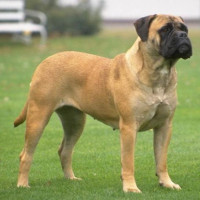
| Powerful build, symmetrical, showing great strength, but not cumbersome; sound and active. |
Behaviour / temperament |
| Powerful; enduring, active and reliable. High-spirited, alert and faithful. |
Head |
||
Cranial region |
||
Skull |
Skull large and square, viewed from every angle, fair wrinkle when interested, but not when in repose. Broad and deep. | |
Stop |
Pronounced. | |
Facial region |
||
Nose |
Well opened nostrils. Nose broad with widely spreading nostrils; flat neither pointed nor turned up in profile. | |
Muzzle |
Muzzle short; distance from tip of nose to stop approximately one-third of length from tip of nose to centre of occiput, broad under eyes and sustaining nearly same width to end of nose; blunt an cut off square, forming right angle with upper line of face, and at same time proportionate with skull. | |
Lips |
Flews not pendulous, never hanging below level of lower jaw. | |
Jaws and teeth |
Under-jaw broad to end. Level (Pincer bite, edge to edge) desired but slightly undershot allowed but not preferred. Canine teeth large and set wide apart, other teeth strong, even and well placed. | |
Cheeks |
Well filled. | |
Eyes |
Dark or hazel, of medium size, set apart the width of muzzle with furrow between. Light or yellow eyes highly undesirable. | |
Ears |
V-shaped, folded forward, set on wide and high, level of occiput giving square appearance to skull which is most important. Small and deeper in colour than body. Point of ear level with eye when alert. Rose ears highly undesirable. | |
Neck |
| Well arched, moderate length, very muscular and almost equal to skull in circumference. |
Body |
||
Back |
Short and straight, giving compact carriage, but not so short as to interfere with activity. Roach and sway backs highly undesirable. | |
Loin |
Loins wide and muscular with fair depth of flank. | |
Chest |
Chest, wide and deep, well let down between forelegs, with deep brisket. | |
Tail |
| Set high, strong at root and tapering, reaching to hocks, carried straight or curved, but not hound fashion. Crank tails highly undesirable. |
Limbs |
Forequarters |
||
Generality |
Forelegs set wide apart, presenting a straight front. | |
Shoulders |
Shoulders muscular, sloping and powerful, not overloaded. | |
Upper arm |
Forelegs powerful and straight, well boned. | |
Pastern |
Pasterns straight and strong. | |
Hindquarters |
||
Generality |
Hind legs strong and muscular. | |
Lower thigh |
Well developed lower thighs, denoting power and activity, not cumbersome. | |
Hock |
Moderately bent. Cow hocks highly undesirable. | |
Feet |
| Well arched, cat-like, with rounded toes, pads hard. Dark toenails desirable. Splayed feet highly undesirable. |
Gait and movement |
| Movement indicates power and sense of purpose. When moving straight neither front nor hind legs should cross or plait, right front and left rear leg rising and falling at same time. A firm backline unimpaired by powerful thrust from hindlegs denoting a balanced and harmonious movement. |
Coat |
||
Hair |
Short and hard, weather-resistant, lying flat to body. Long, silky or woolly coats highly undesirable. | |
Colour |
Any shade of brindle, fawn or red; colour to be pure and clear. A slight white marking on chest permissible. Other white markings undesirable. Black muzzle essential, toning off towards eyes, with dark markings around eyes contributing to expression. | |
Size and weight |
||
Height at withers |
Males 64 - 69 cms, females 61 - 66 cms. | |
Weight |
Males 50 - 59 kgs, females 41 - 50 kgs. | |
Faults |
| • Any departure from the foregoing points should be considered a fault and the seriousness with which the fault should be regarded should be in exact proportion to its degree and its effect upon the health and welfare of the dog and its ability to perform its traditional work. • Faults listed should be in degree of seriousness. |
General faults |
 Aggressive or overly shy. Aggressive or overly shy. |
NB : |
| • Any dog clearly showing physical or behavioural abnormalities shall be disqualified. • The above mentioned faults when occurring to a highly marked degree or frequently are disqualifying. • Male animals should have two apparently normal testicles fully descended into the scrotum. • Only functionally and clinically healthy dogs, with breed typical conformation should be used for breeding. |
Bibliography |
| https://www.fci.be/ |



 English (United Kingdom)

Comments