 |
Deutscher Wachtelhund |
|
FCI standard Nº 104 |
||
Origin |
Germany | |
Translation |
C. Seidler | |
Group |
Group 8 Retrievers, Flushing Dogs, Water Dogs | |
Section |
Section 2 Flushing Dogs | |
Working |
With working trial | |
Acceptance on a definitive basis by the FCI |
Friday 03 December 1954 | |
Publication of the official valid standard |
Wednesday 24 July 1996 | |
Last update |
Friday 12 March 1999 | |
En français, cette race se dit |
 |
Chien d'Oysel allemand |
Diese Norm ist in deutscher Sprache sichtbar |
 |
Deutscher Wachtelhund |
En español, esta raza se dice |
 |
Perdiguero Alemán |
In het Nederlands, wordt dit ras gezegd |
 |
Duitse Oysel hond |
Usage |
| Flushing Dog, versatile hunting dog. |
Brief historical summary |
| From hunting literature, it can be proved that hunting dogs resembling the present day Wachtelhund have existed for centuries and have been used for flushing game. The term « Wachtelhund » also has historic origins. Breeding of the German Spaniel, according to a stud book, began at the turn of the century. The progenitor of the breed was « Lord Augusta 1834 L », who came from Staufenberg (Upper Bavaria). Pure breeding began with a few suitable bitches. At first only brown dogs (sometimes with white markings), and white-brown dogs were bred, the latter occasionally with small tan (red) markings on head and legs, the so-called « Brand ». Through the bitch, « Baby auf der Schanze 1838 L », the brown roan colour occurred in the breed. Rudolf Friess (R.F.), who influenced the breeding of the German Spaniel for decades, introduced the separate colour breeding for browns and roans. By carefully planned matings within both colour strains he succeded to establish the important precondition - in spite of the small gene pool - to keep away from the damages through inbreeding. The separation of the colour strains seemed also sensible in view of the somewhat different dispositions of the dogs. The browns as short distance hunters, easier to make them hunt the game towards the guns, the brown roan colour as long distance hunters, specially willing to follow a trail. The difference in disposition can nowadays no longer be regarded as a valid distinction between the two strains, as in the meantime, for various reasons, numerous matings between the two strains had taken place. Generally, however, the separation still counts today as a preservation of an unrelated reservoir of blood within the breed. The German Spaniel was and is still bred exclusively by hunters for hunters as a flushing and versatile hunting dog. |
General appearance |
| The German Spaniel is a medium sized, long-haired, very muscular flushing dog with noble head and strong bone. Altogether longer than high, but never looking high on leg. |
Important proportions |
| Relation to body length to height at withers : 1,2 to 1. Relation to depth of chest to height at withers : 0,5 to 1. Relation of muzzle to cranial region : 1 to 1. |
Behaviour / temperament |
| Lively, passionate hunter, friendly, assured, very docile and adaptable, neither nervous nor aggressive. Characteristics of the German Spaniel are : • Possessed of a strong desire to find. • Able to pick up scent, firm in tracking. • Reliable at giving tongue. • A fine nose. • Likes retrieving and work in water. • Sharp with game and vermin. • Working independently but still in a controlled manner when appropriately trained and guided; reliable for tracking wounded game, retrieving lost game and flushing; a versatile gundog especially for woodland with heavy cover and water. The trait to point was not given attention since breeding began. |
Head |
||
Cranial region |
||
Skull |
Flat, moderately broad, no marked occiput. | |
Stop |
Only moderately developed. | |
Facial region |
||||||||||||||||||||||||||||||||
Nose |
Nose leather large and dark with wide open nostrils. Depigmented patches are a fault. Roman nose embellishes the dog. | |||||||||||||||||||||||||||||||
Muzzle |
Strong with nasal bridge remaining evenly broad, slightly rounded towards the end. On no account pointed, not shorter than cranial region. | |||||||||||||||||||||||||||||||
Lips |
Straight, dry, taut. Pigment according to coat colour. | |||||||||||||||||||||||||||||||
Jaws and teeth |
Complete set of 42 teeth in the following order seen diagramatically from the front :
Definition of above tooth formation : I = Incisor, C = Canine, P = Premolar, M = Molar. Incisors in upper jaw close in incisor bite in front of those in lower jaw. Pincer bite will be tolerated. Teeth well developed, strong. |
|||||||||||||||||||||||||||||||
Cheeks |
Dry, skin taut, cheek bones not protruding. | |||||||||||||||||||||||||||||||
Eyes |
Medium brown, as dark as possible. Medium size, set in slightly oblique, neither protruding nor deep set with tight fitting lids, not showing any haw. Hair on rims of eyelids. | |||||||||||||||||||||||||||||||
Ears |
Set on high and broad, flat without any twist, hanging directly behind eye. Not thick, fleshy or flabby. Evenly furnished with hair reaching over inner edge. Laid forward, leathers reach nose leather. | |||||||||||||||||||||||||||||||
Neck |
| Strong, nape of neck specially well muscled. Merging with withers in a blunt angle. No visible throatiness at beginning and widening towards chest without dewlap. |
Body |
||
Topline |
Straight in the different parts of the body, merging well into each other. Croup slightly sloping, tail in continuation with topline or carried slightly downwards. | |
Withers |
Strong and well defined. | |
Back |
Short and firm, without any dip behind withers. | |
Loin |
Strongly muscled, therefore broad in appearance. | |
Croup |
Slightly sloping, never overbuilt. Slightly below height of withers. | |
Chest |
Oval, seen from front. Seen from side, reaching to below elbow joint. Ribcage long, well sprung, neither barrel shaped nor flat. | |
Underline and belly |
Tucked up moderately from last (false) rib to rear. Underside also covered as much as possible by protective hair and undercoat. | |
Tail |
| In repose, carried straight in continuation of topline or downwards. When alert or excited, carried slightly upwards and wagging vividly. To avoid injury, the tail should be shortened (docked) by not more than a third during the first three days after birth. In countries where docking is not permitted, the tail can be left natural. |
Limbs |
Forequarters |
||
Generality |
Seen from front, straight and parallel, seen from side, legs well under body, standing vertical to ground. Good angulations. | |
Shoulders |
Strongly muscled. Shoulder blade well laid back. | |
Upper arm |
In movement, sliding along close to chest. | |
Elbows |
Close to body, turning neither in nor out. | |
Forearm |
Straight, connection with joints not rickety. | |
Carpal |
Strong. | |
Pastern |
Set slightly oblique. | |
Forefeet |
Spoon shaped. Toes close to each other, cat-or harefoot undesirable. Coarse, resistant, well pigmented pads and strong nails which get well worn down. | |
Hindquarters |
||
Generality |
Seen from side, good angulation in stifle and hock joints. Seen from rear, straight and parallel, neither bow-legged nor cow hocked; strong bone. | |
Upper thigh |
Broad and very muscular, good angulation between pelvis and upper thigh. | |
Lower thigh |
Long, muscular, sinewy. | |
Stifle |
Strong with good angulation between upper and lower thigh. | |
Metatarsus |
Short. Vertical stance. | |
Hock |
Strong. | |
Hind feet |
As front feet. | |
Gait and movement |
| Fluent and ground covering. Legs straight and parallel sliding closely along the body. |
Skin |
| Coarse and close fitting, no folds and pigmentation. |
Coat |
||
Hair |
Strong, close fitting, mostly wavy, sometimes curly (astrakhan) or smooth long coat, with thick undercoat. Hair not too long, much less thin or even silky. On nape, leathers and croup, often curly. Rearside of legs and tail, well feathered. Frequently frill on neck (jabot). Also well coated on belly. Muzzle and cranial region : Hair short but dense. The leathers are covered by curls or dense wavy hair which also reaches beyond their inner edge. Interdigital gaps have dense but not too long hair. |
|
Colour |
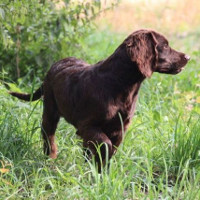
The German Spaniel is bred in two colour varieties : • Solid brown, and more seldom also red*, including all occurring reddish shades (like fox or deer red). Also often with white or ticked markings on chest and toes. • Brown roan, more seldom red* roan. As basic colour, brown or red* hair is closely mixed with white hair. Often with the head brown or red*, as well as with patches or a saddle over the whole back. To this colour variety also belong the pied colour patterns with white as basic colour and large brown or red* patches as well as « tiger » pattern where the white basic colour is in addition sprinkled or ticked with clusters of brown or red* hair, even when bred from solid colour parents. In both colours, red* markings (« Brand ») over eyes, on muzzle, legs and round vent can occur. * Red = all existing reddish shades (fox, roedeer or deer red). |
|
Size and weight |
||
Height at withers |
Dogs : 48 to 54 cm, Bitches : 45 to 52 cm. | |
Weight |
Varying, according to size, between 18 to 25 kg. Bitches are slightly lighter than dogs | |
Faults |
| • Any departure from the foregoing points should be considered a fault and the seriousness with which the fault should be regarded should be in exact proportion to its degree and its effect upon the health and welfare of the dog and its ability to perform its traditional work. • Faults listed should be in degree of seriousness. |
General faults |
 Marked stop. Missing of a first premolar (PM1). Too deep flews, lips not enough taut. Eyelids not close fitting. Too narrow ear channels (disposition for ear trouble). Barrel chest. High on leg or fine bone. Thin, sparse or silky coat; sparsely coated belly. Ear ends leathery. Slightly over or under in size or weight. Marked stop. Missing of a first premolar (PM1). Too deep flews, lips not enough taut. Eyelids not close fitting. Too narrow ear channels (disposition for ear trouble). Barrel chest. High on leg or fine bone. Thin, sparse or silky coat; sparsely coated belly. Ear ends leathery. Slightly over or under in size or weight. |
Serious faults |
| Skins problems : Dermatitis, atopy. Missing teeth, apart from the lack of one PM1. |
Disqualifying faults |
| Aggressive or overly shy. Weak temperament, gun-or game-shy. Serious mouth faults (over-or undershot, wry mouth). Entropion, ectropion. Black coat colour. |
NB : |
| • Any dog clearly showing physical or behavioural abnormalities shall be disqualified. • The above mentioned faults when occurring to a highly marked degree or frequently are disqualifying. • Male animals should have two apparently normal testicles fully descended into the scrotum. • Only functionally and clinically healthy dogs, with breed typical conformation should be used for breeding. |
Bibliography |
| https://www.fci.be/ |
Detailed history |
| The Wachtelhund; in French, German Spaniel or German Oysel Dog; was created in the early twentieth century by a breeder, a certain Frederic Roberth. Like many of his colleagues, Roberth did not see fit to reveal the identity of his protégé's spawners, so that we are reduced to assuming that he has encountered various long-haired hunting dogs, all of modest size, even average. In Germany, Wachtelhund is considered a specialist in difficult terrain. It is said that it is particularly distinguished in hunting fox and hare. As a good spaniel he is, he is used to mark the stop before his prey. Highly appreciated for his courage and daring, this dog has undeniable qualities, but it must be recognized that he is totally unknown in France, where only thirteen subjects are registered in the LOF. To our knowledge, it is in Alsace that we are most likely to meet this great game hunter, or bushman, who proves to be moreover a good companion dog, perhaps a bit exclusive. |



 English (United Kingdom)

Comments