
 |
Taimyr Wolf |
|
He is not recognized by the F.C.I. |
Origin |
Siberia | |
Translation |
Francis Vandersteen | |
En français, cette race se dit |
 |
Loup de Taïmyr |
Diese Norm ist in deutscher Sprache sichtbar |
 |
Taimyr-Wolf |
En español, esta raza se dice |
 |
Lobo de Taimyr |
In het Nederlands, wordt dit ras gezegd |
 |
Taimyr-wolf |
|
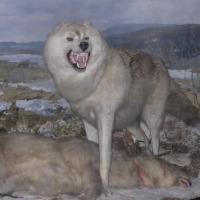
The Taimyr Wolf is no longer an extant breed, but it is a direct, ancient ancestor of modern Husky-type sled dogs. Genetic research shows that the DNA of the now-extinct Taimyr Wolf contributed significantly to the evolution and survival of high-latitude Arctic dogs, notably the Siberian Husky and the Greenland Dog. DNA extracted from a 35,000-year-old Taimyr Wolf rib revealed it to be a distant ancestor of modern Arctic dogs, passing on traits adapted to harsh, freezing climates. Genetic analysis indicates that modern sled dogs—such as Siberian Laikas, Alaskan Malamutes, and Greenland Dogs—all share a common ancestor that lived in the Taimyr region of northern Asia approximately 10,000 years ago. Paleogenetic studies comparing the DNA of modern Greenland Dogs, ancient Siberian Huskies, and an Ice Age wolf concluded that the ancestor of all sled dog breeds originated in Siberia around ten thousand years ago. Genetic analysis shows that all sled dog breeds have their roots in Siberia. It was there, approximately 9,500 years ago, that the first carriers of the genes responsible for adapting these highly specialized animals to life in the harsh Arctic climate emerged. Several regions lay claim to being the ancestral cradle of dogs: Europe, the Altai, Nepal, and the Middle East. In recent years, geneticists and archaeologists have leaned toward a Siberian origin for all dogs, a theory supported by discoveries on Zhokhov Island in Eastern Siberia and by the genomes of the earliest American dogs, which proved similar to those of Siberian Huskies and other sled dogs. In a new study, a team of geneticists and archaeologists led by Vladimir Pitulko—a senior researcher at the Institute for the History of Material Culture in St. Petersburg—uncovered further evidence for this theory and identified the region of origin for all sled dog breeds. To do this, the researchers compared the genomes of modern Greenland dogs, "resurrected" DNA from dogs found on Zhokhov Island, and DNA from an ancient wolf dating back 35,000 years. The remains of this animal had been discovered on the Taymyr Peninsula a decade ago. Thanks to the cold temperatures, the DNA samples within the predator's jaw were exceptionally well preserved. This allowed scientists to study the specimen and compare its genetic makeup to that of ancient and modern sled dogs. Genetic analysis revealed that the three main sled dog breeds—Siberian Laikas, Alaskan Malamutes, and Greenland dogs—shared a common ancestor that lived on the Taymyr Peninsula approximately ten thousand years ago. Around that same time, the last glaciers covering large parts of Eurasia and North America disappeared, enabling these dogs and their human companions to spread across the Arctic and develop their current appearance. |



 English (United Kingdom)

Comments