Finnish Spitz

FCI standard Nº 49

   
Origin
  Finland
Translation
  Finnish Kennel Club
Revised by Renée SporreWilles
Official language (EN)
Group
  Group 5 Spitz and primitive types
Section
  Section 2 Nordic Hunting Dogs
Working
  With working trial only for nordic countries (Sweden, Norway, Finland)
Acceptance on a definitive basis by the FCI
  Tuesday 3 August 1954
Publication of the official valid standard
  Wednesday 11 February 2026
Last update
  Friday 20 March 2026
En français, cette race se dit
Spitz finlandais
Diese Norm ist in deutscher Sprache sichtbar
Finnen Spitz
En español, esta raza se dice
Spitz finlandés
In het Nederlands, wordt dit ras gezegd
Finse Spits
In his country of origin, his name is
 

Suomenpystykorva

Usage

A hunting dog mainly for forest game birds, also predatory small game, water-fowl and elk. Eager hunter; rather independent, yet works co-operatively to game, marking game by barking.
 

Brief historical summary

It is known that already hundreds of years ago dogs of this type were used for all game hunting over the whole country.
Originally the main goal was to develop a dog that barked well at game up in trees and was also beautiful. When the register of the breed started in the 1890s, individuals similar in type and hunting purpose were found mainly in the eastern and northern parts of the country. The first breed standard was established in 1892. The first breed show was held the same year and the first bird-hunting trial in 1897. Today the breed is very common in both Finland and Sweden. It has been developed from pure natural stock and is an essential part of the Finnish culture. The Finnish Spitz was named as the National Dog of Finland in 1979. According to the agreement between the Finnish Kennel Club and the Russian Cynological Federation that was signed in 2006 the Karelian-Finnish Laika and the Finnish Spitz were combined as one breed under the breed standard of the Finnish Spitz.

General appearance

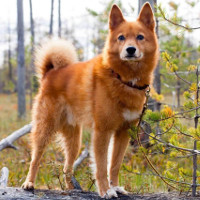
Smaller than medium-sized, almost square. In conformation lean, firm and carries itself well.

Important proportions

The length of the body is the same as the height at the withers.
The depth of the chest is slightly less than half of the height at the withers.
The ratio between the muzzle and skull is approximately 3:4.
The skull is a little broader than long; its breadth is the same as its depth.

Behaviour / temperament

Lively, vigorous, brave and determined. Possibly a little reserved towards strangers, but never vicious.

Head

Cranial region

Skull
  Viewed from above egg-shaped broadening gradually towards the ears, broadest between the ears. Viewed from the front and in profile the skull is slightly convex. The upper axes of the skull and muzzle are almost parallel. The frontal furrow is very shallow. The superciliary ridges and the occiput are slightly visible. 
Stop
  Not very pronounced, the angle between the nasal bridge and the skull is clearly marked.

Facial region

Nose
  Rather small, jet-black.
Muzzle
  Narrow, clean, viewed from above and in profile evenly tapering. The nasal bridge is straight. The lower jaw is clearly visible.
Lips
  Tight, rather thin and close fitting. Good pigmentation.
Jaws and teeth
  The jaws are strong. The teeth are well developed and symmetrical; normal dentition. Tight scissor bite.
Cheeks
  The zygomatic arches are slightly emphasized.
Eyes
  Medium-sized, almond-shaped, slightly oblique and preferably dark. The expression is lively and alert.
Ears
  Set rather high, always erect. Rather small sized, pointed, very mobile and covered with fine hair.

Neck

Muscular; it appears to be rather short in males due to the thick ruff, of medium length in bitches. Throat without dewlap.

Body

Withers
  Clearly defined, especially in males.
Back
  Rather short, straight and muscular.
Loin
  Short and muscular.
Croup
  Of medium length, well developed and slightly sloping.
Chest
  Deep, reaching almost the elbows, not very broad. The ribs are slightly arched; the forechest clearly visible, not very broad.
Underline and belly
  Slightly tucked up.

Tail

Curved vigorously forward from the set-on tightly along the back, down-and slightly backwards pressed against the upper thigh, the tip of the tail reaches to the middle of the upper thigh. When straightened reaches approximately down to the hocks.

Limbs

Forequarters

Generality
  Viewed from the front straight and parallel. The bone is of medium strength. The upper arm is a little shorter than the shoulder blade and the forearm.
Shoulders
  Firm, very mobile and relatively straight.
Upper arm
  A little shorter than the shoulder blade. Slightly sloping and strong.
Elbows
  Placed in front of a vertical line drawn from the highest point of the shoulder blade; pointing straight backwards.
Forearm
  Rather strong, vertical.
Pastern
  Of medium length, slightly sloping.
Forefeet
  Roundish cat-feet. Toes tight and well arched. Pads elastic, always black, the sides covered with dense hair.

Hindquarters

Generality
  Strong, viewed from behind straight and parallel, medium angulation. The bone is of medium strength. The upper thigh is slightly longer than the second thigh.
Upper thigh
  Of medium length, rather broad with well developed muscles.
Stifle
  Pointed forward, medium angulation.
Lower thigh
  Muscular.
Hock
  Set moderately low, medium angulation.
Metatarsus
  Rather short, strong and vertical.
Hind feet
  A little longer than the front feet, otherwise the same. The dewclaws should be removed.

Gait and movement

Light, covering the ground effortlessly. Changes easily from trot to gallop, which is the most natural style of movement. The legs move parallel. When rushing after game, he bursts explosively into a fast gallop.

Skin

Tight overall without wrinkles.

Coat

Hair
  Rather long on the body, semi-erect or erect, stiffer on the neck and back. On the head and the legs, except at the back of the hindquarters, short and close-lying. The stiff hair on the shoulders, especially in males, is noticeably longer and coarser. On the back of the thighs (trousers) and on the tail the hair is long and dense. The undercoat is short, soft, dense and light in colour.
Colour
  The hair on the back is red-or golden brown, preferably bright. A lighter shade inside the ears, on cheeks, throat, chest, belly, inside the legs, back of the thighs and on the tail. A white stripe on the chest and small white markings on the feet are permitted.

Size and weight

Height at withers
  Ideal height for males 47 cm, ideal height for females 42 cm. With a tolerance of ± 3 cm.
Weight
  Males 12 - 13 kg, Bitches 7 - 10 kg.

Faults

• Any departure from the foregoing points should be considered a fault and the seriousness with which the fault should be regarded should be in exact proportion to its degree and its effect upon the health and welfare of the dog and its ability to perform its traditional work.
• Faults listed should be in degree of seriousness.
 

General faults

 Missing tooth (excluding PM1 and M3).

Disqualifying faults

 Aggressive or overly shy dogs.
 Other than erect ears.
 Other than black nose.
 Eyes bright yellow or wall eye.
 Overshot or undershot mouth.
 Kinked tail.
 Large white markings on the chest and/or a white sock.
 Colours differing severely from the basic colour.
 Wavy or curled coat.
 Height other than given in the standard.
 Several missing teeth.

NB :

• Any dog clearly showing physical or behavioural abnormalities shall be disqualified.
• The above mentioned faults when occurring to a highly marked degree or frequently are disqualifying.
• Male animals should have two apparently normal testicles fully descended into the scrotum.
• Only functionally and clinically healthy dogs, with breed typical conformation should be used for breeding.

Bibliography

https://www.fci.be/


Detailed history

To be the national dog in many ways remarkable; of his country does not mean, for this Spitz, that his fame has crossed the frontiers of his native Finland.In the canine encyclopedias, it is very briefly described under different names: Suomempystykorva, its official name, Finsk Spets, Finnish Loulou, Finnish Spitz (name adopted in the Anglo-Saxon countries and sometimes in France) and Finnish Spitz, as it is calls in the hexagon. In his country, he is also the "barking bird dog", which perfectly defines his traditional task. For his friends, he is simply the "Finkie". It is finally a "fox dog", by the color of his dress and his panache, as well as his malice. Of course, it can not be attributed to any kinship, even distant, with the fox, since it is admitted that the vulpine and canine species are not interbreeding.The Finn Spitz is above all a superb representative of the Spitz family and, as such, a direct descendant of the Chien des Tourbières, the oldest domestic dog widespread in Europe and Asia. For him to be considered a national heritage in his country, his presence must have been familiar since time immemorial. It is generally thought that he arrived in the company of the first Finns, coming from the highlands of Asia (it is known that Finnish is, like Hungarian, a language of Asian origin belonging to the Finno-Ugric group). He is also quoted in Kalevala, Finland's national epic song.This dog was very popular, but, as often happens with the widespread breeds, his selection was of little concern to his amateurs, who in many places allowed him to cross with other Spitz. By the end of the 19th century, most of these dogs had lost much of their characteristics. It was then that Finnish cynophiles, who were at the same time sports hunters, wanted to find the ancestral type of the national race: to choose specimens remained pure of any cross, they had to traverse the most remote countries of the country. It is right to emphasize; the fact is not so common; that the selection they undertook had no need of the contribution of another race.The registration of these dogs on a breeding book began in 1880, and the standard of the breed was written in 1892 (that is, to a few details, the text of the standard in force today). In some works, it is specified that the characteristics proper to the race were fixed as early as 1812, which does not correspond to the generally accepted chronology. Be that as it may, the Finn Spitz can not be considered a recent breed, nor even as a newly restored breed. On the contrary, it unites all the criteria of an authentically ancient race, which, since its "enthronement" in the dog world, has not undergone any notable change in its appearance and has been maintained in its original use. It is now firmly established in Finland, where efforts are made, in particular, to preserve its ancestral hunting skills. However, its diffusion is not very important, at least as a purebred, since the book of origins does not register more than one hundred and fifty births per year.If it is well known in the other Scandinavian countries, the Finnish Spitz has long been ignored in the rest of continental Europe, because the Finska Kennelklubben (the Finnish equivalent of the Central Canine Society in France) joined the International Cynological Federation after the Second World War.The British, for their part, always on the lookout for the rarities of the canine world, were not slow to take an interest in Finnish Spitz. Lady Kitty Ritson was the first, in the early twenties, to introduce the breed across the Channel. Many current topics come from her breeding. According to Stanley Dangerfield, after traveling over Finland, Sir Edward Chichester also brought back a very good couple in 1927. The recognition of the breed by the Kennel Club took place in 1935.However, the Finnish Spitz is struggling to conquer Britain. The number of annual births has never reached 100, and the current stability of the workforce does not suggest this possibility. There are, however, excellent breeders in this country, among whom are Mr. and Mrs.. Cavill, Mrs. Priee and Miss PA McQuaide. Two breed associations, the Finnish Spitz Society and the Finnish Spitz Club, ensure the breed's improvement in full respect of the original standard (for once). It is true that it seems difficult, in theory, to perfect or modify anything in Finnish Spitz.The English breeding remains modest, and Finland far (until last year, this country had instituted a forty-four months, which did not facilitate the discovery of Finnish dogs), the breed hardly spread throughout the world. The American Kennel Club, for example, did not recognize it until 1987.The first couple arrived in France in 1954, thanks to a Finnish diplomat. Well before that, one of the founders of the French Club of Nordic dogs, Mr. Fornier de Savignac, had judged this race at the famous Cruft's exhibition in 1936, and, going back in time, it seems that a French explorer had already described in 1675. However, it is not until 1968 that the Finnish Spitz has really established itself in the Hexagon. That year, four subjects were acquired: Kronby and Kukkoha of Finmark (Mr. Proust), Cullabine Windfall, by Mr. Grace, and Cullabine Belinda, by Mrs. Bartolozzi-Carion, followed quickly by Cullabine Ruby at Mr. Grace, and by Cullabine Quaintly and Cullabine Sorrel, at Mrs. Bartolozzi's. Belinda was the first registered champion in France. Uko and Villi of Cascade des Jarreaux, children of Belinda and Windfall, were the first champions born on French soil. Here again, the Finnish Spitz herd progresses, but with a slowness that we must regret. It must nevertheless be recognized that this situation has an indisputable advantage: French breeding can claim its high quality.The Finnish Spitz does not pretend to make the crowd giggle, but it is not anonymous. His flamboyant coat does not go unnoticed. His presence and his pride easily compensate for the modesty of his size. Moreover, for lack of means to evaluate its size, one finds it even big. From the first contact, one does not miss to notice its harmonious and well made aspect, as well as its eminently sympathetic side. His vivacity, his malice and his intelligence are immediately apparent.By its type, it is also not a "go-anywhere" dog. Proud and sensitive at the same time, he shows no tendency to servility. His education must therefore be carried out with understanding and gentleness, but also with firmness. No question of wanting to train "the button" to put "in his boot." A good dose of patience, a sense of justice and a certain constancy will be rewarded with a deep attachment and a friendship that will not be denied under any circumstances. With a little "fingering", it is possible to get almost everything from him.Although independent, this dog does not appreciate being left alone; on the contrary, it should be associated as much as possible with the life of its master and his family. Its vitality is not suitable for the elderly, who could be annoyed by its sometimes turbulent side (especially in its young age). It is also understandable that this native petulance does not particularly predispose him to blossom in an apartment (unless many joggings are offered to him) and that his sensitivity prevents him from teaming up with nervous, irritable, velletic people, like to live in an unstable environment.This vigilant guardian notices everything and does not fail to report it. On this subject, it should not be forgotten that he is a natural enough "talkative" and that he even has an extensive "vocabulary". This propensity to express itself loudly increases if it does not have enough activity, if it is bored, if it remains for a long time left to itself. Such behavior is also common to all dynamic dogs; of any race, who have no alternative but to bark to deceive their idleness. This excellent alarm will be able to be courageous, without tending to become aggressive.Very awake and even full of mischief, charmer, player, he is naturally on the same wavelength as children. It is also "at their size" and does not show brutality. On the subject of children, there is the case of a Finnish Spitz who, a few years ago, saved his young master from drowning in a lake whose ice had given way, keeping him out of the water until he what help arrives.The Finnish Spitz is therefore a very good family dog, but in his country he has one main use: hunting the black grouse. He follows the grouse from tree to tree, no matter what the terrain is, and then holds it to a standstill when it perches while holding or "captivating" its attention with a frenetic dance, thus using a ruse similar to that of a master. Goupil, who, on the occasion, does not hesitate to make antics to lull the mistrust of the game and thus be able to approach and seize it. In addition, by its acute and modulated barking, the Finnish Spitz guides the hunter with precision.Special field-trials are regularly organized. A big annual contest allows to dedicate the "king", that is to say the dog who reveals himself as the "best barker", knowing how to inform his master by the diversity of his vocalises, not without having previously proven the his flair, his sense of hunting and his tenacity. Some people also hunt rabbits and other small game. Finnish Spitz is sometimes used on moose or even bear. A complete hunting dog, in short. Of course, all this is only valid in his country: in France, there are enough hunting breeds so we do not need to appeal to him in this area.Lastly, this dog is solid and rustic, naturally very clean, and has a modest appetite. Its dress, neither short nor very long, which preserves it from all bad weather, does not require any other care than a good brushing: no detangling, no grooming, no baths. Sparkling with intelligence, smart, very friendly, Finnish Spitz wins to be known.

Comments

Latest page updates

  • Samusky

    Samusky He is not recognized by the F.C.I. Origin Northern Russia and Siberia <> Siberia -> North America Translation Francis Vandersteen En français, cette race se dit Samusky Diese Norm ist in deutscher Sprache sichtbar Samusky En español, esta raza se dice Samusky In het Nederlands, wordt dit ras gezegd Samusky This breed is also known as SamhuskySamsky     A...
  • Agouti Husky

    Agouti Husky FCI standard Nº 270 Origin Siberian Translation Francis Vandersteen En français, cette race se dit Husky Agouti Diese Norm ist in deutscher Sprache sichtbar Agouti-Husky En español, esta raza se dice Husky Agouti In het Nederlands, wordt dit ras gezegd Agouti Husky   The "Agouti" Husky is not a distinct breed but a rare color variant...
  • White Husky

    White Husky   FCI standard Nº 270       Origin Siberia Translation Francis Vandersteen En français, cette race se dit Husky blanc Diese Norm ist in deutscher Sprache sichtbar Weißer Husky En español, esta raza se dice Husky blanco In het Nederlands, wordt dit ras gezegd Witte Husky   The white Husky is not a distinct breed, but rather a rare and striking...
  • Taimyr Wolf

    Taimyr Wolf He is not recognized by the F.C.I. Origin Siberia Translation Francis Vandersteen En français, cette race se dit Loup de Taïmyr Diese Norm ist in deutscher Sprache sichtbar Taimyr-Wolf En español, esta raza se dice Lobo de Taimyr In het Nederlands, wordt dit ras gezegd Taimyr-wolf   The Taimyr Wolf is no longer an extant breed, but it...
  • Manchurian Spitz

    Manchurian Spitz He is not recognized by the F.C.I. Origin Manchuria and Siberia region Translation Francis Vandersteen En français, cette race se dit Spitz de Mandchourie Diese Norm ist in deutscher Sprache sichtbar Mandschurischer Spitz En español, esta raza se dice Spitz de Manchuria In het Nederlands, wordt dit ras gezegd Mantsjoerije-spits   The...
  • White Swedish Elkhound

    White Swedish Elkhound He is not recognized by the F.C.I. Origin Sweden Translation Francis Vandersteen En français, cette race se dit Chien d'élan suédois blanc Diese Norm ist in deutscher Sprache sichtbar Schwedischer weißer Elchhund En español, esta raza se dice Perro de alce sueco blanco In het Nederlands, wordt dit ras gezegd Witte Zweedse...
  • Turkish Spitz

    Turkish Spitz He is not recognized by the F.C.I. Origin Turkey Translation Francis Vandersteen En français, cette race se dit Spitz turc Diese Norm ist in deutscher Sprache sichtbar Türkischer Spitz En español, esta raza se dice Spitz turco In het Nederlands, wordt dit ras gezegd Turkse spits This breed is also known as Tonya FinosuFino TonyaKobi   The Tonya...
  • Hunters Creek Feist

    Hunters Creek Feist He is not recognized by the F.C.I. Origin U.S.A. Translation Francis Vandersteen En français, cette race se dit Hunters Creek Feist Diese Norm ist in deutscher Sprache sichtbar Hunters Creek Feist En español, esta raza se dice Hunters Creek Feist In het Nederlands, wordt dit ras gezegd Hunters Creek Feist   The Hunters Creek Feist is...
  • Gray’s Mountain Feist

    Gray’s Mountain Feist He is not recognized by the F.C.I. Origin U.S.A. Translation Francis Vandersteen En français, cette race se dit Gray’s Mountain Feist Diese Norm ist in deutscher Sprache sichtbar Gray’s Mountain Feist En español, esta raza se dice Gray’s Mountain Feist In het Nederlands, wordt dit ras gezegd Gray’s Mountain Feist   The Gray’s...
  • Thornburg Feist

    Thornburg Feist He is not recognized by the F.C.I. Origin U.S.A. Translation Francis Vandersteen En français, cette race se dit Thornburg Feist Diese Norm ist in deutscher Sprache sichtbar Thornburg Feist En español, esta raza se dice Thornburg Feist In het Nederlands, wordt dit ras gezegd Thornburg Feist   The Thornburg Feist is a specialized line of...
  • Mullins Feist

    Mullins Feist He is not recognized by the F.C.I. Origin U.S.A. Translation Francis Vandersteen En français, cette race se dit Mullins Feist Diese Norm ist in deutscher Sprache sichtbar Mullins Feist En español, esta raza se dice Mullins Feist In het Nederlands, wordt dit ras gezegd Mullins Feist   The Mullins Feist is an American hunting dog breed...
  • Kemmer Stock Hybrid Squirrel Dog

    Kemmer Stock Hybrid Squirrel Dog He is not recognized by the F.C.I. Origin U.S.A. Translation Francis Vandersteen En français, cette race se dit Kemmer Stock Hybrid Squirrel Dog Diese Norm ist in deutscher Sprache sichtbar Kemmer Stock Hybrid Squirrel Dog En español, esta raza se dice Kemmer Stock Hybrid Squirrel Dog In het Nederlands, wordt dit...
  • Buckley Mountain Feist

    Buckley Mountain Feist He is not recognized by the F.C.I. Origin U.S.A. Translation Francis Vandersteen En français, cette race se dit Buckley Mountain Feist Diese Norm ist in deutscher Sprache sichtbar Buckley Mountain Feist En español, esta raza se dice Buckley Mountain Feist In het Nederlands, wordt dit ras gezegd Buckley Mountain Feist   The...
  • Charlie Feist

    Charlie Feist He is not recognized by the F.C.I. Origin United Kingdom, U.S.A. Translation Francis Vandersteen En français, cette race se dit Charlie Feist Diese Norm ist in deutscher Sprache sichtbar Charlie Feist En español, esta raza se dice Charlie Feist In het Nederlands, wordt dit ras gezegd Charlie Feist   The charming Charlie Feist is one of...
  • Barger Stock Feist

    Barger Stock Feist He is not recognized by the F.C.I. Origin U.S.A. Translation Francis Vandersteen En français, cette race se dit Barger Stock Feist Diese Norm ist in deutscher Sprache sichtbar Barger Stock Feist En español, esta raza se dice Barger Stock Feist In het Nederlands, wordt dit ras gezegd Barger Stock Feist   The Barger Stock Feist is a...
  • Toy Manchester Terrier

    Toy Manchester Terrier He is not recognized by the F.C.I. Origin U.S.A. Translation Francis Vandersteen En français, cette race se dit Manchester Terrier miniature Diese Norm ist in deutscher Sprache sichtbar Miniatur-Manchester-Terrier En español, esta raza se dice Manchester Terrier miniatura In het Nederlands, wordt dit ras gezegd Miniatuur-Manchesterterriër   The Toy...
  • Donggyeongi

    Donggyeongi He is not recognized by the F.C.I. Origin South Korea Translation Francis Vandersteen En français, cette race se dit Donggyeongi Diese Norm ist in deutscher Sprache sichtbar Donggyeongi En español, esta raza se dice Donggyeongi In het Nederlands, wordt dit ras gezegd Donggyeongi This breed is also known as Daeng GyeonDonggyeong Gae   The...
  • Mackenzie River Husky

    Mackenzie River Husky He is not recognized by the F.C.I. Origin Canada, U.S.A. Translation Francis Vandersteen En français, cette race se dit Husky du fleuve Mackenzie Diese Norm ist in deutscher Sprache sichtbar Mackenzie-River-Husky En español, esta raza se dice Husky del río Mackenzie In het Nederlands, wordt dit ras gezegd Mackenzie-rivier...
  • Danish Spitz

    Danish Spitz He is not recognized by the F.C.I. Origin Denmark Translation Francis VandersteenAuthoritative language (DK) Working No working trial required En français, cette race se dit Spitz danois Diese Norm ist in deutscher Sprache sichtbar Dänischer Spitz En español, esta raza se dice Spitz danés In het Nederlands, wordt dit ras gezegd Deense...
  • Hällefors Elkhound

    Hällefors Elkhound He is not recognized by the F.C.I. Origin Sweden Translation Francis Vandersteen En français, cette race se dit Chien d'élan de Hällefors Diese Norm ist in deutscher Sprache sichtbar Hällefors Elchhund En español, esta raza se dice Elkhound de Hällefors In het Nederlands, wordt dit ras gezegd Hällefors Elkhound   The Hällefors...
  • Great Fauve of Brittany

    Great Fauve of Brittany He is not recognized by the F.C.I. Origin France Translation Francis Vandersteen En français, cette race se dit Grand Fauve de Bretagne Diese Norm ist in deutscher Sprache sichtbar Großer Fauve der Bretagne En español, esta raza se dice Gran Fauve de Bretaña In het Nederlands, wordt dit ras gezegd Grote Fauvist van...
  • Timmon’s Biter Herding Dog

    Timmon’s Biter Herding Dog He is not recognized by the F.C.I. Origin Australia Translation Francis Vandersteen En français, cette race se dit Chien de berger Timmon’s Biter Diese Norm ist in deutscher Sprache sichtbar Timmon’s-Biter-Schäferhund En español, esta raza se dice Perro pastor Timmon’s Biter In het Nederlands, wordt dit ras gezegd Timmon’s...
  • Montemboeuf Dog

    Montemboeuf Dog He is not recognized by the F.C.I. Origin France Translation Francis Vandersteen En français, cette race se dit Chien Montemboeuf Diese Norm ist in deutscher Sprache sichtbar Montemboeuf-Hund En español, esta raza se dice Perro Montemboeuf In het Nederlands, wordt dit ras gezegd Montemboeuf-hond   The Montemboeuf is an extinct dog breed, developed...
  • Leauvenaar Dog

    Leauvenaar Dog He is not recognized by the F.C.I. Origin Belgium Translation Francis Vandersteen En français, cette race se dit Chien Leauvenaar Diese Norm ist in deutscher Sprache sichtbar Leauvenaar-Hund En español, esta raza se dice Perro Leauvenaar In het Nederlands, wordt dit ras gezegd Leauvenaar Hond   The Leauvenaar is an extinct dog breed that...
  • Larye Dog

    Larye Dog He is not recognized by the F.C.I. Origin France Translation Francis Vandersteen En français, cette race se dit Chien de Larye Diese Norm ist in deutscher Sprache sichtbar Larye-Hund En español, esta raza se dice Perro de Larye In het Nederlands, wordt dit ras gezegd Larye-hond This breed is also known as Layrre   The Larye is a...
  • Happa Dog

    Happa Dog He is not recognized by the F.C.I. Origin China Translation Francis Vandersteen En français, cette race se dit Chien Happa Diese Norm ist in deutscher Sprache sichtbar Happa-Hund En español, esta raza se dice Perro Happa In het Nederlands, wordt dit ras gezegd Happa-hond   The Happa Dog was a dog breed originating in China. Closely...
  • Han Epoch Dog

    Han Epoch Dog He is not recognized by the F.C.I. Origin China Translation Francis Vandersteen En français, cette race se dit Chien de l'époque Han Diese Norm ist in deutscher Sprache sichtbar Hund der Han-Zeit En español, esta raza se dice Perro de la época Han In het Nederlands, wordt dit ras gezegd Hond uit de Han-periode This breed is also known...
  • Stable Griffon

    Stable Griffon He is not recognized by the F.C.I. Origin Belgium Translation Francis Vandersteen En français, cette race se dit Griffon d’écurie Diese Norm ist in deutscher Sprache sichtbar Stallgriffon En español, esta raza se dice Grifón de establo In het Nederlands, wordt dit ras gezegd Stalgriffon   The Stable Griffon was developed to hunt rats...
  • Red Decoy Dog

    Red Decoy Dog He is not recognized by the F.C.I. Origin England Translation Francis Vandersteen En français, cette race se dit Chien d'appel rouge Diese Norm ist in deutscher Sprache sichtbar Roter Lockhund En español, esta raza se dice Perro de reclamo rojo In het Nederlands, wordt dit ras gezegd Lokjachthond This breed is also known as Decoy...
  • Coton from Réunion

    Coton from Réunion He is not recognized by the F.C.I. Origin Réunion Island En français, cette race se dit Coton de Réunion Diese Norm ist in deutscher Sprache sichtbar Coton von Réunion En español, esta raza se dice Cotón de Reunión In het Nederlands, wordt dit ras gezegd Coton van Réunion This breed is also known as Réunion Dog   The Coton from...
  • Céris Dog

    Céris Dog He is not recognized by the F.C.I. Origin France Translation Francis Vandersteen En français, cette race se dit Chien Céris Diese Norm ist in deutscher Sprache sichtbar Céris Hund En español, esta raza se dice Perro Céris In het Nederlands, wordt dit ras gezegd Céris Hond   The Céris is an extinct dog breed, created in France by Monsieur de...
  • Roulers Cattle Dog

    Roulers Cattle Dog He is not recognized by the F.C.I. Origin Belgium Translation Francis Vandersteen En français, cette race se dit Bouvier des Roulers Diese Norm ist in deutscher Sprache sichtbar Roulers Treibhund En español, esta raza se dice Boyero de Roulers In het Nederlands, wordt dit ras gezegd Roulers Koehond   The Roulers Cattle Dog was...
  • Paret Cattle Dog

    Paret Cattle Dog He is not recognized by the F.C.I. Origin Belgium Translation Francis Vandersteen En français, cette race se dit Bouvier des Paret Diese Norm ist in deutscher Sprache sichtbar Paret Treibhund En español, esta raza se dice Boyero de Paret In het Nederlands, wordt dit ras gezegd Paret Koehond   The Paret Cattle Dog was one of five...
  • Moerman Cattle Dog

    Moerman Cattle Dog He is not recognized by the F.C.I. Origin Belgium Translation Francis Vandersteen En français, cette race se dit Bouvier des Moerman Diese Norm ist in deutscher Sprache sichtbar Moerman Treibhund En español, esta raza se dice Boyero de Moerman In het Nederlands, wordt dit ras gezegd Moerman Koehond   The Moerman Cattle Dog was...
  • Blanquito de la Habana

    Blanquito de la Habana He is not recognized by the F.C.I. Origin Cuba Translation Francis Vandersteen En français, cette race se dit Blanquito de la Habana Diese Norm ist in deutscher Sprache sichtbar Blanquito de la Habana En español, esta raza se dice Blanquito de La Habana In het Nederlands, wordt dit ras gezegd Blanquito de la Habana   The...
  • Black and Tan Terrier

    Black and Tan Terrier He is not recognized by the F.C.I. Origin United Kingdom Translation Francis Vandersteen En français, cette race se dit Terrier noir et feu Diese Norm ist in deutscher Sprache sichtbar Schwarzer und feuriger Terrier En español, esta raza se dice Terrier Negro y Fuego In het Nederlands, wordt dit ras gezegd Zwart-bruine...
  • Saintonge Hound

    Saintonge Hound He is not recognized by the F.C.I. Origin France Translation Francis Vandersteen En français, cette race se dit Chien de Saintonge Diese Norm ist in deutscher Sprache sichtbar Saintonge-Laufhund En español, esta raza se dice Perro de Saintonge In het Nederlands, wordt dit ras gezegd Saintonge-hond   The Saintonge Hound is an extinct breed that...
  • Basset Saintongeois

    Basset Saintongeois He is not recognized by the F.C.I. Origin France Translation Francis Vandersteen En français, cette race se dit Basset saintongeois Diese Norm ist in deutscher Sprache sichtbar Basset Saintongeois En español, esta raza se dice Basset saintongeois In het Nederlands, wordt dit ras gezegd Basset Saintongeois   The Basset...
  • Basset Normand

    Basset Normand He is not recognized by the F.C.I. Origin France Translation Francis Vandersteen En français, cette race se dit Basset normand Diese Norm ist in deutscher Sprache sichtbar Basset Normand En español, esta raza se dice Basset normando In het Nederlands, wordt dit ras gezegd Basset Normand   The Basset Normand was a Basset-type hound...
  • Basset d'Artois

    Basset d'Artois He is not recognized by the F.C.I. Origin France Translation Francis Vandersteen En français, cette race se dit Basset d'Artois Diese Norm ist in deutscher Sprache sichtbar Basset d’Artois En español, esta raza se dice Basset de Artois In het Nederlands, wordt dit ras gezegd Basset d'Artois   The Basset d’Artois was a basset-type hound...
  • Tenerife Dog

    Tenerife Dog He is not recognized by the F.C.I. Origin Island of Tenerife (Canary Islands) Translation Francis Vandersteen En français, cette race se dit Chien de Tenerife Diese Norm ist in deutscher Sprache sichtbar Teneriffa-Hund En español, esta raza se dice Perro de Tenerife In het Nederlands, wordt dit ras gezegd Tenerife-hond This breed is also known...
  • Welsh Hillman

    Welsh Hillman He is not recognized by the F.C.I. Origin Wales Translation Francis Vandersteen En français, cette race se dit Welsh Hillman Diese Norm ist in deutscher Sprache sichtbar Welsh Hillman En español, esta raza se dice Welsh Hillman In het Nederlands, wordt dit ras gezegd Welsh Hillman   The Welsh Hillman was an old local breed or type of...
  • Turnspit Dog

    Turnspit Dog He is not recognized by the F.C.I. Origin United Kingdom Translation Francis Vandersteen En français, cette race se dit Chien de tournebroche Diese Norm ist in deutscher Sprache sichtbar Rotisserie-Hund En español, esta raza se dice Perro asador In het Nederlands, wordt dit ras gezegd Turnspit-hond   The Turnspit dog was a...
  • Toy Trawler Spaniel

    Toy Trawler Spaniel He is not recognized by the F.C.I. Origin United Kingdom Translation Francis Vandersteen En français, cette race se dit Epagneul Miniature Trawler Diese Norm ist in deutscher Sprache sichtbar Miniatur-Trawler-Spaniel En español, esta raza se dice Spaniel de Trawler en miniatura In het Nederlands, wordt dit ras gezegd Miniatuur...
  • Cão de Fila da Terceira

    Cão de Fila da Terceira He is not recognized by the F.C.I. Origin Terceira Island in the Azores Translation Francis Vandersteen The Terceira Mastiff (Portuguese : Cão de Fila da Terceira) is a local Portuguese dog breed, also known as the Rabo Torto (rabo = tail, torto = twisted). Neither the Fédération Cynologique Internationale nor the Local...
  • Talbot Hound

    Talbot Hound He is not recognized by the F.C.I. Origin France Translation Francis Vandersteen En français, cette race se dit Chien de Talbot Diese Norm ist in deutscher Sprache sichtbar Talbot-Hund En español, esta raza se dice Sabueso Talbot In het Nederlands, wordt dit ras gezegd Talbot-hond This breed is also known as Talbot BloodhoundFrench...
  • English Staghound

    English Staghound He is not recognized by the F.C.I. Origin England Translation Francis Vandersteen En français, cette race se dit Staghound anglais Diese Norm ist in deutscher Sprache sichtbar Englischer Staghound En español, esta raza se dice Staghound inglés In het Nederlands, wordt dit ras gezegd Engelse Staghound   The Staghound is an extinct...
  • Southern Hound

    Southern Hound He is not recognized by the F.C.I. Origin Great Britain Translation Francis Vandersteen En français, cette race se dit Chien du Sud Diese Norm ist in deutscher Sprache sichtbar Südlicher Laufhund En español, esta raza se dice Sabueso del sur In het Nederlands, wordt dit ras gezegd Zuidelijke Hond   The Southern Hound was a large...
  • St. John's Water Dog

    St. John's Water Dog He is not recognized by the F.C.I. Origin Canada Translation Francis Vandersteen En français, cette race se dit Chien d’eau de St. John's Diese Norm ist in deutscher Sprache sichtbar St. John's Wasserhund En español, esta raza se dice Perro de aguas de San Juan In het Nederlands, wordt dit ras gezegd St. John's Water Dog The St...
  • Rache Hound

    Rache Hound He is not recognized by the F.C.I. Origin Middle Ages Translation Francis Vandersteen En français, cette race se dit Chien courant Rache Diese Norm ist in deutscher Sprache sichtbar Rache-Laufhund En español, esta raza se dice Sabueso Rache In het Nederlands, wordt dit ras gezegd Rache-hond This breed is also known as RacchRachRatch   The term...
  • Welsh Grey Sheepdog

    Welsh Grey Sheepdog He is not recognized by the F.C.I. Origin Wales Translation Francis Vandersteen En français, cette race se dit Chien de berger gallois gris Diese Norm ist in deutscher Sprache sichtbar Waliser Grauer Schäferhund En español, esta raza se dice Pastor Gris Galés In het Nederlands, wordt dit ras gezegd Welsh Grey Herdershond This breed is...
  • Old Croatian Sighthound

    Old Croatian Sighthound He is not recognized by the F.C.I. Origin Croatia Translation Francis Vandersteen En français, cette race se dit Lévrier croate ancien Diese Norm ist in deutscher Sprache sichtbar Alter kroatischer Windhund En español, esta raza se dice Viejo lebrel croata In het Nederlands, wordt dit ras gezegd Oude Kroatische Windhond This...
  • Norman Hound

    Norman Hound He is not recognized by the F.C.I. Origin France Translation Francis Vandersteen En français, cette race se dit Chien normand Diese Norm ist in deutscher Sprache sichtbar Normannischer Laufhund En español, esta raza se dice Sabueso Normando In het Nederlands, wordt dit ras gezegd Normandische Brak   Little is known about the origins of...
  • Moscow Water Dog

    Moscow Water Dog He is not recognized by the F.C.I. Origin Russia Translation Francis Vandersteen En français, cette race se dit Chien d'eau de Moscou Diese Norm ist in deutscher Sprache sichtbar Moskauer Wasserhund En español, esta raza se dice Perro de agua de Moscú In het Nederlands, wordt dit ras gezegd Moskou-waterhond This breed is also...
  • Tracking Hound

    Tracking Hound He is not recognized by the F.C.I. Origin Middle Ages Translation Francis Vandersteen En français, cette race se dit Chien pisteur Diese Norm ist in deutscher Sprache sichtbar Spürhund En español, esta raza se dice Sabueso de rastro In het Nederlands, wordt dit ras gezegd Speurhond This breed is also known as LimerLymerLyam...
  • Laconian

    Laconian He is not recognized by the F.C.I. Origin Ancient Laconia, Greece Translation Francis Vandersteen En français, cette race se dit Laconien Diese Norm ist in deutscher Sprache sichtbar Lakonier En español, esta raza se dice Laconio In het Nederlands, wordt dit ras gezegd Laconisch This breed is also known as SpartanCastorian   The Laconian is an...
  • Halls Heeler

    Halls Heeler He is not recognized by the F.C.I. Origin Australia Translation Francis Vandersteen En français, cette race se dit Halls Heeler Diese Norm ist in deutscher Sprache sichtbar Halls Heeler En español, esta raza se dice Halls Heeler In het Nederlands, wordt dit ras gezegd Halls Heeler   The Halls Heeler is the presumed ancestor of two...
  • Dogo Cubano

    Dogo Cubano He is not recognized by the F.C.I. Origin Cuba Translation Francis Vandersteen The Dogo Cubano, also known as the Cuban Dogue, Cuban Bloodhound and Cuban Mastiff, is an extinct breed of dog from Cuba. It was of the Bullmastiff type and was used for bull and dog fighting. The breed was introduced to Cuba to capture runaway slaves...
  • Dalbo Dog

    Dalbo Dog He is not recognized by the F.C.I. Origin Sweden Translation Francis Vandersteen En français, cette race se dit Chien de Dalbo Diese Norm ist in deutscher Sprache sichtbar Dalbo-Hund En español, esta raza se dice Perro Dalbo In het Nederlands, wordt dit ras gezegd Dalbo-hond This breed is also known as DalbohundDalsland Mastiff   Icelandic...
  • Cordoba Fighting Dog

    Cordoba Fighting Dog He is not recognized by the F.C.I. Origin Argentina Translation Francis Vandersteen En français, cette race se dit Chien de combat de Cordoue Diese Norm ist in deutscher Sprache sichtbar Córdoba-Kampfhund En español, esta raza se dice Perro de pelea de Córdoba In het Nederlands, wordt dit ras gezegd Cordoba-vechthond This breed is...
  • Celtic Greyhound

    Celtic Greyhound He is not recognized by the F.C.I. Origin Celtic Mythology Translation Francis Vandersteen En français, cette race se dit Lévrier celte Diese Norm ist in deutscher Sprache sichtbar Keltische Windhund En español, esta raza se dice Lebrel celta In het Nederlands, wordt dit ras gezegd Keltische windhond   The Celtic Greyhound is an...
  • Belgian Mastiff

    Belgian Mastiff He is not recognized by the F.C.I. Origin Belgium Translation Francis VandersteenOrigin SRSH-KMSH - Belgian Royal Canine SocietyAuthentic language FR Group Group 2 : Pinscher and Schnauzer - Molossoid and Swiss Mountain and Cattle Dogs Section Section 2.1 : Molossoids, mastiff type Working Without working trial En français, cette...
  • Argentine polar dog

    Argentine polar dog He is not recognized by the F.C.I. Origin Argentina Translation Francis Vandersteen The Argentine polar dog (perro polar argentino) was a breed of Argentine dog that is now extinct. Argentine polar dogs were developed by the Argentine army to provide sled dogs for their Antarctic bases. The breed was the result of a cross...
  • Alaunt

    Alaunt He is not recognized by the F.C.I. Origin Central Asia Translation Francis Vandersteen This breed is also known as Kavkaz AlauntCaucasian AlauntAlan DoggePersian AlauntContinental AlauntEnglish AlauntFrench AlauntSpanish AlauntAlan DogArnaut Dogge The legendary Alaunt is one of the most important Molosse breeds in history, but also one of...
  • Small Dutch Hound

    Small Dutch Hound He is not recognized by the F.C.I. Origin The Netherlands Translation Francis Vandersteen En français, cette race se dit Petit Chien courant néerlandais Diese Norm ist in deutscher Sprache sichtbar Kleiner niederländischer Brackenhund En español, esta raza se dice Sabueso holandés pequeño In het Nederlands, wordt dit ras gezegd Kleine...
  • Sri Lankan Hound

    Sri Lankan Hound He is not recognized by the F.C.I. Origin Sri Lankan Translation Francis Vandersteen En français, cette race se dit Chien courant du Sri Lanka Diese Norm ist in deutscher Sprache sichtbar Sri-Lanka-Hund En español, esta raza se dice Sabueso de Sri Lanka In het Nederlands, wordt dit ras gezegd Sri Lankaanse Brak This breed is also...

© 2026 Groupe Milouchouchou ASBL. Tous droits réservés. En savoir plus

Protected by Copyright01