 |
Finnish Lapphund |
|
FCI standard Nº 189 |
||
Origin |
Finland | |
Translation |
Finnish Kennel Club | |
Group |
Group 5 Spitz and primitive type | |
Section |
Section 3 Nordic Watchdogs and Herders | |
Working |
Without working trial | |
Acceptance on a definitive basis by the FCI |
Monday 22 August 1955 | |
Publication of the official valid standard |
Friday 30 September 2016 | |
Last update |
Wednesday 12 October 2016 | |
En français, cette race se dit |
 |
Chien finnois de Laponie |
Diese Norm ist in deutscher Sprache sichtbar |
 |
Finnischer Lapphund |
En español, esta raza se dice |
 |
Perro Finlandés de Laponia |
In het Nederlands, wordt dit ras gezegd |
 |
Finse Lappenhond |
In his country of origin, his name is |
Suomenlapinkoira |
Usage |
| Originally a herder and watch dog used in work of keeping reindeer. Today also popular as a companion dog. |
Brief historical summary |
| For hundreds of years the Lapps have used dogs of the same type as Finnish Lapphund as reindeer herders and watchdogs in Fennoscandia and in the northern parts of Russia. Due to these dogs the first standard of the Lapponian Herder was established by the Finnish Kennel Club in 1945. The breed’s name was changed into Lapphund in 1967. In the 1970:s the type and picture of the breed became fixed and the standard has been specified several times. The breed name was again changed into Finnish Lapphund in 1993. The breed type has become stable in a short time and today the breed is very popular mainly as a house and hobby dog in the whole of Finland. |
General appearance |
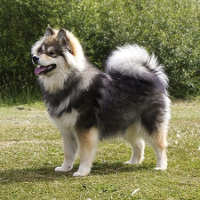
| Smaller than medium sized, the conformation is strong for the size, slightly longer than the height at the withers. Long and thick coated dog with pricked ears. |
Important proportions |
| The depth of the body is slightly less than the half of the height at the withers. The muzzle is slightly shorter than the skull. The skull is slightly longer than broad, the depth is the same as the breadth. |
Behaviour / temperament |
| Keen, courageous, calm and willing to learn. Friendly and faithful. |
Head |
||
Cranial region |
||
Head |
Strong in outline, rather broad. | |
Skull |
Broad, slightly convex. The forehead is rather domed. The frontal furrow is clearly defined. | |
Stop |
Clearly defined. | |
Facial region |
||
Nose |
Preferably black, yet harmonizing with the coat colour. | |
Muzzle |
Strong, broad and straight; viewed from above and in profile evenly, but only slightly tapering. | |
Lips |
Tight. | |
Jaws and teeth |
The jaws are strong. Scissor bite. | |
Cheeks |
The zygomatic arches are clearly marked. | |
Eyes |
Dark brown in colour, yet harmonizing with the coat colour; oval shaped. The expression is soft and friendly. | |
Ears |
Medium sized, carried erect or semi-erect, set rather apart, rather broad at the base, triangular in shape and very mobile. | |
Neck |
| Medium in length, strong and covered with profuse hair. |
Body |
||
Withers |
Muscular and broad, slightly marked. | |
Back |
Strong and straight. | |
Loin |
Short and muscular. | |
Croup |
Of medium length, well developed, only slightly oblique. | |
Chest |
Deep, rather long, reaching almost to the elbows, not very broad. The ribs are slightly arched; the forechest clearly visible, not very strong. | |
Underline and belly |
Slightly tucked up. | |
Tail |
| Set rather high, medium in length, covered with profuse and long hair. The tip of the tail may have a J-formed hook. In movement the tail is curved over the back or side, in rest it may hang. |
Limbs |
Forequarters |
||
Generality |
Powerful with strong bones. Viewed from the front straight and parallel. | |
Shoulders |
Slightly oblique. | |
Upper arm |
As long as the shoulder blade. The angle between shoulder and upper arm is rather open. | |
Elbows |
Placed slightly lower than the lower edge of the ribcage, pointing straight backwards. | |
Forearm |
Rather strong, vertical. | |
Carpal |
Flexible. | |
Pastern |
Of medium length, slightly oblique. | |
Forefeet |
Well arched, oval rather than round, covered with dense hair. The pads are elastic with the sides covered with dense hair. | |
Hindquarters |
||
Generality |
Strong boned, powerful, viewed from behind straight and parallel. The angulation is clearly marked but not too strongly. | |
Upper thigh |
Of medium length, rather broad with well developed muscles. | |
Lower thigh |
Relatively long and sinewy. | |
Stifle |
Pointed forward, the angulation is rather clearly marked. | |
Metatarsus |
Rather short, strong and vertical. | |
Hock |
Moderately low set; the angulation is clearly marked but not too strongly. | |
Hind feet |
As front feet. Dewclaws are not desirable. | |
Gait and movement |
| Effortless. Changes easily from trot to gallop, which is the most natural style of movement. The legs move parallel. When working agile and fast. |
Skin |
| Tight overall without wrinkles. |
Coat |
||
Hair |
Profuse, especially the males have an abundant mane. The outer coat is long, straight and harsh. On the head and on the frontside of the legs the coat is shorter. There has to be an undercoat that is soft and dense. | |
Colour |
All colours are permitted. The basic colour must be dominant. Colours other than the basic colour can occur on head, neck, chest, underside of the body, on legs and tail. | |
Size and weight |
||
Height at withers |
Ideal height for males 49 cm, ideal height for females 44 cm. With a tolerance of ± 3 cm. The type is more important than the size. | |
Faults |
| • Any departure from the foregoing points should be considered a fault and the seriousness with which the fault should be regarded should be in exact proportion to its degree and its effect upon the health and welfare of the dog and its ability to perform its traditional work. • Faults listed should be in degree of seriousness. |
General faults |
 Males not masculine and females not feminine. Light head. Insufficient stop. Drop-ears. Tail carriage continuously lower than the topline. Over angulated or too straight rear angulation. Lack of under coat. Flat coat. Curly outer coat. Basic colour indistinct. Males not masculine and females not feminine. Light head. Insufficient stop. Drop-ears. Tail carriage continuously lower than the topline. Over angulated or too straight rear angulation. Lack of under coat. Flat coat. Curly outer coat. Basic colour indistinct. |
Disqualifying faults |
| Aggresive or overly shy. Overshot or undershot mouth. Kinky tail. |
NB : |
| • Any dog clearly showing physical or behavioural abnormalities shall be disqualified. • The above mentioned faults when occurring to a highly marked degree or frequently are disqualifying. • Male animals should have two apparently normal testicles fully descended into the scrotum. • Only functionally and clinically healthy dogs, with breed typical conformation should be used for breeding. |
Bibliography |
| https://www.fci.be/ |



 English (United Kingdom)

Comments