 |
Great Gascony Blue |
|
FCI standard Nº 22 |
||
Origin |
France | |
Translation |
Mrs. Peggy Davis | |
Group |
Group 6 Scenthounds | |
Section |
Section 1.1 Large-sized Hounds | |
Working |
With working trial | |
Acceptance on a definitive basis by the FCI |
Saturday 10 August 1963 | |
Publication of the official valid standard |
Wednesday 24 January 1996 | |
Last update |
Tuesday 18 February 1997 | |
En français, cette race se dit |
 |
Grand bleu de Gascogne |
Diese Norm ist in deutscher Sprache sichtbar |
 |
Grosser Blauer Gascogne Laufhund |
En español, esta raza se dice |
 |
Gran Sabueso azul de Gascuña |
In het Nederlands, wordt dit ras gezegd |
 |
Grand bleu de Gascogne |
Usage |
| Scenthound used for hunting with the gun and sometimes for coursing big game, but also hare hunting, generally in a pack or individually as a tracking hound. |
Brief historical summary |
| He is of a very old breed; contemporary of the St.Hubert-Hounds he composed, in the 14th century, the packs of Gaston FEBUS, Comte (count) de Foix who used him to hunt the wolf, the bear or the boar. Very widespread in the South (midi) and South-West of France, particularly in Gascony, from where he takes his name; he is at the origin of all the scenthounds named « from the South » (du midi). |
General appearance |
| Ancient breed of dog, of outstanding French type when it comes to the head, the coat and the expression. Imposing, giving an impression of calm strength and of great nobleness. |
Behaviour / temperament |
| Very fine nose; endowed with a sonorous howling voice, with deep tones. Very intent in his way of hunting. Instinctively a pack hound. Temperament calm; obeys orders easily. |
Head |
||
Cranial region |
||
Skull |
Seen from the front, slightly domed and not too broad; the occipital protuberance is marked. Seen from above, the back of the skull is ogival in shape. The forehead is full. | |
Stop |
Slightly accentuated. | |
Facial region |
||
Nose |
Black, well developed; nostrils well opened. | |
Muzzle |
Of equal length to that of the skull; strong; nasal bridge slightly arched. | |
Lips |
Quite drooping, covering well the lower jaw, giving the front part of the muzzle a square profile. The corner of the lips is well marked without being loose. | |
Jaws and teeth |
Scissor bite. Incisors set well square to the jaws. | |
Cheeks |
Lean; the skin shows one or two folds. | |
Eyes |
Oval shape; appear slightly sunken beneath thick eyelids; brown. The lower lid sometimes shows a certain looseness. Expression gentle and a little sad. | |
Ears |
Characteristic of the « blue dog » : they are fine, curled in, ending in a point and must reach beyond the extremity of the nose. The leather is narrow at its base which is situated well below the eyeline. | |
Neck |
| Moderately long; slightly arched; dewlap developed. |
Body |
||
Back |
Rather long but well supported (firm). | |
Loin |
Well fused. | |
Croup |
Slightly sloping, emphasizing the haunches. | |
Chest |
Long, broad; let down to elbow level. Forechest broad. Ribs moderately rounded and long. | |
Side |
Flat and well let down. | |
Tail |
| Rather thick, sometimes there may be some longer and coarser, slightly offstanding hairs (like ears of grain) towards the tip; reaching the point of the hock; strong at its root; carried sabre fashion. |
Limbs |
Forequarters |
||
Generality |
Powerful forehand. | |
Shoulders |
Quite long and muscled, well sloping. | |
Elbows |
Close to the body. | |
Forearm |
Strong bone structure; tendons prominent. | |
Hindquarters |
||
Generality |
Solidly built. | |
Upper thigh |
Long and muscled. | |
Hock |
Broad, slightly bent, well let down. | |
Feet |
| Of a slight elongated oval; toes lean and tight. Pads and nails black. |
Gait and movement |
| Regular and easy. |
Skin |
| Quite thick, supple. Black or strongly mottled with black patches, never entirely white. Mucous membranes (hairless zones) black. |
Coat |
||
Hair |
Short, quite thick; very dense. | |
Colour |
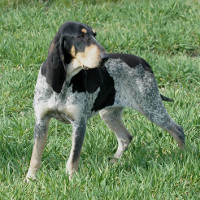
Entirely mottled (black and white) giving a slate blue colouring effect; either marked or not with more or less extended black patches. Two black patches are generally placed at either side of the head, covering the leathers, surrounding the eyes and stopping at the cheeks. They do not meet up on the top of the skull; they leave a white interval in the middle of which there is often a small black oval spot, typical of the breed. Two more or less bright tan markings are placed above the superciliary arches giving a « quatreoeillé » appearance to the eyes. There are also traces of tan on the cheeks, lips, inner face of the leathers, on the legs and under the tail. |
|
Size and weight |
||
Height at withers |
Males 65 to 72 cm, females 62 to 68 cm. | |
Faults |
| • Any departure from the foregoing points should be considered a fault and the seriousness with which the fault should be regarded should be in exact proportion to its degree and its effect upon the health and welfare of the dog and its ability to perform its traditional work. • Faults listed should be in degree of seriousness. |
General faults |
Head : Too short. Skull too flat or too narrow. Leathers set high, short, insufficiently curled in. Too short. Skull too flat or too narrow. Leathers set high, short, insufficiently curled in.Body : Lack of substance. Slack (soft) back. Rump falling away.Tail : Deviated tail.Limbs : Bone structure insufficiently developed. Straight shoulder. Splayed feet. Cow hocks, seen from behind.Coat (Hair) : Too fine and short.Behaviour : Timid subject. |
Disqualifying faults |
| Frightened or aggressive subject. Lack of type. Visible disabling (invalidating) defect. Serious anatomical malformation. Over- or undershot mouth. Light eye. Any coat other than that indicated in the standard. |
NB : |
| • Any dog clearly showing physical or behavioural abnormalities shall be disqualified. • The above mentioned faults when occurring to a highly marked degree or frequently are disqualifying. • Male animals should have two apparently normal testicles fully descended into the scrotum. • Only functionally and clinically healthy dogs, with breed typical conformation should be used for breeding. |
Bibliography |
| https://www.fci.be/ |
Additional information from visitors |
| With origins tracing back to ancient times, the Grand Bleu de Gascogne is one of the oldest scenthounds introduced to France by Phoenician merchants. Established in the Midi region during the Middle Ages as a superb hunter of wolves, boars, deers and other large game, this massive hound eventually became rare in its native land, due in part to the disappearance of wolves. However, its popularity soared in America in the 1700's and the Large Blue Gascony Hound remains more common in the U.S. than France to this day. This powerful breed is a hard working, resilient and tenacious hunter, valued for its stamina and reliable temperament. The Grand Bleu works equally well as a single gundog and as a pack hound, but it is its intelligence and loyalty that make it an amenable companion when raised and handled properly. Muscular, well-boned and reasonably athletic, this is a healthy and longlived breed, some specimens reportedly reaching over 15 years of age. The weatherproof coat is thick and flat. Although black and blue shades were the most prized in France in the past, the majority of modern dogs come in a range of mottled and blue merle tricolor shades with tan and white markings. Average height is around 27 inches. |
Detailed history |
| The Grand Bleu de Gascogne, this proud and numerous breed, is a breed that was set well before those of Anglo-French and Poitevin. However, as for the majority of the current dogs, its origin is still subject to disputes among specialists. Indeed, if one refers to ancient writings, it appears that the type of Gascon dog was defined by Gaston Phoebus, Count of Foix, the famous author of the Book of the hunt (1387), but, as far as to know which were the ancestors of this very beautiful current dog, opinions remain divergent. It may be recalled that, in 1357, Phoebus made a warlike expedition to East Prussia (now Poland), returning from which he passed through the Abbey of St. Hubert in Belgium, known in particular for his famous dogs of St. Hubert, who included two varieties, the whites and the blacks. The Great Blues of Gascony are very close to these black Saint-Hubert, but it is nevertheless difficult to assert that it is the monks who have exclusively provided to Gaston Phoebus the strain of his race, because it is also possible that certain broods have been reported by the lord of Bearn, after his Teutonic campaign: if we know that the prince with the lion's mane manifested to his lieutenant Corbeyran of Rabat all his interest in "superb dogs with silver fur" in With whom the reindeer and the eland on the other side of the Baltic were hunted, it may be supposed that they played a part in the constitution of the Gascon race. But there is another hypothesis, linked to the history of Belgium, which does not exclude the preceding ones: the bishop of Tongeren and Liege, who was beatified and became patron of the hunters, was apparently he, from Aquitaine, where he left with his dogs to evangelize Belgium (he died in Liege in 727). Thus, Gascon dogs could be the ancestors of Saint-Hubert, and not the other way around. However, the archives of the time do not allow to settle the question, because one can not know with precision which lice was covered by which stallion, and, in any case, the truth is undoubtedly between the different versions. Still, these dogs were brought back from the Ardennes and Phoebus crossed them with races of uncertain origins, found in Bearn, and perhaps also with dogs of "Barbary" (North West Africa). ), these light-colored "Baux dogs" which, from Morocco to Tunisia, were then used to force the "rangier", in other words the breed of deer present throughout the Maghreb. It is certain, indeed, that the fancy of the huntsmen of the fourteenth century, who were more preoccupied by the huntsmanship of their dogs than by the prices they could have won in dog shows; which were created anyway only several centuries later; resulted in very different crosses. So, there was no approved standard. Nevertheless, nowadays, the Gascon breeds are well determined. Thus, the Big Blue is one of the largest current dogs, with a size that was between 64 and 75 cm at the beginning of the century, and that is now limited to 65-72 cm for males and 62-68 cm for the lists. His great nose and the way he sticks to the track make him an excellent match. When the wolves still roamed the forests of the Landes, Gironde and Lot-et-Garonne, the Great Blues rendered immense services to the crews specialized in the hunting of this enduring animal but hardly cunning; medium-fast dogs, stubborn and stuck to the track, were perfect for stalking him, even if they only took him two or three days later. In 1863, if we believe the great huntsman that was the Couteulx de Canteleu, the pack of Baron Ruble, kept in the same family since Henry IV, remained one of the most beautiful in France for hunting the wolf's. But the way of the hare also suited the Great Blues of Gascony very well, as testified in particular the pack of Mr. Leo Ducasse (where one found besides products of that of the baron of Ruble), which took between 60 and 70 hares a year in Gironde, in the region of Langon, between 1860 and 1870; everyone who has hunted hare knows what such a performance can mean! Albert de Mérignac also used Gascons, sometimes crossed with Saintongeois, to hunt hare and deer in Aquitaine, and we must not forget that he was one of those whose pack was well known at the end of the last century. A few decades later, we find the dog of Gascony in the path of the hare, especially at the Merrein rally, the Rimbez rally or the Pindères rally. The first, Mr. Cruze, has now returned to the path of deer, and the boatswain crossed his dogs with Saintongeois. Messrs. de Lacaze, son of the founder of the Pindères rally, preferred to cross their Grands Gascons with Virelades, as well as with Gascons-Saintongeois of M. de Mérignac, to hunt hares in the Lot-et-Garonne. The Rimbez rally, which was founded in 1880, did not begin to exhibit his dogs until 1911, when they were already mastered by Saintongeois, which did not prevent the crew from taking between 25 and 30 hares by season, in the Landes. Today, the Bleu de Gascogne is still in the packs of Aquitaine, but it is hardly used there for the re-lapse. If some crews declare officially employ Gascons, it seems, to hear Mr. Bachala, president of the Club, that there is hardly any French decoupling crew of big current dogs whose pack has no Gascon blood in the veins. And, when asked if any of these great dogs are for sale, the answer is that adults have no price. If, from a morphological point of view, the few crossings have differentiated the Great Blues of Gascony from the black Saint-Hubert, in terms of behavior, especially in hunting, the two races appear very close. These are particularly moderately fast dogs, but very fine nose and very catchy, and this is what made the Gascons were excellent; and so much appreciated by Henry IV; in the wolf hunt, for which dogs must have skills that are not those of English dogs, fast but easily discouraged in the face of difficulty. Thus, the pack of the duke of Beaufort, which was renamed in England at the end of the last century, knew of bitter chess while trying to hunt the wolf, during a displacement in Haut-Poitou in 1863. Viscount of the Besge, who attended these hunts (and who hunted with Poitevins as for him), specifies that, to take the wolf and the louvards, it is necessary "special dogs endowed with an exquisite nose, a big foot and a inexhaustible background. All these qualities, the Great Blue Gascony possesses them, and it is able to raise delicate defects by the driest weather, even on the roads where the dust generally makes the dogs unfit to feel any way of game. In addition, the Gascon has a very beautiful voice, most often centered in low tones. And, if the louvards that took M. de Ruble with the Great Gascons have now disappeared from our territory, these dogs are still used in the path of deer, hare and even wild boar. Today, they are found in most parts of France, although they are often mixed Saintongeois or French dogs of various origins, as is for example the case of the rally Varena rally that chases the roe deer in the Dordogne. In the Lot-et-Garonne, Piqu'avant les Bleus has chosen a name that has no doubt about the breed of dogs with which he intends to hunt also deer: a noble and old breed that has maintained the qualities of his ancestors. |



 English (United Kingdom)

Comments