 |
Jämthund |
|
FCI standard Nº 42 |
||
Origin |
Sweden | |
Translation |
Mrs. Renée Sporre-Willes | |
Group |
Group 5 Spitz and primitive types | |
Section |
Section 2 Nordic Hunting Dogs | |
Working |
With working trial only for the Nordic countries (Sweden, Norway, Finland) | |
Acceptance on a definitive basis by the FCI |
Sunday 03 January 1954 | |
Publication of the official valid standard |
Wednesday 04 September 2019 | |
Last update |
Monday 28 October 2019 | |
En français, cette race se dit |
 |
Chien d'élan suédois |
Diese Norm ist in deutscher Sprache sichtbar |
 |
Schwedischer Elchhund |
En español, esta raza se dice |
 |
Perro cazador de alces sueco |
In het Nederlands, wordt dit ras gezegd |
 |
Jämthund |
In his country of origin, his name is |
Jämthund |
Usage |
| Hunting dog. Mainly used for hunting elk, but also used for hunting bear and boar. |
Brief historical summary |
| The Jämthund was only officially recognized in 1946, although it is a very ancient type of dog that has been known since the North of Sweden was populated. The reason forthe late recognition is that the smaller Norwegian Elkhound and the Jämthund were judgedas the same breed. This situation eventually turned out to be impossible. The Jämthund is mainly used for hunting elk but it is also used for bear, boar and lynx. The breed is expected to, under considerable time intensely, bay the game which requires dogs with great strength and endurance. |
General appearance |
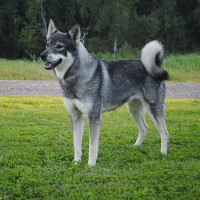
| Large, rectangular spitz, clean-cut, strong, substantial but also agile and with a good stature. Body must not give the impression of being long, nor be too heavy. |
Behaviour / temperament |
| Courageous and energetic but also stoically calm. |
Head |
||
Cranial region |
||
Head |
Clean-cut and longish, proportionally broad between the ears. | |
Skull |
Slightly arched. | |
Stop |
Well defined but not too deep. | |
Facial region |
||
Nose |
Black, wide with well opened nostrils. | |
Muzzle |
Muzzle, measured from stop to nose, slightly shorter than from stop to occiput. Evenly tapering towards tip of nose. Muzzle must not be snipy, neither when viewed from above or from the side. | |
Lips |
Tight fitting. | |
Nasal bridge |
Nasal bridge straight, broad and strong, nose wide. | |
Jaws and teeth |
Scissors bite. | |
Cheeks |
Muscled but not overly bulging. | |
Eyes |
Slightly oval in shape, brown with keen but calm expression. | |
Ears |
High set, perfectly erect, pointed and sensitive in use, slightly longer than width at base. Inside of ears well covered with hair. | |
Neck |
| Long, clean-cut, powerful with good reach. |
Body |
||
Body |
Powerful and clean-cut, slightly longer than height at withers. | |
Back |
Straight and slightly sloping from withers to croup. | |
Loin |
Broad and well developed. | |
Croup |
Broad and only slightly sloping. | |
Chest |
With good depth and well sprung ribs. | |
Underline and belly |
Belly slightly tucked up. | |
Tail |
| Set high, of medium length and of even thickness. Carried lowin a loose curl, over the thigh. Densely coated, but without fringe. |
Limbs |
Forequarters |
||
Shoulders |
Shoulder blade long, well laid back. | |
Elbows |
Close to chest. | |
Forearm |
Straight, clean-cut and with strong bone. | |
Pastern |
Strong with slight slope. | |
Forefeet |
Strong, somewhat oval, pointing straight forward with tightly knit toes. | |
Hindquarters |
||
Generality |
Parallel when viewed from behind. | |
Upper thigh |
Broad and well-muscled. | |
Lower thigh |
Strong and well-muscled. | |
Stifle |
Noticeably well angulated. | |
Metatarsus |
Strong and not set too high. | |
Hock |
Noticeably well angulated. | |
Hind feet |
Strong, somewhat oval, pointing straight forward with tightly knit toes. | |
Gait and movement |
| Powerful, free, with good reach. On the trot, almost «single tracking». |
Coat |
||
Hair |
Topcoat rather close lying but not flat. Undercoat short, soft, light, preferably cream coloured. Coat smooth on head and front of legs, longer on neck, chest, tail and backside of legs and thighs. | |
Colour |
Lighter and darker grey. Characteristic markings : light grey or cream coloured on sides of muzzle, cheeks, throat, chest, belly, legs and under the tail. | |
Size and weight |
||
Height at withers |
Size for dogs 57-65 cm, ideal 61 cm. Size for bitches 52-60 cm, ideal 56 cm. | |
Faults |
| • Any departure from the foregoing points should be considered a fault and the seriousness with which the fault should be regarded should be in exact proportion to its degree and its effect upon the health and welfare of the dog and its ability to perform its traditional work. • Faults listed should be in degree of seriousness. |
General faults |
 Yellow eyes. Domed forehead and bulging cheeks. Twisted tail, tail too short, too loose and not touching the back. Unbroken, well defined white strip on throat down to point of sternum, so called « tie ». Lack of typical light markings on throat and brisket. Coat overlaid with black giving a sooty appearance. Yellow eyes. Domed forehead and bulging cheeks. Twisted tail, tail too short, too loose and not touching the back. Unbroken, well defined white strip on throat down to point of sternum, so called « tie ». Lack of typical light markings on throat and brisket. Coat overlaid with black giving a sooty appearance. |
Serious faults |
| Thin and under-developed lower jaw. Snipy muzzle. Missing teeth, other than PM1 and M3. Deviating proportions, tending square body shape. Thin or too heavy in built. Thin bone. Flat and splayed feet. Insufficient angulation in front and/or rear. Thin, whip-like tail. Coat too short or open. |
Disqualifying faults |
| Aggressive or overly shy. Over- or undershot bite. Hanging ears. Lack of characteristic cream coloured markings on muzzle and cheeks. Height at withers other than stated in the standard. |
NB : |
| • Any dog clearly showing physical or behavioural abnormalities shall be disqualified. • The above mentioned faults when occurring to a highly marked degree or frequently are disqualifying. • Male animals should have two apparently normal testicles fully descended into the scrotum. • Only functionally and clinically healthy dogs, with breed typical conformation should be used for breeding. |
Bibliography |
| https://www.fci.be/ |
Detailed history |
| Called Dog Gray Elk Great in France, country in which there is no copy, the Jâmthund is native of Sweden. Its origins are lost in the mists of time, and dog collectors generally agree that his ancestors were the companions of men of the Paleolithic era. In his home country, Jâmthund has always been used as a hunting dog. Elks were once very numerous in Scandinavia, and they were all the more hunted as they constituted an important food resource. With a flair of the first order, the Jâmthund was very soon held in high esteem by the population. He spotted the momentum from very great distances, approaching it according to the dog's tactics, without frightening or attacking him, merely attracting his attention by serious barking and feigned attacks. When the momentum decided to rush on him, the dog was gradually folding it towards the guns of the hunters, who, guided by the barking, could approach. Some exceptional subjects were once used to stalk the bear. Nevertheless, as a general rule, Jâmthund does not have enough bite and nerve impulses to be used in this type of hunt. Nowadays, moose hunting is severely regulated in the Scandinavian countries, the Jâmthund is used as a watchdog for goods or herds, and its staff remain more confidential, much less important than those of the Norwegian Elkhound , his close relative in the Spitz family. In a Swedish book on Scandinavian dogs, Rune B. Samuelsson and Uho Perttola recognize that current production from livestock is uneven. According to them, there would be important variations between the different lines, and all the crosses practiced would not give complete satisfaction to the users. Some subjects would not have the constitution to hunt. Others would seem to have lost their instinct. These authors insist, however, that there are still serious breeders producing subjects that their brave ancestors would not deny. Apart from his aptitude for hunting, the Jamthund is a pleasant companion, with lively intelligence. Balanced, proud and obedient, he is very attached to his teachers. |



 English (United Kingdom)

Comments