
 |
Polish hound |
|
FCI standard Nº 52 |
||
Origin |
Poland | |
Translation |
Związek Kynologiczny w Polsce (EN). Revised by Renée Sporre-Willes | |
Group |
Group 6 Scenthounds and related breeds | |
Section |
Section 1.1 Large sized Hounds | |
Working |
With working trial | |
Acceptance on a definitive basis by the FCI |
Friday 29 January 1965 | |
Publication of the official valid standard |
Monday 03 November 2014 | |
Last update |
Wednesday 27 May 2015 | |
En français, cette race se dit |
 |
Brachet polonais |
Diese Norm ist in deutscher Sprache sichtbar |
 |
Polnische Bracke |
En español, esta raza se dice |
 |
Sabueso polonés |
In het Nederlands, wordt dit ras gezegd |
 |
Poolse Brak |
In his country of origin, his name is |
Ogar Polski |
Usage |
| Scent Hound. In the past, the Polish Hounds were used mainly for hunting hares, foxes, roe deer, wild boar and during duck hunting, flushing wild ducks from rushes. Nowadays, since hunting hare with dogs is prohibited in Poland (except for mountain areas), Polish Hounds are used only for hunting wild boar and fox throughout the country. |
Brief historical summary |
| The Ogar is an old-established Polish breed. The first reports on hunting with dogs in Poland are found in the ‘Chronicles’ of Gallus Anonymous dating from the 11th century. In chronicles of the 14th century it is mentioned that ogar hounds were bred specifically for the royal hunt. The name ogar is found in the Book on Rural Arts by Piotr Krescentyn published in Cracow in 1549 and in The Life of an Honest Man by Mikołaj Rej from 1568. In 1618, the Cracovian publishing house issued Hunting with Ogar hounds by count Jan Ostroróg, the voivode of Poznań. This work may be considered the first Polish cynological guide, containing the principles of rational breeding. The first description of the Polish (Ogar) Hound is found in the book: ‘The beginnings of the natural history and farming of the national domestic and wild animals’ by Krzysztof Kluk (1779). In the 19th century, many Polish as well as German and Russian publications appeared, describing Polish Hounds in detail. The etymology of the word Ogar is not clear. Different authors claim different origins of the word. According to Sztolcm an and Gerald-Wyżycki, Ogar originated from the Polish word ‘ogorzały’ (‘tawny’), describing the Polish Hound’s colour. In Mann’s opinion, it might have derived from the word ‘grać’ ‘to give tongue’ which defines the characteristic barking on the trail; while Frankiewicz explained it with Czech word ‘ohař’, meaning ‘the pointing dog’. Polish Hounds were very popular and they have found their rightful place in the literature. They can be found on engravings: ancestral and urban emblems, coats of arms, seals, ex-librises and in the paintings of 18th and 19th century as well. Polish Hounds were exhibited at dog shows already in the 19th century. Poland was under occupation at that time and the Polish Hounds were bred in kennels of Polish nobility on the territory annexed by Russia. Poland regained its independence after 123 years of occupation, after the Great War in 1918. The hunting with hounds outlasted only in residual forms in the territory of Easter Borderlands, i.e. in the regions of Polesie, Wołyń and Vilnius. After the World War II, Poland had lost the Easter Borderlands together with the mainstay of Polish Scent Hounds. There were practically no Polish Hounds bred within the new borders of the country. In 1959, colonel Piotr Kartawik imported the first four Polish Hounds from his homeland (nowadays Belarus territory) and established the first Polish Hound kennel in the post-war history with the kennel name ‘z Kresów’ (‘from the Borderlands’). In 1964, on the basis of the Kartawik’s ‘z Kresów’ dogs, engineer Jerzy Dylewski wrote the first standard of the Polish Hound breed that was included in the FCI register on 15 November 1966 under the number 52. |
General appearance |
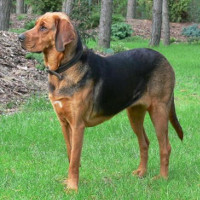
| Medium size hound of muscular, rather heavy build, ensuring endurance but not speed. |
Important proportions |
| The outline is rectangular, the length of body slightly greater than the height at the withers. Height to elbow corresponds to half the height at the withers or slightly more. Skull and muzzle is of equal length. |
Behaviour / temperament |
| The Polish Hound, like all scent hounds, chase the game on the hot trail, with loud barking. The voice is lower pitched in the male and higher in the female. The barking is called “giving tongue” by hunters, and the loud game pursuit by the dogs is described as “the chase”. This outstanding hunting dog is also an excellent family dog, easy to maintain, devoted to the household and wary of strangers. |
Head |
||
Cranial region |
||
Head |
Quite heavy. In profile looks like a medium length rectangle. Top of muzzle nearly parallel with line from stop to occiput. | |
Skull |
Broad, moderately arched between ears, superciliary ridges well developed, occipital crest well pronounced. | |
Stop |
Well defined. | |
Facial region |
||
Nose |
Large, wide and dark. | |
Muzzle |
Elongated; seen from the side deep and truncated at the tip. Nose bridge straight. | |
Lips |
Upper lip thick and drooping; lip corners in folds. | |
Jaws and teeth |
Jaws strong, teeth white, complete scissors bite. | |
Cheeks |
Fleshy. | |
Eyes |
Slightly slanting, not very deep-set, dark brown, with gentle expression, lower lid might be slightly loose in older dogs. | |
Ears |
Pendulous, set quite low, of medium length and width, slightly rounded at tip. Front edges of earlobes are turned towards cheeks and hang close to them. | |
Neck |
| Neck of medium length, with straight line of nape, muscular, quite thick, especially at the base, skin is loose and forms folded dewlap. |
Body |
||
Topline |
Straight. | |
Withers |
Well defined. | |
Back |
Long, broad and well muscled. | |
Loin |
Relatively short. | |
Croup |
Broad, muscular, quite long, slightly rounded. | |
Chest |
Deep, reaching elbows, moderately wide and capacious. True and false ribs long, well sprung, set almost vertically. | |
Underline and belly |
Belly not tucked up. Flanks short and well filled. | |
Tail |
| Thick, rather low set, hanging reaches slightly below hock, slightly curved. In slow movement, slightly raised but not curled over back. While chasing, the dog carries the tail below the top line and slightly turned aside. Underside covered with longer hair. |
Limbs |
Forequarters |
||
Generality |
Forequarters of strong bone, well muscled. Seen from the front straight, set parallel; forearms seen from the side set vertically. | |
Shoulders |
Shoulder blade long, oblique, well muscled. Shoulder blade forms an angle of 100o with the upper arm. | |
Upper arm |
Of medium length, oblique. | |
Elbows |
Lying closely to the body, turns neither in nor out. | |
Forearm |
Of strong bone and elastic tendons. | |
Carpal |
Wide, without thickenings and any symptoms of rickets. | |
Pastern |
Quite short and set slightly oblique. | |
Forefeet |
Very tight, round, toes well knit, with firm pads. Nails are strong, thick, black or horn coloured when the toes are white. | |
Hindquarters |
||
Generality |
Seen from the side set slightly backwards, seen from the rear straight and parallel. | |
Upper thigh |
Long, broad, with well developed muscles. The angle of the coxo-femoral joint is of about 100o. | |
Lower thigh |
Moderately long, of strong bone structure, well muscled, oblique. | |
Stifle |
Well angulated. | |
Metatarsus |
Quite long, almost vertical. | |
Hock |
Well angulated, with strong heel bone. | |
Hind feet |
Very tight, round, toes well knit, with firm pads. Nails are strong, thick, black or horn coloured when the toes are white. | |
Gait and movement |
| Slow trot. While chasing, not a very fast gallop. |
Skin |
| On trunk and limbs smooth and tight; forms wrinkles on forehead. Dewlap hangs in folds. |
Coat |
||
Hair |
On head, muzzle, ears and limbs short and smooth. On other parts of the body the coat is of medium length, thick and hard. It is a little longer on nape, buttocks and underside of the tail. Undercoat is dense and soft. | |
Colour |
Dark saddle and tan. Black or dark grey hair forms a saddle, covering the whole nape, overlapping to back of head, covering back completely, both sides of body and top of tail. Different shades of tan ranging from dark yellow to mahogany on head, especially above eyes, muzzle, ears, front of neck, shoulders, forechest, under belly, thighs, front and hind legs. Ears are always of a darker shade of tan. Permissible amount of white: white blaze on head and nose bridge, white spot on chest, white on legs or on toes only, as well as white tip of tail. | |
Size and weight |
||
Height at withers |
Males : 56–65 cm. Females : 55–60 cm. | |
Weight |
Weight should be proportional to height at withers and the whole conformation. | |
Faults |
| • Any departure from the foregoing points should be considered a fault and the seriousness with which the fault should be regarded should be in exact proportion to its degree and its effect upon the health and welfare of the dog and its ability to perform its traditional work. • Faults listed should be in degree of seriousness. |
Disqualifying faults |
 Aggressive or overly shy dogs. Untypical specimen. Aggressive or overly shy dogs. Untypical specimen. |
NB : |
| • Any dog clearly showing physical or behavioural abnormalities shall be disqualified. • The above mentioned faults when occurring to a highly marked degree or frequently are disqualifying. • Male animals should have two apparently normal testicles fully descended into the scrotum. • Only functionally and clinically healthy dogs, with breed typical conformation should be used for breeding. |
Bibliography |
| https://www.fci.be/ |



 English (United Kingdom)

Comments