 |
Westphalian Dachsbracke |
|
FCI standard Nº 100 |
||
Origin |
Germany | |
Translation |
C.Seilder | |
Group |
Group 6 Scenthounds and related breeds | |
Section |
Section 1.3 Small sized hounds | |
Working |
With working trial | |
Acceptance on a definitive basis by the FCI |
Monday 29 November 1954 | |
Publication of the official valid standard |
Wednesday 24 June 1987 | |
Last update |
Tuesday 06 May 1997 | |
En français, cette race se dit |
 |
Basset de Westphalie |
Diese Norm ist in deutscher Sprache sichtbar |
 |
Westfälische Dachsbracke |
En español, esta raza se dice |
 |
Perro tejonero de Westfalia |
In het Nederlands, wordt dit ras gezegd |
 |
Westfaalse Dasbrak |
Usage |
| Hound. |
General appearance |
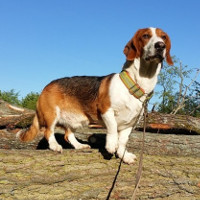
| The Westphalian Dachsbracke is the short-legged variety of the German Hound (Bracke). It corresponds in essential points with the longlegged variety, but gives a compacter, more powerful impression than the former. The Westphalian Dachsbracke is a moderately long, sturdily built, hunting dog, standing 30-38 cm high, with noble head of medium size andwell set on tail which, in quiet movement, is carried upwards in sabre shape or pendant with slight curve at the tip. Facial expression is faithful, friendly, serious and alert. |
Head |
||
Cranial region |
||
Head |
Seen from the front, the head appears, as with the German Hound, narrow and elongated. The occiput protrudes only slightly. | |
Skull |
The skull is only marginally broader than the cheeks. | |
Stop |
Minimal. | |
Facial region |
||
Nose |
The leather has a light, almost flesh coloured strip over the center, while the nose wings have more or less dark pigment. | |
Lips |
Moderately overlapping. | |
Nasal bridge |
Bridge of nose slightly arched. | |
Jaws and teeth |
Dentition extremely strong and even. Incisors are either level (level bite) or the inside of the upper incisors may rub against the outside of the lower incisors (scissor bite). The canines are specially strongly developed. The fold of the mouth is small. | |
Eyes |
Dark, clear, with friendly expression. | |
Ears |
Medium length, broad, close fitting, blunty rounded at tips. | |
Neck |
| Moderately long. Rather thick in relation to the head but getting gradually finer towards head. The skin of the neck is loose but without forming a dewlap. |
Body |
||
Back |
Slightly arched, medium length, with slight dip behind shoulders. | |
Loin |
Broad, strongly developed. | |
Croup |
Falls away obliquely. | |
Chest |
Narrower than with the Dachshund, strongly supported by the forelegs; should not too much let down between these. Ribcage long. | |
Underline and belly |
Belly slight tuck up in belly towards hindquarters. | |
Tail |
| Set on relatively high. The set of merges with the spine without forming any sharp angle. Very thick at root. The underside is bristly, the upper side has smooth hair and comes to a bristly tip without any tuft. |
Limbs |
Forequarters |
||
Generality |
Well developed, clean, heavy boned and sinewy. Front legs seen from front not bowed but straight with feet pointing forward. | |
Elbows |
Close fitting. | |
Hindquarters |
||
Generality |
Straighter than with most other breeds. Hind legs are far more strongly developed in relation to forelegs than with the Dachshound. | |
Upper thigh |
They have strong pronounced muscles, and, seen both from side and rear, stand almost straight. | |
Feet |
| Sturdy with tight short toes. |
Coat |
||
Hair |
The whole body, including the underside, with a very dense and coarse coat. Short on head, leathers and lower part of legs, longer over back, neck and underside of tail. | |
Colour |
Red to yellow with black saddle or mantle and the white « Bracken » markings : Blaze or snip, white muzzle and white collar, white chest, legs and tip of tail. Undesirable are bicoloured dogs as well as dogs with black markings on head. Chocolate brown is a fault. | |
Size and weight |
||
Height at withers |
30 - 38 cm. | |
Faults |
| • Any departure from the foregoing points should be considered a fault and the seriousness with which the fault should be regarded should be in exact proportion to its degree and its effect upon the health and welfare of the dog and its ability to perform its traditional work. • Faults listed should be in degree of seriousness. |
NB : |
| • Any dog clearly showing physical or behavioural abnormalities shall be disqualified. • The above mentioned faults when occurring to a highly marked degree or frequently are disqualifying. • Male animals should have two apparently normal testicles fully descended into the scrotum. • Only functionally and clinically healthy dogs, with breed typical conformation should be used for breeding. |
Bibliography |
| https://www.fci.be/ |
Detailed history |
| When we know that the Dachsbracke (German), variety called "mountain", or "montano-alpine", corresponds exactly to the Alpine Dachsbracke (Austrian), one wonders if a reordering of everything; breeds or varieties; what bears the name of Dachsbrake is not necessary. This neglect is certainly due to the fact that these are working breeds, rarely presented in exhibitions and to the public. The Westphalian Basset was officially introduced at the end of the nineteenth century. It results from the cross between the Dacshund (that is to say the Dachshund) and the Dachsbrake (German version). In some works, we can read that his ancestor is the German current dog or even the "pointer": in fact, it is the Bracke, and more precisely the Dachsbracke. This crossing was intended to produce a dog of an intermediate size, and in particular still able to hunt the fox to the ground despite a large size (more than 15 kilos). On the other hand, perfectly upright legs, longer limbs than those of the Dachshund give it a certain vivacity of pace, although it is disadvantaged in case of work on hilly terrain or very rough. Because of its heredity, this dog is therefore most versatile: able to hunt underground, as a bloodhound, as a dog of red, and to hunt the hare under cover giving voice. Although he is very little known outside hunting circles, we can add that he can also make a very good companion dog. His dress, mostly tricolor (black and fire with some white marks), is very pleasant. His character is no less so: he is calm, obedient, kind, patient. It would be a kind of Germanic Normandy Artesian Basset or a great tricolor Dachshund (it weighs nearly double the largest variety of Dachshund). It remains to be seen whether such a dog can hope for a large audience: even in his country, he is confidential. |



 English (United Kingdom)

Comments