Swedish Lapphund

FCI standard Nº 135

Origin
Suède
Translation
Renée Sporre-Willes / Original version (En)
Group
Group 5 Spitz and primitive types
Section
Section 3 Nordic Watchdogs and Herders
Working
Without working trial
Acceptance on a definitive basis by the FCI
Wednesday 19 January 1955
Publication of the official valid standard
Thursday 10 November 2011
Last update
Wednesday 22 February 2012
En français, cette race se dit
Lapphund suédois
Diese Norm ist in deutscher Sprache sichtbar
Schwedische Lapphund
En español, esta raza se dice
Perro Sueco de Laponia
In het Nederlands, wordt dit ras gezegd
Zweedse Lappenhond
In his country of origin, his name is

Svensk Lapphund

Usage

Reindeer herding dog, nowadays mainly kept as an all-round companion dog.

Brief historical summary

The Swedish Lapphund has been known in the Nordic area for centuries. It is a Nordic Spitz used in the past for reindeer herding, hunting and as a watchdog by the nomadic Laplanders. Nowadays it is mainly kept as a versatile companion dog.

General appearance

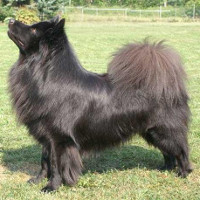
Typical Spitz dog of slightly less than medium size and with proud head carriage.

Important proportions

Rectangular body shape.

Behaviour / temperament

Lively, alert, kind and affectionate. The Lapphund is very receptive, attentive and willing to work. Its abilities as a good herding dog made it very useful in the reindeer trade. It is very versatile, suitable for obedience training, agility, herding, tracking, etc. It is easy to train, full of endurance and toughness.

Head

Cranial region

Skull
Slightly longer than broad; forehead rounded and occiput not clearly defined.  
Stop
Very well marked.

Facial region

Nose
Preferably charcoal black, very dark or in harmony with coat colour.
Muzzle
A little more than one third of the length of the head. Foreface strong, evenly tapering evenly towards tip of nose. Nose bridge straight.
Lips
Close fitting. Palate and lips strongly pigmented.
Jaws and teeth
Scissor bite with evenly set and well developed teeth.
Eyes
Set well apart, almost horizontal, round, fairly big, but not protruding. Brown, preferably dark brown and full of expression. Rims strongly pigmented.
Ears
Triangular, broad at base, small, pricked, tips slightly rounded. Set well apart and very mobile. Tipped ears are undesirable but not a disqualifying fault.

Neck

Medium length, clean-cut and powerful.

Body

Body
Well put together, slightly longer than height at withers.
Back
Level, strong, muscular and springy.
Loin
Short and broad.
Croup
Proportionally long and broad, slightly sloping and well muscled.
Chest
Rather deep reaching to elbow. Ribcage proportionally long and oval and with well-developed last ribs. Forechest well developed; well defined breastbone.
Underline and belly
Belly slightly tucked up.

Tail

Rather high set, reaching to hock joint when extended. Carried curled over back when the dog is moving.

Limbs

Forequarters

Generality
Forequarters should be sufficiently angulated at shoulders and elbows to provide good reach.
Shoulders
Shoulder blade well laid back.
Elbows
Fitting close to chest.
Forearm
Straight, strong and parallel, standing and moving.
Pastern
Sufficiently slanting.
Forefeet
Strong, oval, with tightly knit toes, hardy and elastic padding; well covered with fur also between pads. Nails and pads.

Hindquarters

Generality
Well angulated, but not exaggerated, in stifle and hock joint.
Upper thigh
Muscular.
Metatarsus
Dewclaws permissible.
Hock
Low-set to give power of propulsion.
Hind feet
As fore feet.

Gait and movement

Light and springy, covering ground, parallel with drive.

Coat

Hair
Profuse double coat. Hair standing straight out from body, undercoat dense and finely frizzy. Short hair on head and on front of legs. Longer hair on brisket, backside of legs and on tail. Bushy, long and dense on tail. Forming a ruff round neck. The coat is weather resistant.
Colour
Usually solid black; bronzing is typical as more or less ”bear-brown” shades. White on chest, on feet and tip of tail is permissible.

Size and weight

Height at withers
Ideal size for males : 48 cms. Ideal size for females : 43 cms. Allowance for +/- 3 cm.

Faults

• Any departure from the foregoing points should be considered a fault and the seriousness with which the fault should be regarded should be in exact proportion to its degree and its effect upon the health and welfare of the dog and its ability to perform its traditional work.
• Faults listed should be in degree of seriousness.

Disqualifying faults

 Aggressive or overly shy dogs.
 Untypical.

NB :

• Any dog clearly showing physical or behavioural abnormalities shall be disqualified.
• The above mentioned faults when occurring to a highly marked degree or frequently are disqualifying.
• Male animals should have two apparently normal testicles fully descended into the scrotum.
• Only functionally and clinically healthy dogs, with breed typical conformation should be used for breeding.

Bibliography

https://www.fci.be/


Detailed history

For many, Nordic dog equals sled dog. It is true that men in the polar regions have sometimes had only the dog as a domestic animal, so it is natural that they asked him to pull the sledge.

But we should not generalize. While the discovery of gold in Alaska and the exploration of the poles at the end of the nineteenth century helped to popularize this function, obviously reserved for Nordic dogs, the fact remains that they are also frequently used to more usual for the canine species: the guard, the management of herds, the hunt.

In Scandinavia, it is probably when the end of the ice age, about twelve thousand years ago, that appeared the first populations, in this case the Lapps. For centuries, these essentially nomadic people have lived through reindeer husbandry, which they also used as draft and pack animals, a role in which these deer were far superior to dogs. It is easy to understand that the Lapland dogs were mainly assigned to guard the large herds of reindeer, semi-domestic cattle, and their protection against wolves, bears and other predators.

The Sami dog is very old. For many specialists, it is even one of the oldest dog types: the ancestor of all Spitz, including European Spitz. Indeed, in the Varanger Peninsula, located in the far north of Norway, there is a canine skeleton, seven thousand years old, which has all the characteristics of Lapphund. We can therefore consider this dog as the essential link of one of the branches of the genealogy of the canine species, branch which originates from the polar wolf, characterized by its coiled tail.

From Lapphund, Spitz-type dogs, both Scandinavians and Europeans (formerly known as Loulous), from the Baltic Sea, which gave birth to Schipperke, Pinscher, and Schnauzer, are probably descended. The tail of these last two dogs also reveals their ancestry: if we did not cut them, it would be rolled up, like that of their ancestors Spitz. One can also think that several shepherd breeds have some Spitz blood in their veins.

Here is the dog of the Lapps placed among the ancestors of multiple races today. As such, it deserves to be included in any canine panorama claiming completeness. However, it can not be said that the Lapphund, whose exact name is Lapplândsk Spets (Swedish Dog of Lapland), has excited the enthusiasm of dog enthusiasts. Nevertheless, it already appeared, for example, in the work of veterinary doctor Heuillet Tous les chiens, published in 1934, and at the same time, the Swedish specialists were concerned about his fate, which allowed his official recognition by the International Cynological Federation in 1944.

It should be remembered that the Lapland territory covers the northern part of Norway, Sweden and Finland, and even extends as far as the Soviet Union. However, Swedish and Finnish cynophilia being the most active, it is understandable that it is in these two countries that the Sami dog has been given a breed status. This is also the case with Lapinkoïra, or Finnish Lapland Dog, which corresponds, with a few details, to Lapphund.

Today, the Lapphund is hardly encountered among the Lapps, and it is seen very little in the Swedish exhibitions. Elsewhere, it seems that it is present only in Switzerland, although in very small numbers. By consulting the statistics of the Book of French origins, we learn that a single subject was recorded, in 1983, in France. The French Club of Nordic dogs admits that they do not know of other copies living in France. Failing, therefore, to participate in dog shows, the Lapphund could compete in the category of rare dogs.

Ancestral and rare, the Lapphund is not at first singled out by any physical eccentricity. Medium in size (from 40 to 50 centimeters at the withers), it is a typical Spitz with its pointed ears and muzzle, its curled tail on its back, its compact size, its solid frame, its very well-stocked hair. But, to fulfill its traditional task of monitoring large herds of reindeer in transhumance (up to three thousand head), it must be extremely active and enduring. In addition, its hardiness must be foolproof, since it lives beyond the Arctic Circle. In addition, it is endowed with an undeniable courage, to dissuade the big predators (bears and wolves) to attack the herds, possibly to face them.

Very attentive, always alert, he is the appointed guardian of the summer camps and the Lappish villages. Sometimes it has also been adopted by Swedish farmers. Some Nordic guard dogs and shepherds also have the ability to track game. As Lapps have no other canine auxiliary than the Lapphund, it is possible that this dog may occasionally be used for hunting.

As a pet dog, the Lapphund is affectionate, attached to the whole family, kind to children. He is good at guarding the house and the garden, showing no propensity to bite. Moreover, this dog knows to be disciplined and obedient, except if his master lacks firmness, in which case his independent side will quickly take over. Contrary to what is sometimes written, no major obstacle should oppose the adaptation of the Lapland dog in our regions. His long and abundant hair is completed by a very dense undercoat that protects him from the worst weather, without him having to suffer from the heat wave. It lacks only a few enthusiasts stubborn enough to allow this fundamental character of the long history canine to be admired in the flesh in our latitudes.

Comments

Latest page updates

  • Telomian

    Telomian He is not recognized by the F.C.I. Origin Malaysia Translation Francis Vandersteen A brief presentation of the Telomian The Telomian is a very rare breed of dog, and the only one native to Malaysia to have been bred outside the country. They were originally bred by the indigenous people of Malaysia to combat parasites such as snakes, rats,...
  • King Wheaten -- Cavalier King Charles Spaniel X Irish Soft Coated Wheaten Terrier

    King Wheaten He is not recognized by the F.C.I. Origin Great Britain <> Ireland -> U.S.A. Translation Francis Vandersteen A brief presentation of the King Wheaten The King Wheaten is a small dog with a heart this big and a playful disposition. Borrowing the energy and soft-coated waves of the Irish Soft Coated Wheaten Terrier and the size and...
  • Spanierd -- English Springer Spaniel X German Shepherd

    Spanierd He is not recognized by the F.C.I. Origin Great Britain <> Germany -> U.S.A. Translation Francis Vandersteen A brief presentation of the Spanierd The Spanierd is a hybrid dog. Its parent breeds are the English Springer Spaniel and the German Shepherd. They have an affable personality. He's known for entertaining family and friends with his...
  • Alaskan Goldenmute -- Alaskan Malamute X Golden Retriever

    Alaskan Goldenmute He is not recognized by the F.C.I. Origin U.S.A. <> Great Britain -> U.S.A. Translation Francis Vandersteen This breed is also known as Alaskan GoldenGoldenmuteAlaskan Gold Retriever     A brief presentation of the Alaskan Goldenmute The Alaskan Goldenmute is a descendant of two great dog breeds: the Alaskan Malamute and the Golden...
  • French pointing dog Pyrenean type

    French pointing dog Pyrenean type FCI standard Nº 134 Origin France Translation Mrs. Peggy Davis Group Group 7 Pointing Dogs Section Section 1.1 Continental Pointing Dogs « Braque » Type Working With working trial Acceptance on a definitive basis by the FCI Tuesday 18 January 1955 Publication of the official valid standard Tuesday 01 August 2023 Last...
  • French pointing dog Gascogne type

    French pointing dog Gascogne type FCI standard Nº 133 Origin France Translation Mrs. Peggy Davis Group Group 7 Pointing Dogs Section Section 1.1 Continental Pointing Dogs « Braque » Type Working With working trial Acceptance on a definitive basis by the FCI Monday 17 January 1955 Publication of the official valid standard Tuesday 01 August 2023 Last...
  • Vucciriscu

    Vucciriscu He is not recognized by the F.C.I. Origin Sicily Translation Francis Vandersteen En français, cette race se dit Vucciriscu Diese Norm ist in deutscher Sprache sichtbar Vucciriscu En español, esta raza se dice Vucciriscu In het Nederlands, wordt dit ras gezegd Vucciriscu This breed is also known as Sicilian Vucciriscu Sicilian Butcher...

© 2026 Groupe Milouchouchou ASBL. Tous droits réservés. En savoir plus

Protected by Copyright01
We use cookies

We use cookies on our website. Some of them are essential for the operation of the site, while others help us to improve this site and the user experience (tracking cookies). You can decide for yourself whether you want to allow cookies or not. Please note that if you reject them, you may not be able to use all the functionalities of the site.

Ok