
 |
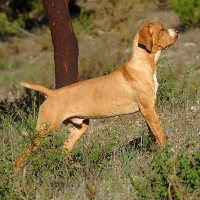
Portuguese Pointing Dog |
|
FCI standard Nº 187 |
||
Origin |
Portugal | |
Translation |
Portuguese Kennel Club. Revised by Jennifer Mulholland & Renée Sporre-Willes | |
Group |
Group 7 Pointing Dogs | |
Section |
Section 1.1 Continental Pointing Dogs | |
Working |
With working trial | |
Acceptance on a definitive basis by the FCI |
Wednesday 13 July 1955 | |
Publication of the official valid standard |
Tuesday 04 November 2008 | |
Last update |
Monday 30 March 2009 | |
En français, cette race se dit |
 |
Chien d'arrêt portugais |
Diese Norm ist in deutscher Sprache sichtbar |
 |
Portugiesischer Vorstehhund |
En español, esta raza se dice |
 |
Perdiguero Portugués |
In het Nederlands, wordt dit ras gezegd |
 |
Portugese Pointer |
In his country of origin, his name is |
Perdigueiro Português |
Usage |
| Hunting dog. |
Brief historical summary |
| The Portuguese Pointing Dog originates from the Iberian Peninsula, descending from the old Peninsular Pointing Dog, a common ancestor to other pointing dogs. It evolved by adapting to the climate, terrain and game and from the selection imposed by the socio-cultural specificity of the Portuguese, who have been breeding it for centuries for hunting purposes. The breed conserved the morphological and functional traits similar to those existing nowadays. Its existence in Portugal can be traced back to at least the 12th century. In the 14th century it was known as the “podengo de mostra”, already showing the capacity for pointing game. It was bred in the royal and nobility kennels and used in falconry. In the 16th century, already named “perdigueiro” (from “perdiz” the common Portuguese name for partridge), it was frequently used by commoners. The definition of the current traits and dissemination by a group of breeders and hunters began in the first quarter of the 20th century. |
General appearance |
| Medium sized dog, rectilinear, bracoïd type, strong but with an harmonious construction combined with great suppleness of movement. Seen from the side, the topline and underline form an elegant outline. |
Important proportions |
| Square, or almost square body. The skull to muzzle ratio is 6:4; height at withers to depth of chest is 2:1. |
Behaviour / temperament |
| Extremely kind and affectionate, hardy, capable of great endurance and devotion. Calm and very sociable, but somewhat haughty towards other dogs. Curious by nature, works with persistence and vivacity. Always a keen hunting dog that stays in close contact with the hunter. |
Head |
||
Cranial region |
||
Head |
In proportion to the size of the body, well built and harmonious in dimension, it gives the impression of being larger than it is. Slightly bulky, neither bony nor fleshy. Covered with loose, thin skin and without wrinkles. Rectilinear in profile and square when seen from the front. Convergent longitudinal superior cranium-facial axes. | |
Skull |
Square, almost flat top line when seen from the front and slightly arched in profile, with a length that should not exceed 6/10 of the total head length, therefore with 60% cephalic index. Seen from the front the forehead is almost flat, high, wide and symmetrical, slightly arched in profile. Well developed superciliary arches. Wide and not very deep frontal furrow. Barely perceptible occipital protuberance. | |
Stop |
Well defined (90-100º). | |
Facial region |
||
Nose |
The angle between the nasal bridge and the upper lip is 90°. Nose of good conformation, well developed with large wet and wide open nostrils. Black. | |
Muzzle |
Rectilinear and horizontal, adequately broad, with the same width over its length which is 4/10 of the head length. | |
Lips |
Pendulous upper lips, square in profile, at a right angle with the nasal bridge, semicircular at the tip when seen in profile; seen from the front, forming a sharp angle in the inferior edge; they join the lower lips by loose, folded commissures, with drooping corners. Averagely cut mouth, with irregularly pigmented (mucous) membranes, should have a normal occlusion allowing normal overlapping of the upper lip. | |
Jaws and teeth |
Healthy, correct and full dentition, with scissors bite. | |
Cheeks |
Parallel. Barely perceptible retro-commissural fold, with full parotid area (i.e. Well filled out under ear). | |
Eyes |
Expressive, lively, brown, of a darker colour than the coat; oval shaped tending to round, biggish but not too big, level set and filling the orbit. Thin and wide open lids, with black pigmentation. | |
Ears |
Set above the level of the eyes on the rear part of the head, hanging, almost flat surface with one or two longitudinal folds when attentive, triangular, much wider at the base than at the tip in a proportion of 2.5 to 1, and with rounded tip. The length of the ears should be slightly superior to that of the skull. Thin, smooth, covered with thin, dense and very short hair. | |
Neck |
| Straight, slightly arched in the upper third part, length not inferior to the head length, not very thick and with a short dewlap in the throat. It should join the head gracefully at an angle of approximately 90º and the connection between neck and body should not be accentuated. |
Body |
||
Topline |
Rectilinear, rising slightly from croup to withers. | |
Withers |
Not very high. | |
Back |
Short, broad, rectilinear and slightly sloping down to the loin, to which it joins well. | |
Loin |
Short, very broad, with strong muscles, slightly arched and well connected to the croup. | |
Croup |
Of proportional width in relation to the loin, of harmonious conformation with a slightly oblique axis slightly sloping down. | |
Chest |
Deep and broad, with good thorax width, more developed in length and depth than in width, reaching the elbow. Well sprung ribs in the upper section and very broad. Considering the girth and in cross-section, the chest and its bordering ribs appear horseshoe-shaped, with both ends meeting sternum. | |
Underline and belly |
Slightly uprising from sternum to groin. The slim belly joins the hip in a circumference arch; the distance separating the hip from the last rib gives the flank a short and well coupled appearance. | |
Tail |
| Natural : of medium length, not reaching below the hock. Straight, of medium set, thick at the base and slightly tapering to the tip. Well set in perfect continuity with the line of the croup. At rest it hangs naturally, but never between the thighs. In motion, it rises horizontally or slightly above the topline but never vertically or sickle-shaped. Wagging from side to side. Docked : in order to cover the genitals without surpassing them. |
Limbs |
Forequarters |
||
Generality |
Straight when seen from the front and perfectly parallel to the main line of the body. Seen from the sides, upright and giving an overall appearance of great stability, support and natural ease of movement. | |
Shoulders |
Long; with medium inclination, well set and quite strongly muscled. 120º scapula-humerus angle. | |
Upper arm |
Close to the chest. Its length is in accordance with the shoulder blade and the angulation is proportionate. | |
Elbows |
Separated from the chest by the armpit, clean, well let down, of equal distance to the main line of the body, neither turned in or out. 150º humerus-radius angle. | |
Forearm |
Set off from the body, long, straight and perpendicular to the ground, when seen from front or sides. | |
Carpal |
In perfect continuity to the forearm. | |
Pastern |
Broad, slightly sloping. | |
Forefeet |
Proportional to the size of the limb, tending to be round rather than long, but without resembling cat-feet. Well formed toes, tight, uniform and robust to give good support. Strong and well developed pads, with black, thick, hard and resistant hide. Strong nails, hard and preferably black. | |
Hindquarters |
||
Generality |
Upright when seen from the back and perfectly parallel to the main body line, with normal uprightness when seen from sides. | |
Upper thigh |
Long, broad, well muscled. Buttocks shaped in a more or less accentuated curve, long and with a slightly elastic musculature. 95º hip-femur angle. | |
Lower thigh |
Well placed, the length being proportional to the length of the thigh, its obliquity should be in proportion with the slope of the croup. | |
Stifle |
Slightly below the belly, but not too far from it. Slightly prominent and slightly turned out. 120º femur-tibia angle. | |
Metatarsus |
Of medium height, vertical, almost cylindrical, of even thickness and lean. | |
Hock |
Sufficiently open and well placed, clean, broad and thick. 145º tibia-tarsus angle. | |
Hind feet |
Identical to the forefeet, but slightly longer. | |
Gait and movement |
| With normal stride, easy and elegant. Polyvalent in its work and quite adaptable to diverse ground, weather and game, the movement switches between a simple suspension gallop and an extended, easy and rhythmic trot. |
Coat |
||
Hair |
Short, hard, close, harsh and dense, covering the body evenly, with the exception of the armpits, groin, perianal and genital regions where is more sparse and softer. It is thinner and shorter on the head, especially on the ears, which have a velvety look. Without undercoat. | |
Colour |
Yellow of light, medium and dark shades, solid or with white patches on the head, neck, chest, lower extremity of limbs, below the elbows and hocks and tip of tail when undocked. | |
Size and weight |
||
Height at withers |
Males: 56 cm +/- 4 cm, females: 52 cm +/- 4 cm. | |
Weight |
Males 20-27 Kg, females 16-22 Kg. | |
Faults |
| • Any departure from the foregoing points should be considered a fault and the seriousness with which the fault should be regarded should be in exact proportion to its degree and its effect upon the health and welfare of the dog and its ability to perform its traditional work. • Faults listed should be in degree of seriousness. |
General faults |
 Shyness. Skull/muzzle ratio slightly different from 6/4. Narrow. Prominent occipital protuberance. Very developed frontal sinus. Pronounced frontal furrow. Presence of wrinkles. Nose any colour other than black. Muzzle short or long. Upper lips not square. Commissure not perceptible. Incorrect pigmentation of the mucous membranes. Pincer bite. Eyes small, light, inexpressive; too round. Ears of medium set, very big or very small, pointed tip. Neck too short. Without dewlap or too much dewlap. Poor development of the chest. Tail too short when natural, too low set or with atypical carriage (vertical or sickle-shaped). Limbs and feet turned in or out, splayed feet. Soft hair. Shyness. Skull/muzzle ratio slightly different from 6/4. Narrow. Prominent occipital protuberance. Very developed frontal sinus. Pronounced frontal furrow. Presence of wrinkles. Nose any colour other than black. Muzzle short or long. Upper lips not square. Commissure not perceptible. Incorrect pigmentation of the mucous membranes. Pincer bite. Eyes small, light, inexpressive; too round. Ears of medium set, very big or very small, pointed tip. Neck too short. Without dewlap or too much dewlap. Poor development of the chest. Tail too short when natural, too low set or with atypical carriage (vertical or sickle-shaped). Limbs and feet turned in or out, splayed feet. Soft hair. |
Serious faults |
| Too shy. Skull-muzzle relation very different from 6/4. Barely defined stop, parallel longitudinal superior cranium-facial axes. Muzzle slanted. Eyes slanted. Squinting (east-west/cross-eyed). Ears fleshy, low set, excessively folded or curling. Saddled or roached top line. Croup too sloping. Body too long, round thorax. Tucked up belly. White patches outside the limits set by the standard. Oversized or undersized. |
Disqualifying faults |
| Aggressive or overly shy. Head atypical with convex muzzle, too long or too short, skull too narrow. Divergent longitudinal superior cranium-facial axes. Nose total lack of pigmentation. Undershot or overshot. Eyes uneven in shape or size, of different colours. Wall eye, congenital blindness. Deafness congenital or acquired. Body completely atypical, showing signs of crossbreeding to other breeds. Coat different from breed type. Albinism. Any other colour than the described type. |
NB : |
| • Any dog clearly showing physical or behavioural abnormalities shall be disqualified. • The above mentioned faults when occurring to a highly marked degree or frequently are disqualifying. • Male animals should have two apparently normal testicles fully descended into the scrotum. • Only functionally and clinically healthy dogs, with breed typical conformation should be used for breeding. |
Bibliography |
| https://www.fci.be/ |



 English (United Kingdom)

Comments