 |
Sloughi |
|
FCI standard Nº 188 |
||
Origin |
Morocco | |
Translation |
Mrs. Moreau-Sipiere and Prof. R. Triquet, brought up to date by Dr. Paschoud | |
Group |
Group 10 Sighthounds | |
Section |
Section 3 Short-haired Sighthounds | |
Working |
Without working trial, racing licence | |
Acceptance on a definitive basis by the FCI |
Thursday 08 November 1934 | |
Publication of the official valid standard |
Thursday 08 January 1998 | |
Last update |
Monday 27 April 1998 | |
En français, cette race se dit |
 |
Sloughi |
Diese Norm ist in deutscher Sprache sichtbar |
 |
Sloughi |
En español, esta raza se dice |
 |
Sloughi |
In het Nederlands, wordt dit ras gezegd |
 |
Sloughi |
Usage |
| Sighthound. |
Brief historical summary |
| The Sloughi has existed for many centuries in North Africa. Nowadays most Sloughis are to be found in Morocco which is responsible for the standard. The Sloughi exists only in a single short-haired variety. |
General appearance |
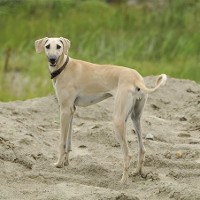
| By demeanour, by delicacy of tissue and by muscular leanness, his general appearance is that of a very racy and elegant dog. |
Important proportions |
| For a male with an ideal size of 27, 5 inches (70 cm), the length of the body from point of shoulders to point of buttock should be 26-27 inches (67-68 cm). For a female with an ideal size of 26 inches (65 cm), the length of the body from point of shoulders to point of buttock should be 24-25 inches (62-63 cm). The ratio between length of body (from point of shoulder to point of buttock) and height at withers should be 0,96 (9,6 : 10). The ratio between depth of chest and height at withers should be 0,4 (4 : 10). The ratio between length of foreface and total length of head should be 0,5 (1 : 2). |
Behaviour / temperament |
| Although noble and haughty, he is very attached to his master and defends him in case of need. With an instinct of hunter, capable of sustained effort, he also appreciates the home conforts. |
Head |
||
Cranial region |
||
Head |
Seen from the side, the head is longish, refined, delicate but rather strong. Seen from above, it has the shape of a very long wedge, the skull being the widest part, tapering to the tip of the nose. | |
Skull |
Rather broad, seen from aside flat; from one ear to the other the skull measures 4-6 inches (12 to 14 cm). The skull is distinctly rounded at the back and curving harmoniously on the sides. The superciliary ridges are scarcely projecting, the frontal groove hardly marked and the occipital crest and protuberance barely visible. | |
Stop |
Hardly pronounced. | |
Facial region |
||
Nose |
Black. Strong enough to avoid being pinched. Nostrils well opened. The nose leather not being held up by a skeletal structure is very slightly inclined. | |
Muzzle |
It has the shape of a, without exaggeration, elongated wedge and is perceptibly as long as the skull. The bridge of the nose is straight from its root. | |
Lips |
Thin and supple, just covering the lower jaw; the corner of the mouth must be as little visible as possible. | |
Jaws and teeth |
Teeth normal, jaws strong and regular. Scissor bite. | |
Eyes |
Large, dark, well-set in their sockets, sometimes just covered by a slight obliquity of the eyelids. The expression is gentle, a little sad, the look like nostalgic. With a light coat, the eye can be ambercoloured. The eye rims are pigmented. | |
Ears |
Set high slightly above the eye line, drooping, close to the head, not too large, triangular and slightly rounded at the tips. | |
Neck |
| Long, well set off from the shoulders and with the topline (crest) slightly arched. The length is perceptibly equal to the length of the head. The skin is fine, tight, without any dewlap; the hair is very smooth. |
Body |
||
Topline |
Gently and harmoniously curved with prominent haunch bones equal in height or slightly higher than the withers. | |
Withers |
Well projecting. | |
Back |
Short, almost horizontal. | |
Loin |
Short, lean, wide and slightly arched. | |
Croup |
Bony, wide and oblique, but not falling strongly away. | |
Chest |
Not too wide; in depth it hardly reaches the level of the elbow. Well developed in length. The ribs are flat. | |
Underline and belly |
Sternum long and raised, belly and flanks well tucked up. The underline is evenly curved, neither abruptly cut up nor whippety. | |
Tail |
| Thin, lean, set-on in line with the croup and carried below the line of the back. It should be, at least, long enough to reach the point of hocks. At rest, the tip is forming an accentuated curve. |
Limbs |
Forequarters |
||
Generality |
Forelegs vertical and parallel. | |
Shoulders |
Long and oblique. | |
Upper arm |
Strong. | |
Forearm |
Bony and muscular. | |
Carpal |
Supple and strong. | |
Pastern |
Supple and strong. | |
Hindquarters |
||
Generality |
Viewed from behind, hindlegs vertical and parallel; muscles flat, tendons well chiselled. | |
Upper thigh |
Flat and muscular. | |
Lower thigh |
Long and well muscled. | |
Metatarsus |
Strong, without dewclaws. | |
Hock |
Strong, well bent. | |
Feet |
| Lean, in the shape of an elongated oval. In many lightly built Sloughis the foot assumes the shape of a harefoot. The two middle toes are distinctly longer than the others. The nails are black or coloured. |
Gait and movement |
| Walk, trot, gallop. Gait supple, smooth and with long strides, covering plenty of ground. |
Skin |
| Very fine, close fitting to the body, without folds or dewlap. |
Coat |
||
Hair |
Very short, dense, fine. | |
Colour |
The colour reaches from light sand through all possible different shades to red sand (fawn), with or without black mask, with or without black mantle, with or without black brindling, with or without black overlay. | |
Size and weight |
||
Height at withers |
For males 26-29 inches (66-72 cm), for females 24-27 inches (61-68 cm). | |
Faults |
| • Any departure from the foregoing points should be considered a fault and the seriousness with which the fault should be regarded should be in exact proportion to its degree and its effect upon the health and welfare of the dog and its ability to perform its traditional work. • Faults listed should be in degree of seriousness. |
General faults |
 Bad ratio between length of body and height at withers. Head and body slightly too heavy. Stop too much or insufficiently pronounced. Too light coloured eyes. Top line not horizontal. Croup narrow, too or insufficiently oblique. Belly not enough tucked up. Rounded ribs. Chest not long enough, seen from the side cut up or very arched. Tail too short, with too much hair, badly carried. Muscles round and protruding. Hair hard and coarse. Small white mark on the chest. Bad ratio between length of body and height at withers. Head and body slightly too heavy. Stop too much or insufficiently pronounced. Too light coloured eyes. Top line not horizontal. Croup narrow, too or insufficiently oblique. Belly not enough tucked up. Rounded ribs. Chest not long enough, seen from the side cut up or very arched. Tail too short, with too much hair, badly carried. Muscles round and protruding. Hair hard and coarse. Small white mark on the chest. |
Disqualifying faults |
| Aggressive or overly shy. Body clearly longer than high, haunch bones lower than withers. Depigmented areas on the mucous membranes. Over-or undershot mouth. Ears erect, or raised with tips drooping, too long, folding backwards (rose ear). Hair semi-long. Fringes on legs or tail. White stockings, larger white markings. Colour not in accordance with the standard. |
NB : |
| • Any dog clearly showing physical or behavioural abnormalities shall be disqualified. • The above mentioned faults when occurring to a highly marked degree or frequently are disqualifying. • Male animals should have two apparently normal testicles fully descended into the scrotum. • Only functionally and clinically healthy dogs, with breed typical conformation should be used for breeding. |
Bibliography |
| https://www.fci.be/ |



 English (United Kingdom)

Comments