
 |
Hovawart |
|
FCI standard Nº 190 |
||
Origin |
Germany | |
Translation |
Mrs. R. Binder-Gresly | |
Group |
Group 2 Pinscher and Schnauzer Molossoid breeds- Swiss Mountain and Cattle Dogs | |
Section |
Section 2.2 Molossoid breeds, Mountain type | |
Working |
With working trial | |
Acceptance on a definitive basis by the FCI |
Monday 21 November 1955 | |
Publication of the official valid standard |
Friday 21 March 2025 | |
Last update |
Friday 28 March 2025 | |
En français, cette race se dit |
 |
Hovawart |
Diese Norm ist in deutscher Sprache sichtbar |
 |
Hovawart |
En español, esta raza se dice |
 |
Hovawart |
In het Nederlands, wordt dit ras gezegd |
 |
Hovawart |
Usage |
| Working Dog. |
Brief historical summary |
| The Hovawart is a very old German working dog breed. The name’s origin stems from Middle High German (an old form of German); Hova = Hof (= yard, farm) and wart = Wächter (= watchman). Since 1922 the breeding of this breed, by using dogs similar in type still found on farms, has been restored. Apart from this, in the early years of breeding, crosses with German Shepherd Dogs, Newfoundlands, Leonbergers and other breeds were admitted. Due to the strict measurements taken in selecting the breeding stock, the original working type was attained again. In the country of origin very great importance is attached to the health of the Hovawart. Especially the presence of hip dysplasia has been reduced to a small percentage by selecting, for decades, breeding stock free from dysplasia. It is to be expected that all other Hovawart breed clubs will aim for this exemplary goal. |
General appearance |
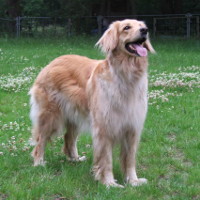
| The Hovawart is a powerful, medium size, slightly elongated, long-haired working dog. Difference between sexes is clearly recognizable, specially in shape of head and build of body. |
Important proportions |
| Length of body comprises at least 110 to 115 % of height at withers. |
Behaviour / temperament |
| Recognized working dog with versatile usage. Kind and even disposition. Has protective instinct, self-confidence and ability to take stress; of medium temperament; combined with a very good nose. His balanced body proportions and special devotion to his family make him an outstanding companion, watch, guard, tracking and rescue-dog. |
Head |
||
Cranial region |
||
Head |
The nasal bridge is straight and parallel to the skull. Muzzle and skull are of about the same length. The skin of the head fits tightly. | |
Skull |
The powerful head has a broad, rounded forehead. | |
Stop |
Well visible. | |
Facial region |
||
Nose |
Nostrils well developed. In black/gold and black dogs pigmentation is black; in blond dogs it is black; « snow nose » (temporary loss of pigmentation) accepted. | |
Muzzle |
Strong, tapering only slightly when seen from above and in profile. | |
Lips |
Fit tightly. | |
Jaws and teeth |
Strong complete scissor bite with 42 teeth according to tooth formula. Teeth set square to the jaws. Pincer bite accepted. | |
Eyes |
Oval, neither protruding nor deep set. Colour : dark to medium brown. Eyelids fit tightly. | |
Ears |
The loosely fitting triangular drop ears are set on high and wide apart, thus giving the optical illusion of broadening the skull. They reach in length to the corners of the mouth (labial commisure). Their tip is slightly rounded. When the dog is at ease they are kept hanging flat, when alert they may be carried directed slightly forward. Their front edge lies approximately halfway between eye and occiput. | |
Neck |
| Strong, of medium length. Skin tightly fitting. |
Body |
||
Back |
Straight and firm. | |
Loin |
Strong, slightly longer than rump. | |
Croup |
Medium long and slightly sloping. | |
Chest |
Broad, deep and strong. | |
Tail |
| Bushy, reaching to below the hocks, but not to the ground. According to the dog’s mood it is carried high and curved over the back or hanging down. |
Limbs |
Forequarters |
||
Generality |
Forelegs strong, straight and vertical, seen from the front and side. | |
Shoulders |
Very well muscled. Shoulder-blade long and well laid back. | |
Upper arm |
Long, closely fitting to body. | |
Elbows |
Fitting well to chest. | |
Carpal |
Strong. | |
Pastern |
Moderately sloping. | |
Hindquarters |
||
Generality |
Hindlegs strong and vertical when seen from behind. Hindquarters are well angulated. | |
Upper thigh |
Very well muscled. | |
Lower thigh |
Very well muscled. | |
Hock |
Strong, well let down. | |
Feet |
| Roundish, strong and compact. Toes arched and tight. Dewclaws to be removed except in those countries where this is prohibited by law. Nails with black pigmentation in black/gold and black dogs; in blond dogs there may be less pigmentation. |
Gait and movement |
| In all gaits the movement of the Hovawart is on a straight line and covering the ground well. The trot is very extended, with powerful drive from the hindquarters. |
Skin |
| Tightly fitting all over. With a bluish sheen in black/gold and black dogs, with a mostly pink sheen in blond dogs. |
Coat |
||
Hair |
The strong long-haired coat is lightly waved and lying close, with only little undercoat. It is longer on chest, belly, rearside of forelegs, rearside of thighs and tail. It is short on head and at the front side of the fore- and hindlegs. The coat is dense. | |
Colour |
There are 3 colour varieties : black/gold, black, blond. Black/gold : The coat is black and shiny, the colour of the markings medium blond. On the head the markings begin below the nasal bridge and extend round the corners of the mouth into the marking of the throat. The point-shaped markings above the eyes are clearly visible. The chest markings consist of two adjacent patches which may be connected. On the forelegs, the marking, seen from the side, extends from the toes to about the pastern and tapers off on the rearside at about elbow level. On the hindlegs, seen from the side, the marking below the hock is seen as a broad stripe, above the hock only as a narrow stripe which extends on the front side of the hindleg up to the level of the belly. A marking is also present beneath the set on of the tail. The markings are distinct in outline everywhere. Single small white spots on the chest as well as some single white hairs on toes and tip of tail are permissible. Black pigmentation on eyelids, lips and pads. Black : The coat is black and shiny. Some single white spots on the chest as well as some single white hairs on toes and tip of tail are permissible. Black pigmentation on eyelids, lips and pads. Blond : The coat is medium blond, shiny and becomes lighter towards legs and belly. Single small white spots on the chest as well as some single white hairs on toes and tip of tail are permissible. Black pigmentation on eyelids, lips and pads. |
|
Size and weight |
||
Height at withers |
For dogs : 63 - 70 cm, for bitches : 58 - 65 cm. | |
Faults |
| • Any departure from the foregoing points should be considered a fault and the seriousness with which the fault should be regarded should be in exact proportion to its degree and its effect upon the health and welfare of the dog and its ability to perform its traditional work. • Faults listed should be in degree of seriousness. |
Disqualifying faults |
 Aggressive or overly shy dogs. Aggressive or overly shy dogs.GENERAL APPEARANCE : Dogs which do not conform to the impression of original breed type. Distinctly « doggy » bitches. Distinctly « bitchy » dogs.IMPORTANT PROPORTIONS : Distinctly differing body proportions than those quoted in the standard.BEHAVIOUR/TEMPERAMENT : Aggressive, anxious, gunshy or lethargic dogs.HEAD : Lacking stop. Blue eye or wall eye. Erect, tipped ears, rose ear; off-standing ears. Undershot, overshot or wry mouth. Absence of more than 2 of the 4 PM1 or the 2 M3, or absence of any other tooth.NECK : Distinct dewlap or very throaty.BODY : Pronounced sway or roach back. Narrow or barrel shaped chest. Abnormal tail; tail much too short; pronounced ring tail.LIMBS: Much too high in hindquarters (overbuilt).COAT : HAIR : Predominantly curly coat (ring curls).COLOUR : In general : All colours not conforming to the standard, eg blue-grey, deer colour, brown, white, patched, blond with smutty touch or predominantly banded hair. White patches; single white hairs on the inside of the upper thighs are not a disqualifying fault.Black/Gold dogs : Grey or brown patches other than the correct markings. Undercoat predominantly of another colour than black. Predominantly grey or whitish markings.Black dogs : Grey or brown patches. Undercoat predominantly of another colour than black.Blond dogs : Some single white hairs on the nasal bridge are not a disqualifying fault. Red-blond colour throughout without getting lighter. Whitish-blond colour, also on ears. Distinctly white markings. Dark patches or dark mask.Size : Undersize. Oversize by more than 3 cm. |
NB : |
| • Any dog clearly showing physical or behavioural abnormalities shall be disqualified. • The above mentioned faults when occurring to a highly marked degree or frequently are disqualifying. • Male animals should have two apparently normal testicles fully descended into the scrotum. • Only functionally and clinically healthy dogs, with breed typical conformation should be used for breeding. |
Bibliography |
| https://www.fci.be/ |



 English (United Kingdom)

Comments