
 |
Spanish Hound |
|
FCI standard Nº 204 |
||
Origin |
Spain | |
Translation |
Mrs. Peggy Davis | |
Group |
Group 6 Scenthounds and related breeds | |
Section |
Section 1.2 Medium sized Hounds | |
Working |
With working trial | |
Acceptance on a definitive basis by the FCI |
Friday 15 November 1957 | |
Publication of the official valid standard |
Wednesday 26 May 1982 | |
Last update |
Monday 24 July 2000 | |
En français, cette race se dit |
 |
Chien courant espagnol |
Diese Norm ist in deutscher Sprache sichtbar |
 |
Spanischer Laufhund |
En español, esta raza se dice |
 |
Sabueso español |
In het Nederlands, wordt dit ras gezegd |
 |
Spaanse Hound |
Usage |
| Hunting hound for small game, although he is not averse to big game hunting, be it boar, stag, deer, fox, wolf or the bear. The hunter, instructed by the dog’s voice and its modulations, will recognize the sequence of events of the hunting and its incidents such as : Cold or fresh line of scent, double scent lines, firmness on line or « halali » (kill). The Sabueso español (hound) is a great specialist in hunting the hare with his doubling habit and he is most efficient in blood tracking (searching of wounded big game). |
Brief historical summary |
| Already known in the late Middle Ages, he is brilliantly described by the venery book by King Alphonse XI (XIVth century) as well as by Argote de Molina (1582) and by numerous classic authors. |
General appearance |
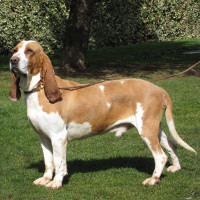
| Medium sized dog, balanced, with rather long proportions, with a lovely head and long leathers. The development of his thoracic perimeter and the length of his body which exceeds greatly the height at the withers, are remarkable. Compact bone structure and solid legs; fine hair, smooth and flat. The gaze is soft, sad and noble. |
Important proportions |
| Long line structure. · Length of the body is widely superior, from 7 to 10 cm, to the height at the withers. · Length of skull / length of muzzle = 1/1, i.e. they are of equal length. |
Behaviour / temperament |
| He is an affectionate and calm dog which, when out hunting big game, shows extraordinary courage and bravery. |
Head |
||
Cranial region |
||
Head |
Harmonious, long and in proportion with the rest of the body. Cranial-facial lines divergent. Seen from above, the ensemble skull and muzzle must appear elongated and very uniform. No impression of pointed muzzle. | |
Skull |
Medium width, broader in the males. Convex profile. The width of the skull should be equal to its length; seen from the front, it must be domed. Occipital crest simply marked. | |
Stop |
In gentle slope, only slightly marked. | |
Facial region |
||
Nose |
Large, moist with open and well developed nostrils. Its colour varies from light to intense black, always in relation with the colour of the mucous membranes. | |
Muzzle |
Straight profile, a very slight sub-convexity only at its end portion admissible. Seen from above, it appears moderately rectangular, decreasing in width as it gets nearer the nose. | |
Lips |
The upper lip must clearly cover the lower lip; it is loose and moderately abundant. The lower lip forms a well marked labial corner. The mucous membranes must be of the same colour as the nose. Palate of the same colour as the mucous membranes, with marked ridges. | |
Jaws and teeth |
Scissor bite. Teeth white and sound. Canines well developed, all premolars present. | |
Eyes |
Medium, almond shape, hazel colour, dark; with a sad, noble and intelligent expression. Eyelids pigmented like the nose and the mucous membranes, close to the eyeball. Slight relaxing at rest is permitted. | |
Ears |
Large, long and hanging. Of soft texture, rectangular shape and rounded tip. Set below eye level and hang freely twisted in corkscrew. Without being stretched, they must reach well beyond the nose. The venous system is very visible and just under the skin. | |
Neck |
| Truncated cone, broad and strong, muscled and supple; skin thick and very loose, which forms, without exaggeration, a marked and loose dewlap. |
Body |
||
Body |
Clearly rectangular, very strong and robust, with an important thoracic perimeter which must be more, by 1/3, than the height at the withers : height at the withers 3, thoracic perimeter 4. | |
Topline |
Straight, with a slight dip of the back and convexity of the loin, characteristics of the breed, but not a saddle back. | |
Withers |
Set forward and lightly marked. | |
Back |
Powerful, broad, of marked length. | |
Loin |
Very broad and powerful; slightly raised. | |
Croup |
Powerful, broad, rather horizontal. The height at the rump must be the same or below the height at the withers. Taking into account the tendency of the breed to increase in size, it will be permitted that the rump will be slightly higher. | |
Chest |
Very developed, broad, deep and high, well let down to the elbow. Point of sternum marked. Rounded ribs, with very wide intercostal spaces, forming a large thoracic cage. | |
Underline and belly |
Belly not very tucked up; the flanks are deep, very visible, and full. | |
Tail |
| Thick at the root and set at medium height. Strong and covered with very short hair forming a small paint brush at the tip. At rest carried slightly curved and hanging down below the point of the hock; at work and in action, it raises sabre fashion, without excess, with a continual lateral movement. Never straight, directed upwards or resting on the rump. |
Limbs |
Forequarters |
||
Generality |
Perfectly vertical, straight, parallel. Give the impression of being short and muscles and tendons are clearly visible. The length of the forearm must be equal to that of the shoulder. Of strong bone structure, with powerful pasterns; elbows really close to the body. | |
Shoulders |
Shoulder-blade oblique, rounded, muscled and of equal length to that of the upper arm. Scapulo-humeral angle : close to 100°. | |
Upper arm |
Strong. | |
Elbows |
Close to the thorax. Humeral-radial angle : close to 120°. | |
Forearm |
Straight, short, vertical. Strong bones. | |
Pastern |
Strong and powerful bone structure. Seen in profile, only slightly oblique. | |
Forefeet |
Catfeet, toes tight, phalanges strong and high. Nails strong and solid, pads large and tough. Interdigital membranes moderate and covered with fine hair. | |
Hindquarters |
||
Generality |
Powerful, muscled and with excellent angulation. Legs correct, hocks without deviations, metatarsal long and feet solid. They give the dog the necessary strength, agility and impulsion to follow the trail on very bumpy terrains and with significant uneveness. | |
Upper thigh |
Strong and muscular. Coxal-femoral angle : near 100°. | |
Lower thigh |
Of moderate length, muscular. Femoral-tibial angle : nearly 115°. | |
Hock |
Well marked with the tendon clearly visible. Angle of the hock open; getting close to 120°. | |
Hind feet |
Catfeet, slightly oval. More elongated than the front feet. Present, or not, dewclaws are usually single, rarely double; their removal is allowed. | |
Gait and movement |
| The preferred gait is the trot, which is long, sustained and economical without tendency to lateralisation or ambling. Particular attention should be paid to the elbows and the hocks whilst moving. There is, in the walk, a natural tendency of the breed to walk with the head low while sniffing. |
Skin |
| Very elastic, thick and pink in colour, loose all over the body; on some occasions it forms wrinkles on the forehead when the head is lowered. |
Coat |
||
Hair |
Dense, short, fine and smooth (flat). Covering the whole of the body down to the interdigital spaces. | |
Colour |
White and orange, with dominance of one or the other colour and distributed in irregular markings, well defined and without ticking. The orange colour may vary from a lighter shade (lemon) to an intense russet-brown. | |
Size and weight |
||
Height at withers |
This breed presents a pronounced sexual dimorphism which reveals itself in the difference in size between the males and the females; these last are noticeably smaller and finer. Height at the withers : males from 52 to 57 cm, females from 48 to 53 cm. In subjects of excellent proportions, 1 cm above the size limits is tolerated. |
|
Faults |
| • Any departure from the foregoing points should be considered a fault and the seriousness with which the fault should be regarded should be in exact proportion to its degree and its effect upon the health and welfare of the dog and its ability to perform its traditional work. • Faults listed should be in degree of seriousness. |
General faults |
 Profile of the muzzle arched, but without excess. Pincer bite. Absence of one premolar. Loose eyelids to the point of uncovering a bit of conjunctiva. Weakness in the dorsal-lumbar line and swaying at the walk. Loin too elevated, which, although permitted, must never be exaggerated. Profile of the muzzle arched, but without excess. Pincer bite. Absence of one premolar. Loose eyelids to the point of uncovering a bit of conjunctiva. Weakness in the dorsal-lumbar line and swaying at the walk. Loin too elevated, which, although permitted, must never be exaggerated. |
Serious faults |
| Frail appearance. Muzzle too pointed or blunt. Moderately overshot mouth; absence of canines or premolars not due to traumatisms. Entropion or ectropion. Cropped ears. Saddle back. Height at the croup much more than the height at the withers. Thoracic perimeter insufficient. Tail carried too high or resting on the croup; docked tail. Incorrect position of the legs; weak or crooked legs. Out at the elbows, at the walk or when standing. Cow-hocked. Lateral movements of the legs when walking. Wavy coat, hard or semi-long. Depigmentation. Unbalanced temperament, excessively timid, nervous or aggressive. |
Disqualifying faults |
| Aggressive or overly shy dogs. Length of the body equal or below that of the height at withers. Split nose. Excessively overshot mouth; undershot bite in any degree. Hair hard and long; woolly coat which indicates cross-breeding. Tri-coloured dogs or with tan markings on the muzzle and the legs. |
NB : |
| • Any dog clearly showing physical or behavioural abnormalities shall be disqualified. • The above mentioned faults when occurring to a highly marked degree or frequently are disqualifying. • Male animals should have two apparently normal testicles fully descended into the scrotum. • Only functionally and clinically healthy dogs, with breed typical conformation should be used for breeding. |
Bibliography |
| https://www.fci.be/ |
Additional information from visitors |
| The Spanish Hound is descended from working mastiffs crossed with local hunting dogs and imported Talbot Hounds. Related to the early Bloodhounds, the Sabueso is believed to had stayed pure and identical to its Medieval progenitors. Originally separated into two types, only the larger variant remains in existance today, while the smaller Lebrero variety is thought to be extinct. The Sabueso Espanol mainly hunts alone and is rarely seen in packs, due to its unfriendly attitude towards other dogs. This powerful hound is a hard worker, valued for its great stamina and drive, still enjoying popularity in Spain, both as a hunter and watchdog. The coat is flat and smooth, always white in colour with red or black markings. Average height is around 20 inches. |



 English (United Kingdom)

Comments