 |
Bavarian Mountain Scenthound |
|
FCI standard Nº 217 |
||
Origin |
Germany | |
Translation |
C. Seidler | |
Group |
Group 6 Scenthounds and related breeds | |
Section |
Section 2 Leash (Scent) hounds | |
Working |
With working trial, which take note of the relevant hunting requirements. | |
Acceptance on a definitive basis by the FCI |
Saturday 14 November 1959 | |
Publication of the official valid standard |
Tuesday 22 August 2017 | |
Last update |
Friday 22 September 2017 | |
En français, cette race se dit |
 |
Chien de rouge de Bavière |
Diese Norm ist in deutscher Sprache sichtbar |
 |
Bayrischer Gebirgsschweisshund |
En español, esta raza se dice |
 |
Rastreador montañés de Baviera |
In het Nederlands, wordt dit ras gezegd |
 |
Bayrischer Gebirgsschweisshund |
Usage |
| In accordance with the hunting requirements as a specialist for the search of hoofed game, the Bavarian Mountain Scent Hound has to show all the of him required abilities to be useful for the more difficult search. This usefulness must be confirmed by the relevant working trials. |
Brief historical summary |
| All Liam Hounds (Leithunde) and Leashhounds (Schweisshunde) are descended from the original hunting dogs, the “Bracken”. All pure “Bracken” have the finest nose for following ground scent and trail; they are firm on scent, have a strongly developed will to follow a trail and are readily giving tongue on scent. Only the most reliable and perseverant Bracken were chosen from the pack to be used on the leash to search for the lost trail of the hunted game. From those most calm and biddable Bracken, the Liam Hounds (Leithunde, working only on natural, cold scent) and the “Scent Hounds” (Schweisshunde, the so called “spoilt Liam Hounds”, working the trial of wounded game) were later bred. Through crossing of genetically fairly close breeds at the end of the 18th and beginning of the 19th century, the present day Hanoverian Scenthound evolved. After the Revolution in 1848, in fact, after the break up of the large hunting estates and the replacement of the previous hunting methods by stalking and hiding (waiting for the game) and at the same time with the improvement of the firearms, the dog was needed “after the shot”. Specialized in firmly working on the leash, one could not dispense with the loud chase, perseverance and keenness, especially in mountain regions. There the Hanovarian Scenthound proved too heavy. To achieve the desired accomplishments, even in difficult mountain territory, Baron Karg-Bebenburg, Reichenhall, bred the racy and ennobled lighter Mountain Scenthound after 1870, by crossing Hanovarian Scenthounds and red Mountain Scenthounds. More and more these dogs ousted other breeds from the mountain regions so that the Bavarian Mountain Scenthound is, today, the classical companion for the professional hunter and game keeper. In 1912 the Club for Bavarian Mountain Scenthounds was founded with its seat in Munich. It is the only recognized Club for Bavarian Mountain Scenthounds in Germany. |
General appearance |
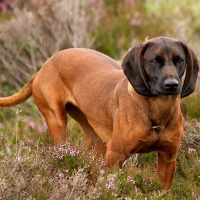
| An altogether balanced, lightish, very mobile and muscular, medium size dog. The body is slightly longer than high, slightly higher at rear, standing on not too long legs. Head carried level or slightly upwards, tail level or slanting downwards. |
Important proportions |
| Height at withers should be in the proportion to length of back of 1 : 1.15; the chest should reach down to the elbow. |
Behaviour / temperament |
| Calm and balanced, devoted to his owner, reserved with strangers. Required is a sound, self assured, unafraid, biddable dog, neither shy nor aggressive. |
Head |
||
Cranial region |
||
Skull |
Relatively broad, flatly arched. Clear rise to forehead. Superciliary arches well developed; occiput not pronounced. | |
Stop |
Well defined. | |
Facial region |
||
Nose |
Of good size, not too broad. Nostrils well opened. Black or dark red. | |
Muzzle |
Somewhat off-set from eyes, slightly shorter than skull, sufficiently broad, never pointed. Nasal bridge slightly convex or straight. | |
Lips |
Pendulous, medium thickness. Corner of lips clearly visible. | |
Jaws and teeth |
Strong jaws with a perfect, regular and complete scissor bite in which the upper incisors overlap the lower incisors without any gap and with the teeth set vertical to the jaw. 42 healthy teeth, according to tooth formula. Pincer bite permitted. | |
Cheeks |
Only moderately pronounced. | |
Eyes |
Clear, alert expression. Not too large or too round. Dark brown or slightly lighter. Well fitting, pigmented lids. | |
Ears |
Somewhat over medium length but at most reaching to nose. Heavy, set on high and broad, rounded at tips. Hanging close to head without any twist. | |
Neck |
| Of medium length and strong. Skin somewhat looser on throat. |
Body |
||
Topline |
Slight rise from withers to hindquarters. | |
Withers |
Barely defined, flowing transition from neck to back. | |
Back |
Strong and supple. | |
Loin |
Relatively short, broad, very well muscled. | |
Croup |
Long and fairly level (drooping by 20 – 30 º is seen to be ideal). | |
Chest |
Moderately broad, well developed forechest, oval ribcage, deep and long, with ribs reaching far back. Chest reaching down to elbow joint. | |
Underline and belly |
Gradually rising towards rear. Belly slightly tucked up. | |
Tail |
| Medium length, reaching, at most, to hocks. Set on high, carried horizontal or slightly slanting downwards. |
Limbs |
Forequarters |
||
Generality |
Legs seen from the front, straight and parallel; seen from the side, standing well under the body. Good angulations. | |
Shoulders |
Well slanting, laid back shoulder blade. Strongly muscled. | |
Upper arm |
Long, with good and lean muscles. Scapulo-humeral angulation 90 - 100º. | |
Elbows |
Close fitting to body, turning neither in nor out. | |
Forearm |
Lean, vertical and straight. Strong bone, very well muscled. | |
Carpal |
Strong (stifle angulation 100 - 110º). | |
Pastern |
Slanting lightly. | |
Hindquarters |
||
Generality |
Strong bone. Seen from rear, straight and parallel. Good angulations. | |
Upper thigh |
Broad and very muscular. | |
Lower thigh |
Relatively long, muscular and sinewy. | |
Stifle |
Strong. | |
Metatarsus |
Short, standing vertical. | |
Hock |
Strong. | |
Feet |
| Spoon shaped with well arched, tight toes as well as sufficiently cushioned, coarse, resistant and well pigmented pads. Feet move parallel; in stance and movement turning neither in nor out. Nails black or horn colour. |
Gait and movement |
| Ground covering, with good reach in front and strong drive from the rear. Fore- and hindlegs straight and parallel; lightly springy gait. Preferred movement when in action: walk and gallop. |
Skin |
| Strong, tight fitting. |
Coat |
||
Hair |
Dense, close fitting, moderately harsh with little gloss. Finer on head and leathers, harsher and longer on belly, legs and tail. | |
Colour |
Deep red, deer red, reddish brown, tan, also clear fawn to biscuit colour, reddish gray as the winter coat of a deer, also brindled or interspersed with black hairs. The basic colour on the back is generally more intense, muzzle and leathers dark. Tail, mostly, interspersed with dark hair. Small light-coloured patch on chest (“Bracken Star”) permitted. | |
Size and weight |
||
Height at withers |
Dogs 47 to 52 cm, bitches 44 to 48 cm. No departure from above permitted in either dogs or bitches. | |
Weight |
Weight in relation to height to withers: males ideally 20 – 30 kg, females ideally 17 – 25 kg. | |
Faults |
| • Any departure from the foregoing points should be considered a fault and the seriousness with which the fault should be regarded should be in exact proportion to its degree and its effect upon the health and welfare of the dog and its ability to perform its traditional work. • Faults listed should be in degree of seriousness. |
Serious faults |
 Flesh coloured nose. Mouth slightly over- or undershot. Partial pincer bite. Very loose eyelids. Marked hollow or roach back. Very flat or barrel shaped chest. Very in or out at elbow. Distinctly overbuilt hindquarters. Hindlegs very close, cow-hocked or bow-shaped, in stance or movement. Too fine or thin coat. Strong deviation in colour, black colour with red markings (Black and Tan). Deviation in size. Flesh coloured nose. Mouth slightly over- or undershot. Partial pincer bite. Very loose eyelids. Marked hollow or roach back. Very flat or barrel shaped chest. Very in or out at elbow. Distinctly overbuilt hindquarters. Hindlegs very close, cow-hocked or bow-shaped, in stance or movement. Too fine or thin coat. Strong deviation in colour, black colour with red markings (Black and Tan). Deviation in size. |
Disqualifying faults |
| Aggressive or overly shy. Not showing clear sexual dimorphism. Under and oversized dogs. Not recognized coat colour. Incorrect bites. Over- or undershot, wry mouth, Palisade bite, wry mouth, partial pincer, slanted bites. Missing teeth (except P1 ; M3 must be present). Ectropion, entropion. Tail kinked from birth. |
NB : |
| • Any dog clearly showing physical or behavioural abnormalities shall be disqualified. • The above mentioned faults when occurring to a highly marked degree or frequently are disqualifying. • Male animals should have two apparently normal testicles fully descended into the scrotum. • Only functionally and clinically healthy dogs, with breed typical conformation should be used for breeding. |
Bibliography |
| https://www.fci.be/ |



 English (United Kingdom)

Comments