 |
German Roughhaired Pointer |
|
FCI standard Nº 232 |
||
Origin |
Germany | |
Translation |
Elke Peper. Revised in October 2007 by R. Triquet | |
Group |
Group 7 Pointing Dogs | |
Section |
Section 1.1 Continental Pointing Dogs « Braque » Type | |
Working |
With working trial | |
Acceptance on a definitive basis by the FCI |
Thursday 24 August 1961 | |
Publication of the official valid standard |
Thursday 29 November 2001 | |
Last update |
Thursday 13 March 2008 | |
En français, cette race se dit |
 |
Chien d'arrêt allemand à poil raide |
Diese Norm ist in deutscher Sprache sichtbar |
 |
Deutsch Stichelhaar |
En español, esta raza se dice |
 |
Perro de muestra alemán de pelo cerdoso |
In het Nederlands, wordt dit ras gezegd |
 |
Duitse Staande Hond Stekelhaar |
Usage |
| Versatile, easily tractable working gundog. |
Brief historical summary |
| The Deutsch Stichelhaar is the oldest German rough-coated pointing dog. In 1888, the cynologist Hans von Kadisch managed to prove that this breed is the rough-coated variety of the German partridge dog ("Hühnerhund") and not just another variety of the Short-Haired Pointing Dog. That means, the Deutsch Stichelhaar has not been newly created, but has been re-developed from the very few specimens still found in the country. In 1892, the "Club Stichelhaar" was founded, renamed "Verein Deutsch Stichelhaar" in 1976. From the beginning, the Club was devoted to the principles of pure breeding and refused all kinds of interbreeding to any of the English pointing breeds. |
General appearance |
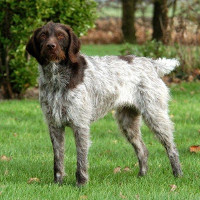
| Strong pointing dog of medium to large size with stiff, hard coat and moderate beard. The eyebrows are pronounced giving a grim appearance to the dog. |
Important proportions |
| • The length of the body should be as much as possible equal to the height at the withers. • It may exceed the height at the withers slightly. |
Behaviour / temperament |
| Balanced, calm, resistant, courageous but self-controlled, neither shy nor aggressive. The temperament is calm and even. |
Head |
||
Cranial region |
||
Head |
In proportion to the size of the body; in accordance with its sex. | |
Skull |
Slightly rounded, broad, seen from the side the highest point of the arch is in its middle. Occipital protuberance not too pronounced. | |
Stop |
Only slightly pronounced, gradually rising. | |
Facial region |
||
Nose |
Light brown to dark brown, not flesh-coloured. | |
Muzzle |
Long, powerful, of medium width. Not pointed. | |
Lips |
Dropping and close fitting, the corner of the mouth forming a fold. | |
Nasal bridge |
The bridge of the nose is straight. | |
Jaws and teeth |
Powerful jaws with a regular complete scissor bite according to the dentition formula. | |
Eyes |
Slightly oval, of medium size, clear; neither deep-set nor protruding. Eyerims close-fitting all around. Of brown colour, also lighter in lighter coat colours, but not yellow. | |
Ears |
Of medium length, not too broad at the base; the blunt tips are rounded. Set on high and evenly across their full width. Not too far protruding beyond the back skull, hanging smoothly and close to the sides of the head without being twisted. | |
Neck |
| Of medium length, strong, slightly arched nape line, gradually widening towards the full width of the chest. Without dewlap. |
Body |
||
Topline |
Straight and only slightly sloping backwards. | |
Withers |
Distinctly marked. | |
Back |
Straight, strong, well muscled, firm. | |
Loin |
Well muscled. | |
Croup |
Not too short, only slightly sloping. | |
Chest |
Brisket deep and well developed seen from the front. | |
Ribs |
Ribs well sprung, never flat. | |
Underline and belly |
Moderately tucked-up, firm especially at the flanks. | |
Tail |
| Of medium length, strong at the root and set on not too low. Moderate tail docking is permissible. In countries where docking is prohibited by law, the tail may be left natural. It should reach to the hock joint and should be carried straight or at the most very slightly bent upwards. |
Limbs |
Forequarters |
||
Generality |
Seen from the front, straight and parallel, seen from the side, set well under the body. The distance from the elbows to the ground to be slightly greater than the distance from the elbows to the withers. | |
Shoulders |
Sloping, strongly muscled. | |
Upper arm |
Not too long, strongly muscled. | |
Elbows |
Neither turning in nor out. | |
Forearm |
Straight and strong. | |
Carpal |
Strongly developed. | |
Pastern |
Straight and strong. | |
Forefeet |
Round with well-knit toes. Pads large and tough, nails well arched. | |
Hindquarters |
||
Generality |
Seen from the rear, straight and parallel, with strong bones, well muscled. Well angulated at the stifles and the hocks. | |
Upper thigh |
Muscular, broad, with good angulation between pelvis and upper thigh. | |
Lower thigh |
Long, sinewy and muscular. | |
Stifle |
Strong, well angulated. | |
Metatarsus |
Set almost perpendicular under the hocks. | |
Hock |
Strong. | |
Hind feet |
Oval-round, with well-knit toes. Pads large and tough, nails well arched. Parallel and neither turning in nor out when standing or moving. | |
Gait and movement |
| Covering plenty of ground with good reach and powerful drive, parallel coming and going, with upstanding stance. |
Skin |
| Tight, without folds. |
Coat |
||
Hair |
On the body the coat should be stiff, harsh and bristly; it is lying loosely to the body, all hairs on the respective parts of the body growing the same direction. It is approximately 4 cm long. On the shoulders and towards the undersides of the body it is slightly longer with some straight featherings, running from the throat downwards along the central line of the chest and the belly. Rather frequently, there is a hardly visible undercoat on the whole body. On the muzzle the hair forms a moderately developed beard. On the bridge of the nose it is short and harsh, neither long nor soft, nor falling. On the skull the hair is close lying, short and harsh. On the ears it is slightly longer than in the German Short-Haired Pointer and not as harsh as on the top of the head. The head should be free from any soft, woolly or silky coat. The eyebrows are bushy and strong, the hairs standing off forming an oblique arch. On the front of the forelegs the short hard coat is flat lying, at the back there is some what longer feathering from the elbows down to the pasterns. The backsides of the hindlegs are slightly feathered almost down to the hocks. Between the toes the coat is short and softer but not protruding. The tail is densely and well covered by coat, the hair lying close to the skin in the direction of their growth. On the underside the coat is somewhat longer but without forming an off-standing brust or plume. |
|
Colour |
• Brown, with or without white chest patch. • Brown roan, with or without brown patches. • Light roan, with or without brown patches. |
|
Size and weight |
||
Height at withers |
Dogs 60 to 70 cm, bitches 58 to 68 cm. | |
Faults |
| • Any departure from the foregoing points should be considered a fault and the seriousness with which the fault should be regarded should be in exact proportion to its degree and its effect upon the health and welfare of the dog and its ability to perform its traditional work. • Faults listed should be in degree of seriousness. |
Serious faults |
 Clumsy, awkward appearance. Excessively big head. Conical back skull, too strongly developed occipital protuberance. Flesh-coloured or black nose. Too long, folded or fleshy ears. Swayback, overbuilt back. Crooked front legs. Elbows distinctly turning in or out. Feet flat or splayed or turning out, hare feet. Coat parted on the back. Clumsy, awkward appearance. Excessively big head. Conical back skull, too strongly developed occipital protuberance. Flesh-coloured or black nose. Too long, folded or fleshy ears. Swayback, overbuilt back. Crooked front legs. Elbows distinctly turning in or out. Feet flat or splayed or turning out, hare feet. Coat parted on the back. |
Disqualifying faults |
| Weak temperament, gun or game shyness, aggressive or vicious dog, overly shy. Undershot, overshot, wry mouth. Missing teeth, except for two premolars 1 (PM1). Entropion, ectropion. Soft or medium soft coat (except for the beard and the eyebrows). Black coat, yellow or red markings on the head and the limbs. |
NB : |
| • Any dog clearly showing physical or behavioural abnormalities shall be disqualified. • The above mentioned faults when occurring to a highly marked degree or frequently are disqualifying. • Male animals should have two apparently normal testicles fully descended into the scrotum. • Only functionally and clinically healthy dogs, with breed typical conformation should be used for breeding. |
Bibliography |
| https://www.fci.be/ |



 English (United Kingdom)

Comments