 |
Majorca Mastiff |
|
FCI standard Nº 249 |
||
Origin |
Spain | |
Translation |
C. Seidler | |
Group |
Group 2 Pinscher and Schnauzer-Molossoid breeds-Swiss Mountain Cattle Dogs | |
Section |
Section 2.1 Molossian, Mastiff type | |
Working |
Without working trial | |
Acceptance on a definitive basis by the FCI |
Saturday 21 September 1963 | |
Publication of the official valid standard |
Wednesday 11 December 1996 | |
Last update |
Friday 13 June 1997 | |
En français, cette race se dit |
 |
Dogue de Majorque |
Diese Norm ist in deutscher Sprache sichtbar |
 |
Mallorca Dogge |
En español, esta raza se dice |
 |
Dogo Mallorquín |
In het Nederlands, wordt dit ras gezegd |
 |
Ca de Bou |
In his country of origin, his name is |
Perro Dogo Mallorquín |
Usage |
| Watch and Guard Dog. |
Brief historical summary |
| Since ancient times, seafaring from East to West in the Mediterranean region has led to the exchange of culture and science between nations. These reciprocal relations, even though mainly of a commercial nature, also gave the opportunity for an exchange of domestic animals. Amongst these were watch and guard dogs which were needed in harbours and coastal settlements as a protection against pirates and robbers coming in by sea. Amongst these mostly large, strong, resistant dogs with large heads and powerful teeth, one type distinguished itself. It was the mastiff of the Iberian Peninsula, which, in Spain, was used in various areas as a hunting or as a fighting dog against bulls and other dogs. This breed accompanied King Jacob 1 on his conquests and arrived in the Balearics about the year 1230. In the 17th century, Minorca and others areas came into British possession, following the treaty of Utrecht. The British brought their own fighting and guard dogs with them into the Balearics and crossed them with the native mastiffs of the Iberian Peninsula, which also occurred in the Balearic Isles. In the beginning of the 18th century, fights between dogs and bulls (bull baiting) were very popular and the Britons inhabiting the Island looked for a breed which would be held suited to such fights. These circumstances explain the name “Ca de Bou”, Bull Dog. In the Spanish Stud Book for the year 1923, the existence of this breed is already established. The first official entry was in the year 1928 and in 1929, when such a breed was exhibited for the first time at a Dog Show in Barcelona. |
General appearance |
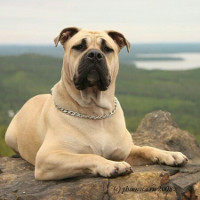
| A typical Molossian of somewhat elongated build, strong and powerful, of medium size. The difference between the sexes is apparent in the head, whose circumference is definitely greater in dogs than in bitches. |
Behaviour / temperament |
| Quiet by nature, he can under some circumstances be courageous and brave. He is at ease with people, faithful and devoted to his master. As a watch and guard dog, he is unsurpassed. In quiet situations, he is trusting and self assured. When roused, his expression is piercing. |
Head |
||
Cranial region |
||
Head |
Strong and massive. | |
Skull |
Large, broad and almost square. Its circumference, specially in males, is greater than the chest measurement taken at the withers. Forehead is broad and flat. Frontal furrow well defined. Seen from the front, due to the shape of the skull, back of skull is not visible. Upper planes of skull and muzzle are almost parallel, lightly converging. | |
Stop |
Seen from side, strongly defined and protruding; seen from front, only noticeable because the eyebrow arches form a definite frontal furrow. | |
Facial region |
||
Foreface |
The jaw muscles are strong, protruding, well developed and reach to the middle region below the eye. Even though there are some folds which occur sideways over the chewing muscles, there are altogether no folds in the skin of the head. | |
Nose |
Black and broad. The philtrum between the nostrils is well defined. | |
Muzzle |
Set on at inner corner of eye, broad and conical, in profile reminiscent of a blunt cone with a broad base. The nasal bridge is staight, rising slightly. Length of muzzle is in proportion of 1 to 3 to length of skull. | |
Lips |
Laterally the upper lip covers the lower lip to the middle part of the muzzle, where the corner of the mouth appears. The upper lip is rather taut, whereas the lower lip is folded in its middle part, so that in a closed muzzle, the lips are not noticeable. The completely red mucous membrane of the mouth cavity has distinct transversal ridges and the rims of the gums have black pigment. | |
Jaws and teeth |
The jaws are strong, incisors in a correct row and canines well apart. The mouth is complete, teeth white and strong. The bite is undershot; the gap of the not exaggerated undershot bite should not be more than 1 cm. When the muzzle is closed, teeth must not be visible. | |
Eyes |
Large, oval in shape, lids wide open, clearly outlined and slightly slanting. Colour should be as dark as possible and according to coat colour. Conjunctiva not visible. Looked at from front, white of eyes should not be visible. The eyes are deep set and far apart. | |
Ears |
Set on high and to the sides, rather small, with inner ear opening visible and drawn backwards in a curve; it is a so called “rose ear”. In repose, the tip of the ear is below the line of the eye. | |
Neck |
| Strong, thick, in harmony to the whole. At set on, roughly the diameter of the head; fitting well into withers. Skin slightly loose; thin dewlap permitted. |
Body |
||
Loin |
Short, relatively narrow, with definite arch towards croup. | |
Croup |
1 to 2 cm higher in position than withers. Slanting to horizontal at an angle of 30 degrees and slightly narrower than chest. | |
Chest |
The rib cage is somewhat cylindrical, deep and reaches to the elbows. As the tops of the shoulder blades are wide apart, the chest is broad at the height of the withers. | |
Underline and belly |
The chest line runs parallel to the ground. The belly line rises and is tucked up lightly, not greyhound-like. | |
Tail |
| Low set on. Thick at root, tapering towards the tip. Hangs naturally in repose; in action it forms a slight curve and is raised to height of the top line. |
Limbs |
Forequarters |
||
Shoulders |
Moderately short, slightly, slanting, hardly protruding. | |
Upper arm |
Straight, parallel, set well apart. | |
Elbows |
Standing away from the chest because of width of breast but in no way turned out. | |
Forearm |
Well muscled, straight, strong bone structure. | |
Forefeet |
Strong with thick, close together, lightly rounded toes. Pads slightly pigmented. | |
Hindquarters |
||
Generality |
Muscles broader than in forequarters. | |
Upper thigh |
Broad, naturally angulated. | |
Hock |
Short, straight, strong. Dewclaws not desired. | |
Hind feet |
Strong with thick toes which are longer than those of front feet but altogether oval in shape. Pigmented pads preferred. | |
Gait and movement |
| The typical movement of this breed is the trot. |
Skin |
| Rather thick. Close fitting to body except on neck, where a slight dewlap may occur. |
Coat |
||
Hair |
Short and rough to the touch. | |
Colour |
Brindle, fawn and black, preference in this order. In brindle dogs, dark tones are preferred, in fawn, the deeper shade is preferred. White patches are permitted on front feet, on chest and on muzzle up to a maximum of 30% of the whole coat. A black mask is also permitted. | |
Size and weight |
||
Height at withers |
For dogs : from 55 to 58 cm. For bitches : from 52 to 55 cm. | |
Weight |
In dogs the weight ranges from 35 to 38 kg. In bitches the weight ranges from 30 to 34 kg. | |
Faults |
| • Any departure from the foregoing points should be considered a fault and the seriousness with which the fault should be regarded should be in exact proportion to its degree and its effect upon the health and welfare of the dog and its ability to perform its traditional work. • Faults listed should be in degree of seriousness. |
Serious faults |
 Dogs which are taller at withers than their height at croup. Undershot by more than 1 cm. Scissor or pincer bite. Lack of two premolars. Lack of rose ears, ears which lie flat, close to cheeks. Ears set on erect, even if the back third is the shape of a rose ear. Tail shaped like a Bulldog’s. Any other serious fault according to the standard. Dogs which are taller at withers than their height at croup. Undershot by more than 1 cm. Scissor or pincer bite. Lack of two premolars. Lack of rose ears, ears which lie flat, close to cheeks. Ears set on erect, even if the back third is the shape of a rose ear. Tail shaped like a Bulldog’s. Any other serious fault according to the standard. |
Disqualifying faults |
| Aggressive or overly shy. Overshot mouth. Light or yellow eyes. Cropped ears or docked tail. White colour which takes up more than 30% of the whole body elsewhere than on front legs, chest and muzzle. Patches of any other colour. |
NB : |
| • Any dog clearly showing physical or behavioural abnormalities shall be disqualified. • The above mentioned faults when occurring to a highly marked degree or frequently are disqualifying. • Male animals should have two apparently normal testicles fully descended into the scrotum. • Only functionally and clinically healthy dogs, with breed typical conformation should be used for breeding. |
Bibliography |
| https://www.fci.be/ |



 English (United Kingdom)

Comments