 |
Havanese Bichon |
|
FCI standard Nº 250 |
||
Origin |
Western Mediterranean basin, development Cuba, patronage FCI | |
Translation |
Mrs. Peggy Davis, revised by R. Triquet | |
Group |
Group 9 Companion and Toy Dogs | |
Section |
Section 1 Bichons and related breeds | |
Working |
Without working trial | |
Acceptance on a definitive basis by the FCI |
Tuesday 24 September 1963 | |
Publication of the official valid standard |
Monday 31 October 2016 | |
Last update |
Monday 12 December 2016 | |
En français, cette race se dit |
 |
Bichon havanais |
Diese Norm ist in deutscher Sprache sichtbar |
 |
Havaneser Bichon |
En español, esta raza se dice |
 |
Bichón Habanero |
In het Nederlands, wordt dit ras gezegd |
 |
Bichon Havanezer |
Usage |
| Companion and toy dog. |
Brief historical summary |
| The breed comes from the Western Mediterranean region and has developed along the Spanish and Italian coastal region. It would seem that these dogs were imported early in Cuba by ocean navigating Italian captains. Erroneously, the most frequent brown colour of these dogs (tobacco) gave birth to the legend which would mean it to be a breed originating from Havana, capital of Cuba. The political events however have led to the total disappearance of the old blood lines of the Havanese in Cuba; apparently a few dogs could be successfully smuggled out from Cuba; their descendants have survived in the U.S.A. |
General appearance |
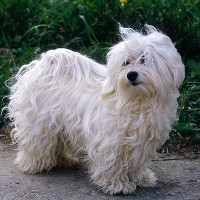
| The Havanese is a sturdy little dog, low on his legs, with long abundant hair, soft and preferably wavy. His movement is lively and elastic. |
Important proportions |
| The length of the muzzle (tip of nose to stop) is equal to the distance between the stop and the occipital protuberance. The relation between the length of the body (measured from the point of the shoulder to the point of the buttock) and the height at the withers is of 4/3. |
Behaviour / temperament |
| Exceptionally bright he is easy to train as alarm dog. Affectionate, of a happy nature, he is amiable, a charmer, playful and even a bit of a clown. He loves children and plays endlessly with them. |
Head |
||
Cranial region |
||
Head |
Of medium length, the relation between the length of the head and that of the trunk (measured from the withers to the base of the tail) is of 3/7. | |
Skull |
Flat to very slightly rounded, broad; forehead hardly rising; seen from above it is rounded at the back and almost straight and square on the other three sides. | |
Stop |
Moderately marked. | |
Facial region |
||
Nose |
Black or brown. | |
Muzzle |
Narrowing progressively and slightly towards the nose but neither snipey nor truncated. | |
Lips |
Fine, lean, tight. | |
Jaws and teeth |
Scissor bite. A complete dentition is desirable. The absence of premolars 1 (PM1) and molars 3 (M3) is tolerated. | |
Cheeks |
Very flat, not prominent. | |
Eyes |
Quite big, almond shape, of brown colour as dark as possible. Kind expression. The eyes rims must be dark brown to black. | |
Ears |
Set relatively high; they fall along the cheeks forming a discreet fold which raises them slightly. Their extremity is in a lightly rounded point. They are covered with hair in long fringes. Neither propeller ears (sticking sideways), nor stuck to the cheeks. | |
Neck |
| Of medium length. |
Body |
||
Body |
The length of the body is slightly superior to that of the height at the withers. | |
Topline |
Topline straight, slightly arched over the loin. | |
Croup |
Noticeably inclined. | |
Chest |
Les côtes sont bien cintrées et le ventre est relevé. | |
Ribs |
Well sprung. | |
Underline and belly |
Well tucked up. | |
Tail |
| Carried high, either in shape of a crozier or preferably rolled over the back; it is furnished with feathering of long silky hair. |
Limbs |
Forequarters |
||
Generality |
Forelegs straight and parallel, lean; good bone structure. The distance from the ground to the elbow must not be greater than that between the elbow and the withers. | |
Hindquarters |
||
Generality |
Good bone structure; moderate angulations. | |
Feet |
| Of slightly elongated shape; small; tight toes. |
Gait and movement |
| According to his happy nature, the Havanese has a strikingly light-footed and elastic gait; forelegs with free stride and pointing straight forward, the hindlegs giving them the impulsion and moving in a straight line. |
Coat |
||
Hair |
Undercoat woolly and not very developed; it is often totally absent. The topcoat is very long (12-18 cm in an adult dog), soft, flat or wavy and may form curly strands. All grooming, the usage of scissors to even out the length of the coat and all trimming is forbidden. Exception : tidying up the hair on the feet is permitted, the hair on the forehead may be slightly shortened so that it does not cover the eyes and the hair on the muzzle may be slightly tidied up, but it is preferable to leave it in natural length. | |
Colour |
Rarely completely pure white, fawn in its different shades (slight blackened overlay admitted), black, havana-brown, tobacco colour, reddish-brown. Patches in mentioned colours allowed. Tan markings in all nuances permitted. | |
Size and weight |
||
Height at withers |
From 23 to 27 cm,tolerance from 21 to 29 cm. | |
Faults |
| • Any departure from the foregoing points should be considered a fault and the seriousness with which the fault should be regarded should be in exact proportion to its degree and its effect upon the health and welfare of the dog and its ability to perform its traditional work. • Faults listed should be in degree of seriousness. |
Serious faults |
 General appearance lacking in type. Truncated or snipey muzzle, length not identical to that of the skull. Bird of prey eyes; eyes too deep set or prominent; rims of eyelids partially depigmented. Body too long or too short. Straight tail, not carried high. « French » front (pasterns too close, feet turned outwards). Deformed hind feet. Coat harsh, not abundant; hair short except on puppies; groomed coat. General appearance lacking in type. Truncated or snipey muzzle, length not identical to that of the skull. Bird of prey eyes; eyes too deep set or prominent; rims of eyelids partially depigmented. Body too long or too short. Straight tail, not carried high. « French » front (pasterns too close, feet turned outwards). Deformed hind feet. Coat harsh, not abundant; hair short except on puppies; groomed coat. |
Disqualifying faults |
| Aggressive or overly shy. Depigmented nose. Upper or lower prognathism. Ectropion, entropion; rim of eyelids of one or both eyes depigmented. Size over or under the indicated norms of the standard. |
NB : |
| • Any dog clearly showing physical or behavioural abnormalities shall be disqualified. • The above mentioned faults when occurring to a highly marked degree or frequently are disqualifying. • Male animals should have two apparently normal testicles fully descended into the scrotum. • Only functionally and clinically healthy dogs, with breed typical conformation should be used for breeding. |
Bibliography |
| https://www.fci.be/ |



 English (United Kingdom)

Comments