
 |
Polish Lowland Sheepdog |
|
FCI standard Nº 251 |
||
Origin |
Poland | |
Translation |
Mrs. Peggy Davis | |
Group |
oup 1 Sheepdogs and Cattle Dogs (except Swiss Cattle Dogs) | |
Section |
Section 1 Sheepdogs | |
Working |
Without working trial | |
Acceptance on a definitive basis by the FCI |
Saturday 05 October 1963 | |
Publication of the official valid standard |
Friday 07 August 1998 | |
Last update |
Friday 07 August 1998 | |
En français, cette race se dit |
 |
Berger polonais de plaine |
Diese Norm ist in deutscher Sprache sichtbar |
 |
Polnischer Niederungshütehund |
En español, esta raza se dice |
 |
Perro de pastor polaco de las llanuras |
In het Nederlands, wordt dit ras gezegd |
 |
Poolse laagland herder |
In his country of origin, his name is |
Polski Owczarek Nizinny |
Usage |
| Easy to handle, he works like a sheepdog and guard dog. Moved to urban city life, he is a very good companion dog. |
General appearance |
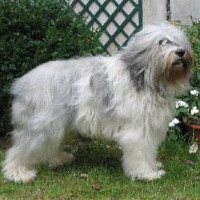
| The Polish Lowland sheepdog is a dog of medium size, compact, strong, muscular, with a thick long coat. His well groomed coat gives an attractive and interesting appearance. |
Important proportions |
| The proportions of height at withers to length of body is 9 : 10. The ratio length of muzzle to length of skull is 1 : 1 ; yet the muzzle can be a little shorter. |
Behaviour / temperament |
| Of a lively but tempered disposition, vigilant, agile, intelligent, perceptive and gifted with a good memory. Resistant to unfavourable climatic conditions. |
Head |
||
Cranial region |
||
Head |
Medium dimension, proportional, not too heavy. The thick fur on the forehead, the cheeks and the chin give the head a look of being heavier than it really is. | |
Skull |
Not excessively broad, slightly rounded. Frontal furrow and occipital protuberance noticeable. | |
Stop |
Well accentuated. | |
Facial region |
||
Nose |
As darks as possible in relation to the colour of the coat with large nostrils. | |
Muzzle |
Strong, blunt. Nasal bridge straight. | |
Lips |
Fitting well; their edges are of the same colour as the nose. | |
Jaws and teeth |
Strong jaws. Teeth strong, with scissor or pincer bite. | |
Eyes |
Medium size, oval, not protruding, hazel colour, with lively and piercing look. The rims of the eyelids are dark. | |
Ears |
Hanging, set rather high, of medium size, heart-shaped, wide at base; the fore edge is close against the cheeks; very mobile. | |
Neck |
| Of medium length, strong, muscled, without dewlap, carried rather horizontally. |
Body |
||
Body |
Rather rectangular than square. | |
Withers |
Well accentuated. | |
Back |
Flat, well muscled. | |
Loin |
Broad, well fused. | |
Croup |
Short, slightly truncated. | |
Chest |
Deep, of medium width; ribs quite well sprung, neither flat nor barrel-shaped. | |
Underline and belly |
Outlining an elegant curve towards the hindquarters part. | |
Tail |
| • Short tail or stumpy-tail, very shortly docked tail. • Undocked quite long and very hairy tail. At rest the tail is hanging; if the dog is alert, the tail is gaily curved over the back, never curled or lying on the back. • Undocked tail of medium length, carried in different manners. |
Limbs |
Forequarters |
||
Generality |
Seen in profile and from the front : Vertical and straight. Stance well balanced due to a strong skeleton (bone structure). | |
Shoulders |
Broad, of medium length, oblique, clean cut, very muscular. | |
Pastern |
Slightly slanting in relation to the forearm. | |
Forefeet |
Oval, tight toes, slightly arched pads really hard. Nails short, as dark as possible. | |
Hindquarters |
||
Generality |
Seen from behind: Vertical, well angulated. | |
Upper thigh |
Broad, well muscled. | |
Hock |
Well developped. | |
Hind feet |
Compact, oval shape. | |
Gait and movement |
| Easy and ground covering. Walk or trot smooth (whitout much vertical displacement). The dog often ambles when he walks slowly. |
Skin |
| Tight fitting, without any folds. |
Coat |
||
Hair |
The whole body covered with coarse hair, dense, thick, and profuse; soft undercoat. Straight or slightly wavy hair is acceptable. The hairs falling from the forehead cover the eyes in a characteristic manner. | |
Colour |
All colours and patches are acceptable. | |
Size and weight |
||
Height at withers |
Males : 45 - 50 cm. Females : 42 - 47 cm. The dog must retain the type of a working dog; consequently his size must not go down below the standard; he must neither be too weak nor delicate. | |
Faults |
| • Any departure from the foregoing points should be considered a fault and the seriousness with which the fault should be regarded should be in exact proportion to its degree and its effect upon the health and welfare of the dog and its ability to perform its traditional work. • Faults listed should be in degree of seriousness. |
Disqualifying faults |
 Aggressive or overly shy. Aggressive or overly shy. |
NB : |
| • Any dog clearly showing physical or behavioural abnormalities shall be disqualified. • The above mentioned faults when occurring to a highly marked degree or frequently are disqualifying. • Male animals should have two apparently normal testicles fully descended into the scrotum. • Only functionally and clinically healthy dogs, with breed typical conformation should be used for breeding. |
Bibliography |
| https://www.fci.be/ |



 English (United Kingdom)

Comments