 |
Alpine Dachsbracke |
|
FCI standard Nº 254 |
||
Origin |
Austria | |
Translation |
C. Seidler | |
Group |
Group 6 Scenthounds and related breeds | |
Section |
Section 2 Leash (scent) hounds | |
Working |
With working trial | |
Acceptance on a definitive basis by the FCI |
Sunday 01 June 1975 | |
Publication of the official valid standard |
Tuesday 10 October 1995 | |
Last update |
Tuesday 18 June 1996 | |
En français, cette race se dit |
 |
Basset des Alpes |
Diese Norm ist in deutscher Sprache sichtbar |
 |
Alpenländischen Dachsbracke |
En español, esta raza se dice |
 |
Dachsbracke de los Alpes |
In het Nederlands, wordt dit ras gezegd |
 |
Alpenlandse Dasbrak |
This breed is also known as |
Alpine-Erzebrigs
|
Usage |
| A robust, weather resistant working dog used by the mountain huntsman. The Alpine Dachsbracke is used as a tracking hound for wounded deer and as scenthound for hare and fox. |
Brief historical summary |
| Already in ancient times, a hunting/shooting dog was used which bore a remarkable resemblance in appearance to the Alpine Dachsbracke. Crown Prince Rudolf of Habsburg in 1881 and 1885 made his gamekeepers from Mursteg and Ischl include Alpine Dachsbracken on his hunting trips to Turkey and to Egypt. In 1932 the “Alpine- Erzgebirgs- Dachsbracke” was recognized by the top canine organisations in Austria as the third Scenthound breed. In 1975 the name was altered to “Alpenländische Dachsbracke” and the F.C.I. declared Austria as the country of origin. In 1991 the Alpenländische Dachsbracke was included in Section 2 of Scenthounds in the FCI nomenclature. |
General appearance |
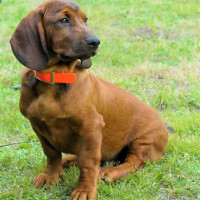
| A short legged, sturdy hunting dog with a robust, strong boned body structure, dense coat, firm muscles. |
Important proportions |
| • Relation of height at shoulder to length of body = 2 : 3. • Relation of facial region to cranial region = 9 : 10. |
Behaviour / temperament |
| Expression intelligent and friendly. Fearless personality. |
Head |
||
Cranial region |
||
Skull |
Lightly arched. Well defined furrow in fore-head, lightly emphasized occiput. | |
Stop |
Pronounced. | |
Facial region |
||
Nose |
Black. | |
Muzzle |
Strong. | |
Lips |
Close fitting with black pigment, moderately rounded curve of lips. | |
Jaws and teeth |
Strong complete teeth with scissor or pincer bite. A complete set with 42 teeth is sought after; the absence of totally two PM1 or PM2 (premolar 1 or 2) is tolerated; the M3 (molar 3) are not taken into account. | |
Eyes |
With dark brown iris. Eyelids close fitting to eyeballs with black pigment. | |
Ears |
Set on high without folds, hanging broad and smooth, medium length (should reach to the canines), well rounded at tips. | |
Neck |
| Muscular, not too long. |
Body |
||
Body |
Trunk strong and well muscled, elongated. | |
Withers |
Moderately emphasized. | |
Back |
Straight. | |
Loin |
Short and broad. | |
Croup |
Barely sloping. | |
Chest |
Deep and broad with pronounced forechest. Depth of chest should be about half the height at shoulder. | |
Underline and belly |
Belly moderately tucked up. | |
Tail |
| Set on high, thick at root. Longer hair on underside (brush tail); reaching barely to ground, carried slightly downward. |
Limbs |
Forequarters |
||
Generality |
Front legs are straight and strong; they appear short in relation to the body. | |
Shoulders |
Shoulder blade close fitting, long, sloping and strongly muscled. | |
Hindquarters |
||
Generality |
Muscular, strong and well angulated. Seen from the rear, the axis of the legs is straight. | |
Feet |
| Front and hind feet strong, round, toes tight against each other. Strong pads and black nails. |
Gait and movement |
| Movement is ground covering, not tripping. Preferred gait : Trot. |
Skin |
| Elastic and strong, without wrinkles. |
Coat |
||
Hair |
The double coat consists of very thick top coat and a dense undercoat, which covers the whole body and is close fitting. | |
Colour |
The ideal colour is dark deer red with or without black hairs lightly interspersed. Also black with clearly defined red-brown markings on head (Vieräugl), chest, legs, feet and underside of tail. White star on chest permitted. | |
Size and weight |
||
Height at withers |
34-42 cm. Ideal height for dogs 37-38 cm, Ideal height for bitches : 36-37 cm. | |
Faults |
| • Any departure from the foregoing points should be considered a fault and the seriousness with which the fault should be regarded should be in exact proportion to its degree and its effect upon the health and welfare of the dog and its ability to perform its traditional work. • Faults listed should be in degree of seriousness. |
General faults |
 Weak bone. Lack of muscle. Too pointed, too short or too long in muzzle. Too light eye, lids not close fitting. Short or pointed leathers. Loose shoulders. Wrong stance of front or hind legs. Coat too thin or too short. Slight departure from correct colour. Weak bone. Lack of muscle. Too pointed, too short or too long in muzzle. Too light eye, lids not close fitting. Short or pointed leathers. Loose shoulders. Wrong stance of front or hind legs. Coat too thin or too short. Slight departure from correct colour. |
Disqualifying faults |
| Aggresive or overly shy. Any deviation which will hinder ability to hunt. Lack of more than two premolars 1 or 2 (the M3 are not taken into account). Height at withers less than 34 cm and more than 42 cm. Weakness in temperament. |
NB : |
| • Any dog clearly showing physical or behavioural abnormalities shall be disqualified. • The above mentioned faults when occurring to a highly marked degree or frequently are disqualifying. • Male animals should have two apparently normal testicles fully descended into the scrotum. • Only functionally and clinically healthy dogs, with breed typical conformation should be used for breeding. |
Bibliography |
| https://www.fci.be/ |



 English (United Kingdom)

Comments