 |
Old Danish Pointing Dog |
|
FCI standard Nº 281 |
||
Origin |
Denmark | |
Group |
Group 7 Pointing dogs | |
Section |
Section 1.1 Continental pointing dogs, « Braque » type | |
Working |
With working trial | |
Acceptance on a definitive basis by the FCI |
Wednesday 02 April 1969 | |
Publication of the official valid standard |
Thursday 08 January 1998 | |
Last update |
Monday 12 October 1998 | |
En français, cette race se dit |
 |
Chien d'arrêt danois ancestral |
Diese Norm ist in deutscher Sprache sichtbar |
 |
Altdänischer Vorstehhund |
En español, esta raza se dice |
 |
Antiguo perro de muestra Danés |
In het Nederlands, wordt dit ras gezegd |
 |
Voorouderlijke Deense checkhond |
In his country of origin, his name is |
Gammel Dansk Hønsehund |
Usage |
| Versatile gundog for birds. |
Brief historical summary |
| The origin of the breed can be traced back to the year about 1710 when a man named Morten Bak, living in Glenstrup near the towns of Randers and Hobro, through 8 generations was crossing gypsy dogs with local farmdogs and in this way established a pure breed of piebald white and brown dogs called Bakhounds or Old Danish Pointing Dogs. The local farmers called their farmdogs « Bloodhounds », but it seems more likely that these hounds were offspring from the Squire’s scent hounds, which in their turn were descendants from mainly St. Hubert Hounds (Bloodhounds). Likewise it is probable that the gypsy dogs generally descended from Spanish pointing Dogs and other breeds of scent hounds like the ones mentioned above, so in many ways St.Hubert Hounds have contributed to the breed Old Danish Pointing Dog. |
General appearance |
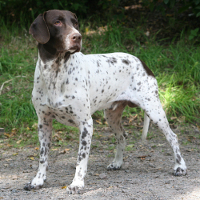
| Medium sized dog, rectangular and strongly built. One of the most charming features of the breed is the great difference between male and female. While the dog is powerful and substantial, the bitch is characterized by being lighter, more spirited and capricious. |
Important proportions |
| The ratio of height at withers to length of body is about 8 : 9. |
Behaviour / temperament |
| Conveys the impression of a quiet and stable dog showing determination and courage. During the hunt progressing rather slowly, always maintaining contact with the hunter and accomplishing its task as a pointing Dog without creating unnecessary disturbance of the ground. The breed is suited for small as well as large hunting grounds. |
Head |
||
Cranial region |
||
Head |
Short and wide, without pronounced stop. Occiput prominent and clearly visible from any angle. | |
Skull |
Sufficiently wide and distinctly rounded. | |
Stop |
Not pronounced. | |
Facial region |
||
Nose |
Fleshy, strongly defined, nostrils wide open. Colour from dark to more light liver. | |
Muzzle |
Bridge of nose wide. | |
Lips |
Flews deep all the way from the nose and covering the lower jaw. The deep flews contribute to giving the head its characteristic depth. | |
Jaws and teeth |
Powerful jaws with regular scissor bite. Full dentition wanted. | |
Cheeks |
Well defined and deep, very muscular. | |
Eyes |
Medium sized, neither sunk nor prominent. Dark brown colour desirable. Considering the origin of the breed a slight drooping of the lower eyerim is tolerated, but should not be encouraged. | |
Ears |
Set rather low, broad and slightly rounded at the ends. Length is correct if the ear, when held towards the nose, will leave free a little more than the outer third of muzzle. Front edge of ear should hang nicely close to the cheek. | |
Neck |
| Muscular and well furnished. Throatiness is considered a hallmark of the breed, but should not be exaggerated. |
Body |
||
Withers |
Well defined. Highest point of topline at the withers, falling slightly to the croup. | |
Back |
Firm and very muscular. | |
Loin |
Short, wide and muscular, strongly coupled. | |
Croup |
Broad, not too short, slightly sloping towards set-on of tail. | |
Chest |
Deep and wide ; a good width desired especially for males. Brisket reaches down to elbows. Ribs well sprung and reaching far back. Ribcage neither flat nor barrel-shaped. A well developed forechest is most desirable. | |
Tail |
| Set somewhat high rather than too low. Fairly wide at base, tapering towards the end. Medium length, reaching almost to the hocks. Tail is carried naturally drooping. Docking is not allowed. |
Limbs |
Forequarters |
||
Generality |
Viewed from the front strong, straight and parallel. | |
Shoulders |
Lying flat and tight against the chest, with strong muscles clearly showing when moving or standing. | |
Upper arm |
Of good length, very muscular. | |
Elbows |
Close, but not too tight to the body, neither turned in nor out, set rather far back. Good angulation upper/lower arm. | |
Forearm |
Straight, with powerful muscles and good bone. | |
Carpal |
Powerful. | |
Pastern |
Slightly bent in relation to the forearm. | |
Forefeet |
Strong and firm, well arched and with tough pads. | |
Hindquarters |
||
Generality |
Viewed from behind straight and parallel. Good angulation and powerful bone. | |
Upper thigh |
Muscular, fairly long and broad. Good angulation pelvis/thigh. | |
Lower thigh |
Fairly long, muscular. | |
Stifle |
Strong, well bent. | |
Metatarsus |
Slight angulation to lower thigh. | |
Hock |
Strong and powerful. | |
Hind feet |
Strong and firm, well arched and with tough pads. | |
Gait and movement |
| Reachy strides with good drive from behind and corresponding reach in front. Movement straight and parallel front and rear. Good, high carriage of head. |
Skin |
| Not too fine, rather tight fitting on body and limbs. On head and neck the skin is more loose, forming dewlap and fold at the corners of the lips. |
Coat |
||
Hair |
Short and dense, somewhat hard to the touch. Hair must cover the body entirely. | |
Colour |
White with brown markings, a few large or many small, brown specks ( freckles) on white. The brown colour may vary, but brown to dark brown is preferred. | |
Size and weight |
||
Height at withers |
Male 54-60 cm, above 56 cm preferred, bitch 50-56 cm, above 52 cm preferred. | |
Weight |
Mature male 30-35 kg, bitch 26-31 kg. | |
Faults |
| • Any departure from the foregoing points should be considered a fault and the seriousness with which the fault should be regarded should be in exact proportion to its degree and its effect upon the health and welfare of the dog and its ability to perform its traditional work. • Faults listed should be in degree of seriousness. |
General faults |
 Bad carriage of head. Nose flesh-coloured or spotted. Muzzle too short. Flews insufficiently deep. Missing one or two PM1. Eyes too light. Slight roach back. Croup too short. Tail carried too high over topline. Slightly bow-legged, slightly cow-hocked. Hair too sparse. Small departures in size (1-2 cm) above and below limits. Bad carriage of head. Nose flesh-coloured or spotted. Muzzle too short. Flews insufficiently deep. Missing one or two PM1. Eyes too light. Slight roach back. Croup too short. Tail carried too high over topline. Slightly bow-legged, slightly cow-hocked. Hair too sparse. Small departures in size (1-2 cm) above and below limits. |
Serious faults |
| Bone too fine. Pronounced stop. Muzzle snipey. Pincer bite. Missing teeth one tooth other than PM1. Pronounced roach back, slight swayback. Obvious lack in chest development. Brisket not sufficiently defined. Ribcage too flat or barrel shaped. Elbows turned strongly in or out. Heavily cow-hocked or bow-legged. Weak pasterns. Flat or splay-feet. Weak, timid behaviour. |
Disqualifying faults |
| Aggresive or overly shy. Strong deviation in sex characteristics. Teeth : More than two P1 plus one other tooth missing. Non-visible teeth will be considered missing unless their existence at a previous show can be certified. Undershot, overshot bite or any other faulty bite. Cleft palate or hare lip. Ectropion, entropion, distichiasis (double row of eyelashes). Malformation of chest or ribcage ( eg too short sternum causing abrupt rise of underline behind ribs). Deviations from size more than 2 cm above or below limits. Very shy and weak behaviour. |
NB : |
| • Any dog clearly showing physical or behavioural abnormalities shall be disqualified. • The above mentioned faults when occurring to a highly marked degree or frequently are disqualifying. • Male animals should have two apparently normal testicles fully descended into the scrotum. • Only functionally and clinically healthy dogs, with breed typical conformation should be used for breeding. |
Bibliography |
| https://www.fci.be/ |



 Deutsch (Deutschland)
  English (United Kingdom)

Comments