 |
Beagle-Harrier |
|
FCI standard Nº 290 |
||
Origin |
France | |
Translation |
Mrs Peggy Davis | |
Group |
Group 6 Scenthounds and related breeds | |
Section |
Section 1.2 Medium-sized Hounds | |
Working |
With working trial | |
Acceptance on a definitive basis by the FCI |
Saturday 02 September 1972 | |
Publication of the official valid standard |
Tuesday 01 August 2023 | |
Last update |
Friday 06 October 2023 | |
En français, cette race se dit |
 |
Beagle-Harrier |
Diese Norm ist in deutscher Sprache sichtbar |
 |
Beagle-Harrier |
En español, esta raza se dice |
 |
Beagle-Harrier |
In het Nederlands, wordt dit ras gezegd |
 |
Beagle-Harrier |
Usage |
| Scenthound. |
Brief historical summary |
| It is a French hunter, Baron Gerard, who created the breed in the late 19th century, from the Beagle and the Harrier, two dogs typically British. The goal was to bring the intrinsic qualities of these two races (speed and flair) to obtain a hunting dog with hare. Very rare commodity, it is found that in France where it is used today for the hare, deer, fox and even wild boar. |
General appearance |
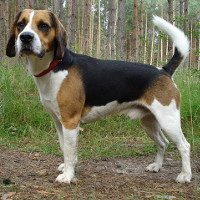
| Dog of medium proportions, balanced distinguished, agile and vigorous. |
Head |
||
Cranial region |
||
Head |
Moderately strong. | |
Skull |
Rather broad and quite voluminous. Occipital protuberance hardly marked. | |
Stop |
Not pronounced. | |
Facial region |
||
Nose |
Developed, black. | |
Muzzle |
Its length is roughly equal to that of the skull. Never square, but in profile tapering without being pointed. | |
Lips |
Covering the lower jaw. | |
Nasal bridge |
Nasal bridge rather straight, never arched. | |
Eyes |
Well open, dark in colour, of a frank, lively and intelligent expression. | |
Ears |
Quite short and medium-broad; they are set at eye level; they are slightly rounded in their medium part; they come down flat against the skull to turn slightly in their lower part in a slight oval. | |
Neck |
| Free although well attached to the shoulders, slightly arched in profile in its upper part. |
Body |
||
Back |
Short, well sustained and muscled. | |
Loin |
Strong and muscled; can be slightly arched. | |
Chest |
Well set down, but ribs never too flat, which could reduce the thoracic cage too much. Sternum well extended to the rear. The false ribs, without being cylindrical, must nevertheless be long and sufficiently well sprung so as to provide an ample thoracic cage. | |
Underline and belly |
Belly never very tucked up, rather filled out. | |
Limbs |
Forequarters |
||
Generality |
Strong, straight and parallel. | |
Shoulders |
Long, oblique and muscled. | |
Hindquarters |
||
Generality |
Hips well detached, oblique and strong. | |
Upper thigh |
Well let down, fleshy and muscular. | |
Hock |
Close to the ground and vertical. | |
Feet |
| Neither too long nor slim, but tight with thick and hard pads. |
Gait and movement |
| Supple, lively and sure. |
Coat |
||
Hair |
Rather thick, not too short but flat. | |
Colour |
Tri-colour (fawn with black blanket, and white); not too much importance should be given to the blanket, with markings more or less bright tan, or pale, or with black overlay. Because there exist grey Harrier, the grey tri-colours or the white-greys would not be either disqualified or penalised only because of their colour. | |
Size and weight |
||
Height at withers |
From 45 cm to 50 cm. | |
Faults |
| • Any departure from the foregoing points should be considered a fault and the seriousness with which the fault should be regarded should be in exact proportion to its degree and its effect upon the health and welfare of the dog and its ability to perform its traditional work. • Faults listed should be in degree of seriousness. |
General faults |
 Head too heavy. Stop too pronounced. Butterfly nose. Muzzle too short and square; muzzle too pointed. Nasal bridge arched. Over- or undershot mouth. Curled ears, recalling and infusion of French blood. Feet flat and splayed. Depigmented scrotum. Frightened apperance, soft or unintelligent. Head too heavy. Stop too pronounced. Butterfly nose. Muzzle too short and square; muzzle too pointed. Nasal bridge arched. Over- or undershot mouth. Curled ears, recalling and infusion of French blood. Feet flat and splayed. Depigmented scrotum. Frightened apperance, soft or unintelligent. |
Disqualifying faults |
| Aggressive or overly shy dogs. |
NB : |
| • Any dog clearly showing physical or behavioural abnormalities shall be disqualified. • The above mentioned faults when occurring to a highly marked degree or frequently are disqualifying. • Male animals should have two apparently normal testicles fully descended into the scrotum. • Only functionally and clinically healthy dogs, with breed typical conformation should be used for breeding. |
Bibliography |
| https://www.fci.be/ |



 English (United Kingdom)

Comments