
 |
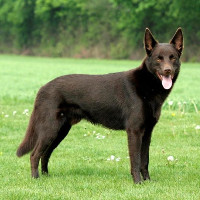
Australian Kelpie |
|
FCI standard Nº 293 |
||
Origin |
Australia | |
Group |
Group 1 Sheepdogs and Cattledogs (except Swiss Cattledogs) | |
Section |
Section 1 Sheepdogs | |
Working |
With working trial | |
Acceptance on a definitive basis by the FCI |
Monday 03 September 1973 | |
Publication of the official valid standard |
Monday 08 October 2012 | |
Last update |
Tuesday 11 December 2012 | |
En français, cette race se dit |
 |
Kelpie australien |
Diese Norm ist in deutscher Sprache sichtbar |
 |
Australischer Kelpie |
En español, esta raza se dice |
 |
Australian Kelpie |
In het Nederlands, wordt dit ras gezegd |
 |
Australian Kelpie |
Usage |
| Sheepdog. |
Brief historical summary |
| Following the opening of vast areas of land in the Australian States of New South Wales and Victoria, the sheep numbers increased so dramatically that some properties were over two million acres and ran over a quarter of a million sheep. In areas as extensive as these, herding (originally carried out by convicts) was impractical, wire fences were erected and sheep were left to run free. It was then necessary to have dogs to handle sheep in such large areas. A dog had to be developed to work in the conditions present in Australia. These conditions included heat, rough terrain, dust storms and vast distances. The Kelpie being able to perform the work of several men. Tireless workers in the hottest and dustiest of climates. Like so many breeds, the origin of the Kelpie is disputed. There is no doubt, however, that the origin of the breed came from dogs imported from Scotland. These dogs were black and tan, long-haired with semi- pricked ears, medium sized and of Collie type. Others were smooth haired with erect ears but still of Collie type. Litters from these dogs also produced red (liverbrown) puppies. |
General appearance |
| The general appearance shall be that of a lithe, active dog of great quality, showing hard muscular condition combined with great suppleness of limb and conveying the capability of untiring work. It must be free from any suggestion of weediness. |
Important proportions |
| The length of the dog from the forechest, in a straight line to the buttocks, is greater than the height at the withers, as 10 is to 9. |
Behaviour / temperament |
| The Kelpie is extremely alert, eager and highly intelligent, with a mild, tractable disposition and an almost inexhaustible energy, with marked loyalty and devotion to duty. It has a natural instinct and aptitude in working of sheep, both in open country and in the yard. Any defect of structure or temperament foreign to a working dog must be regarded as uncharacteristic. |
Head |
||
Cranial region |
||
Head |
The head is in proportion to the size of the dog. The overall shape and contours produce a rather fox like expression, which is softened by the almond-shaped eyes. | |
Skull |
Slightly rounded and broad between the ears. The forehead running in a straight profile towards the stop. | |
Stop |
Pronounced. | |
Facial region |
||
Nose |
The colour conforms to that of the body coat. | |
Muzzle |
Cleanly chiselled and defined, preferably slightly shorter in length than the skull. | |
Lips |
Tight and clean, free from looseness. | |
Jaws and teeth |
The teeth should be sound, strong and evenly spaced, the lower incisors just behind but touching the upper; that is a scissor bite. | |
Cheeks |
Neither coarse nor prominent, but round to the foreface. | |
Eyes |
The eyes are almond shaped, of medium size, clearly defined at the corners, and show an intelligent and eager expression. The colour of the eyes to be brown, harmonising with the colour of the coat. In the case of blue dogs a lighter coloured eye is permissible. | |
Ears |
The ears are pricked and running to a fine point at the tips, the leather fine but strong at the base, set wide apart on the skull and inclining outwards, slightly curved on the outer edge and of moderate size. The inside of the ears are well furnished with hair. | |
Neck |
| The neck is of moderate length, strong, slightly arched, gradually moulding into the shoulders, free from throatiness and showing a fair amount of ruff. |
Body |
||
Topline |
Firm, level. | |
Loin |
Strong and well muscled. Flanks of good depth. | |
Croup |
Rather long and sloping. | |
Chest |
Deep, muscular and moderately broad. Ribs well sprung and carried well back, not barrel ribbed. | |
Tail |
| The tail during rest should hang in a very slight curve. During movement of excitement it may be raised, but under no circumstances should the tail be carried past a vertical line drawn through the root. It should be furnished with a good brush. Set on a position to blend with sloping croup, and it should reach approximately to the hock. |
Limbs |
Forequarters |
||
Generality |
The forelegs should be muscular with strong but refined bone, straight and parallel when viewed from the front. | |
Shoulders |
Clean, muscular, well sloping with the shoulder-blades close set at the withers. | |
Upper arm |
Should be at a right angle with the shoulder-blade. | |
Elbows |
Neither in nor out. | |
Pastern |
When viewed from the side, the pasterns should show a slight slope to ensure flexibility of movement and the ability to turn quickly. | |
Forefeet |
The feet should be round, strong, deep in pads, with close knit well arched toes and strong, short nails. | |
Hindquarters |
||
Generality |
Should show breadth and strength. When viewed from behind, the hind legs, from the hocks to the feet, are straight and placed parallel, neither close nor too wide apart. | |
Stifle |
Well turned. | |
Hock |
Fairly well let down. | |
Hind feet |
The feet should be round, strong, deep in pads, with close knit well arched toes and strong short nails. | |
Gait and movement |
| To produce the almost limitless stamina demanded of a working sheepdog in wide open spaces, the kelpie must be perfectly sound, both in construction and movement. Movement should be free and tireless and the dog must have the ability to turn suddenly at speed. When trotting the feet tend to come closer together at ground level as speed increases, but when the dog comes to rest it stands four square. |
Coat |
||
Hair |
The coat is a double coat with a short dense undercoat. The outer coat is close, each hair straight, hard and lying flat, so that it is rain-resisting. Under the body, to behind the legs, the coat is longer and forms near the thigh a mild form of breeching. On the head (including the inside of the ears), to the front of the legs and feet, the hair is short. Along the neck it is longer and thicker forming a ruff. The tail should be furnished with a good brush. A coat either too long or too short is a fault. As an average, the hairs on the body should be from 2 to 3 cms in length. | |
Colour |
Black, black and tan, red, red and tan, fawn, chocolate, and smoke blue. | |
Size and weight |
||
Height at withers |
Males : 46 to 51 cms. Females : 43 to 48 cms. | |
Faults |
| • Any departure from the foregoing points should be considered a fault and the seriousness with which the fault should be regarded should be in exact proportion to its degree and its effect upon the health and welfare of the dog and its ability to perform its traditional work. • Faults listed should be in degree of seriousness. |
Serious faults |
 Loose shoulders. Any tendency of cow- or bow hocked. Weaving or plating movement. Movement that is restricted or shows stiltedness. Loose shoulders. Any tendency of cow- or bow hocked. Weaving or plating movement. Movement that is restricted or shows stiltedness. |
Disqualifying faults |
| Aggressive or overly shy dogs. |
NB : |
| • Any dog clearly showing physical or behavioural abnormalities shall be disqualified. • The above mentioned faults when occurring to a highly marked degree or frequently are disqualifying. • Male animals should have two apparently normal testicles fully descended into the scrotum. • Only functionally and clinically healthy dogs, with breed typical conformation should be used for breeding. |
Bibliography |
| https://www.fci.be/ |



 English (United Kingdom)

Comments