
 |
German hound |
|
FCI standard Nº 299 |
||
Origin |
Germany | |
Translation |
C. Seidler, revised by Dr. Paschoud | |
Group |
Group 6 Scenthounds and related breeds | |
Section |
Section 1.3 Small sized hounds | |
Working |
With working trial | |
Acceptance on a definitive basis by the FCI |
Tuesday 28 January 1964 | |
Publication of the official valid standard |
Tuesday 24 June 1997 | |
Last update |
Monday 15 September 1997 | |
En français, cette race se dit |
 |
Brachet allemand |
Diese Norm ist in deutscher Sprache sichtbar |
 |
Deutsche Bracke |
En español, esta raza se dice |
 |
Sabueso aleman |
In het Nederlands, wordt dit ras gezegd |
 |
Duitse Brak |
Usage |
| Hound. |
Brief historical summary |
| From the formerly numerically strong varieties of the Bracken, the only one surviving in Germany is the Westphalian Bracke. Its most significant local variety was the tricolour Sauerländer Holzbracke. Through melting this type with local Steinbracken, one certain type has evolved, which since 1900 has been designated as the Deutsche Bracke (German Bracke / Hound). |
General appearance |
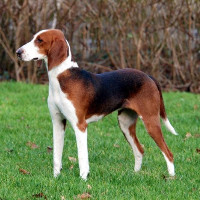
| That of a light, high stationed, elegant, yet strongly made hunting dog with a noble, comparatively fine head, good leathers and a well carried but in respect of the noble general appearance, remarkably thick tail. Slightly tucked up abdomen. |
Important proportions |
| Length of head in dogs of medium size approximately 21 cm, from muzzle to beween eyes about 9 cm. |
Head |
||
Cranial region |
||
Head |
Fine, clean, elongated. Seen from the front, the head appears narrow and long, the skull only little broader than the not sharply protruding cheeks which merge very gradually with the muzzle. | |
Skull |
Slightly domed, occiput protrudes but only slightly. | |
Stop |
Minimal. | |
Facial region |
||
Nose |
Has a light, almost flesh coloured strip in its middle, while the wings of the nose have more or less dark pigment. | |
Lips |
Moderately pendant, corner of mouth small. | |
Nasal bridge |
Very slightly convex. | |
Jaws and teeth |
Extremely strong and even. Incisors meet either on top of each other or the inside of the upper incisors touches the outside of the lower incisors. Canines particularly strongly developed. | |
Eyes |
Dark, clear with friendly expression. | |
Ears |
Long, about 14 cm and broad, about 9 cm, close fitting and rounded at ends. | |
Neck |
| Moderate length and rather strong in relation to the head. |
Body |
||
Back |
Slightly arched. | |
Croup |
Falling away slightly. | |
Chest |
Deep, reaching to below elbows. Flatly rounded with long ribcage. | |
Tail |
| Long, not noticeably strong at the root. As a protection against knocking against tree trunks and branches, it has bushy long hair and is therefore comparatively thick, yet tapering to a point and somewhat brush-like. Tail is carried hanging down or upwards in a gentle curve. |
Limbs |
Forequarters |
||
Generality |
High, very well made, lean, fine boned and sinewy. | |
Shoulders |
Clean. | |
Elbows |
Close fitting. | |
Hindquarters |
||
Upper thigh |
Thighs broad and full in profile. | |
Lower thigh |
Lower thigh long and not very broad, well angulated. | |
Feet |
| Longer than cat-feet, coarse, very tight toes. |
Coat |
||
Hair |
Long for a short haired dog. Very dense, hard, almost bristly. Well coated and dense on belly. Generally a little longer on underside of tail forming a moderate brush. Buttocks (thighs) well breeched. | |
Colour |
Red to yellow with black saddle or blanket and the white "Bracken" markings : blaze running through, white muzzle with neck ring (closed neck ring should be aimed for), white chest, legs and tip of tail. | |
Size and weight |
||
Height at withers |
40 to 53 cm, moderate departure from these measurements permitted. | |
Faults |
| • Any departure from the foregoing points should be considered a fault and the seriousness with which the fault should be regarded should be in exact proportion to its degree and its effect upon the health and welfare of the dog and its ability to perform its traditional work. • Faults listed should be in degree of seriousness. |
General faults |
 Long cast, low body shape. Teckel-like (Dachshund type) head. Pointed, folded or short leathers. Sickle or ring tail. Faulty legs. Splayed, incorrect feet. Chocolate colour, particolour. Particolour. Long cast, low body shape. Teckel-like (Dachshund type) head. Pointed, folded or short leathers. Sickle or ring tail. Faulty legs. Splayed, incorrect feet. Chocolate colour, particolour. Particolour. |
Disqualifying faults |
| Aggressive or overly shy dogs. |
NB : |
| • Any dog clearly showing physical or behavioural abnormalities shall be disqualified. • The above mentioned faults when occurring to a highly marked degree or frequently are disqualifying. • Male animals should have two apparently normal testicles fully descended into the scrotum. • Only functionally and clinically healthy dogs, with breed typical conformation should be used for breeding. |
Bibliography |
| https://www.fci.be/ |



 English (United Kingdom)

Comments