 |
American Foxhound |
|
FCI standard Nº 303 |
||
Origin |
U.S.A. | |
Group |
Group 6 Scenthounds and related breeds. | |
Section |
Section 1.1 Large-sized hounds | |
Working |
With working trial | |
Acceptance on a definitive basis by the FCI |
Friday 02 November 1979 | |
Publication of the official valid standard |
Friday 02 November 1979 | |
Last update |
Thursday 05 March 1998 | |
En français, cette race se dit |
 |
American Foxhound |
Diese Norm ist in deutscher Sprache sichtbar |
 |
Americanischer Foxhound |
En español, esta raza se dice |
 |
Foxhound americano |
In het Nederlands, wordt dit ras gezegd |
 |
Amerikaanse Foxhound |
Usage |
| Hound. |
Brief historical summary |
| The trace of the American Foxhound has been found in Maryland in the United States around 1650. This is the oldest American hound. His background is English hunting dogs. A British farmer Robert Brooke had imported English foxhounds in the United States. Under the influence of George Washington, he made crosses with hounds English, Irish and French packs of dogs sent by Lafayette in order to obtain the ideal dog for fox hunting. It was recognized by the Kennel Club in 1984. Although race is highly regarded in his country, a dog is not widespread. |
General appearance |
| Enduring, rather overbearing, this dog works better alone than in groups. It can get used to family life provided he can satisfy his great need for exercise. The foxhounds have a particular voice, which allows each master to recognize his dog. |
Behaviour / temperament |
| This is a very affectionate and loving dog, not a fighter. It remains an excellent companion for the whole family. Like any pet, they need exercise and space to gallop. They say sweet and determined, strong and brave work. The foxhound is a fast dog regardless of road conditions that borrows nose to the ground. His voice is so melodious that its modulations were imitated in popular song. |
Head |
||
Cranial region |
||
Head |
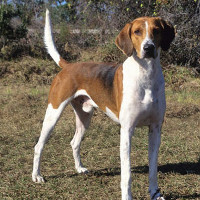
Should be fairly long, slightly domed at occiput. | |
Skull |
Broad and full. | |
Stop |
Moderately defined. | |
Facial region |
||
Muzzle |
Of fair length, straight and square-cut. | |
Eyes |
Large, set well apart, soft and houndlike; expression gentle and pleading. Colour brown or hazel. | |
Ears |
Set on moderately low, long, reaching when drawn out nearly, if not quite, to the tip of the nose; fine in texture; fairly broad, with almost entire absence of erectile power; setting close to the head with the forward edge slightly inturning to the cheek; round at tip. | |
Neck |
| Rising free and light from the shoulders, strong in substance, yet not loaded, of medium length. The throat clean and free from folds of skin, a slight wrinkle below the angle of the jaw, however, is allowable. |
Body |
||
Back |
Moderately long, muscular and strong. | |
Loin |
Broad and slightly arched. | |
Chest |
Should be deep for lung space, narrower in proportion to depth than the English Hound, 28 inches girth (71 cm) in a 23-inch (58 cm) hound being good. | |
Ribs |
Well sprung; back ribs should extend well back. | |
Side |
A three-inch (7,6 cm) flank allowing springiness. | |
Tail |
| Set moderately high; carried gaily, but not turned forward over the back; with slight curve; with very slight brush. |
Limbs |
Forequarters |
||
Generality |
Forelegs straight, with fair amount of bone. | |
Shoulders |
Sloping, clean, muscular, not heavy or loaded, conveying the idea of freedom of action with activity and strength. | |
Pastern |
Short and straight. | |
Forefeet |
Foxlike. Well arched toes, strong nails, pads full and hard. | |
Hindquarters |
||
Upper thigh |
Strong and muscled, giving abundance of propelling power. | |
Stifle |
Strong and well let down. | |
Hock |
Firm, symmetrical and moderately bent. | |
Hind feet |
Close and firm. | |
Coat |
||
Hair |
Close, hard hound coat of medium length. | |
Colour |
Any colour. | |
Size and weight |
||
Height at withers |
Dogs should not be under 22 or over 25 inches (56-63,5 cm). Bitches should not be under 21 or over 24 inches (53-61 cm), measured across the back at the point of the withers, the hound standing in a natural position with his feet well under him. | |
Weight |
Between 30 to 34 kg for males and from 25 to 34 kg for females. | |
Faults |
| • Any departure from the foregoing points should be considered a fault and the seriousness with which the fault should be regarded should be in exact proportion to its degree and its effect upon the health and welfare of the dog and its ability to perform its traditional work. • Faults listed should be in degree of seriousness. |
General faults |
 Skull very flat, narrow across the top; excess of dome. Roman-nosed, or upturned, giving a dish-face expression. Muzzle long and snipey, cut away decidedly below the eyes, or very short. Eyes small, sharp and terrierlike, or prominent and protruding. Ears short, set-on high, or with a tendency to rise above the point of origin. Neck thick, short, cloddy, carried on a line with the top of the shoulders. Throat showing dewlap and folds of skin to a degree termed throatiness ». Back very long, swayed or roached back. Loins flat, narrow. Chest disproportionately wide or with lack of depth. Ribs flat. Tail long. Teapot curve or inclining forward from the root. Rat tail. Entire absence of brush. Forelegs crooked. Shoulders straight, upright. Out at elbow. Carpus knuckled over forward or bent backward. Cowhocks or straight hocks. Feet long, open or spreading. Lack of muscle and propelling power. Coat short, thin, or of a soft quality. Skull very flat, narrow across the top; excess of dome. Roman-nosed, or upturned, giving a dish-face expression. Muzzle long and snipey, cut away decidedly below the eyes, or very short. Eyes small, sharp and terrierlike, or prominent and protruding. Ears short, set-on high, or with a tendency to rise above the point of origin. Neck thick, short, cloddy, carried on a line with the top of the shoulders. Throat showing dewlap and folds of skin to a degree termed throatiness ». Back very long, swayed or roached back. Loins flat, narrow. Chest disproportionately wide or with lack of depth. Ribs flat. Tail long. Teapot curve or inclining forward from the root. Rat tail. Entire absence of brush. Forelegs crooked. Shoulders straight, upright. Out at elbow. Carpus knuckled over forward or bent backward. Cowhocks or straight hocks. Feet long, open or spreading. Lack of muscle and propelling power. Coat short, thin, or of a soft quality. |
Disqualifying faults |
| Aggressive or overly shy dogs. |
NB : |
| • Any dog clearly showing physical or behavioural abnormalities shall be disqualified. • The above mentioned faults when occurring to a highly marked degree or frequently are disqualifying. • Male animals should have two apparently normal testicles fully descended into the scrotum. • Only functionally and clinically healthy dogs, with breed typical conformation should be used for breeding. |
Bibliography |
| https://www.fci.be/ |



 English (United Kingdom)

Comments