 |
Kooikerhondje |
|
FCI standard Nº 314 |
||
Origin |
The Netherlands | |
Translation |
Lydia K. M. Erhart Revised by Renée Sporre-Willes / Original version : (EN) |
|
Group |
Group 8 Retrievers – Flushing Dogs – Water Dogs | |
Section |
Section 2 Flushing Dogs | |
Working |
Without working trial | |
Acceptance on a definitive basis by the FCI |
Wednesday 31 January 1990 | |
Publication of the official valid standard |
Wednesday 13 October 2010 | |
Last update |
Wednesday 19 January 2011 | |
En français, cette race se dit |
 |
Kooikerhondje |
Diese Norm ist in deutscher Sprache sichtbar |
 |
Kooikerhondje |
En español, esta raza se dice |
 |
Kooikerhondje |
In het Nederlands, wordt dit ras gezegd |
 |
Kooikerhondje |
Usage |
| Sporting and Companion Dog used for duck decoy. |
Brief historical summary |
| In 1942, during the Second World War, the Baroness Van Hardenbroek van Ammerstol began to recreate the Kooikerhondje. She gave a picture of the type of dog she was looking for to a pedlar and asked him to look out for such dogs. At a farm in the province of Friesland he found the bitch now well known as Tommy. She became the founding bitch of the Kooikerhondje. In 1966 the Raad van Beheer adopted the interim breed and in 1971 the breed was officially recognized. The Kooikerhondje was and still is used in the duck decoys. His task is still to lure the ducks into the decoy with his gaily waving tail; he does not hunt the ducks. He calmly moves between the decoy-screens in order to provoke the ducks curiosity and lure them further down the decoy pipe where the ducks are captured in a trap. They are either killed for the table or ringed for ornithological research. |
General appearance |
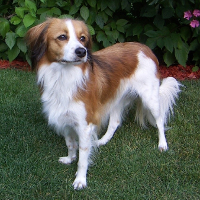
| The Kooikerhondje is a harmoniously built orange-red parti-coloured small sporting dog of almost square body proportions. He moves with his head held high; in action the well-feathered waving tail is carried level with, or above the topline. The ears have black hair at the tip, the so-called earrings. The dog is presented with a natural, untrimmed coat. |
Important proportions |
| The length of the body from the point of the shoulder (at the scapula/humerus) to the point of the buttocks may be slightly longer than the height at the withers. Skull and muzzle are of about equal length. |
Behaviour / temperament |
| Lively and agile, self-confident and with sufficient perseverance and stamina, good natured and alert, however not noisy. The breed is faithful, easy-going and friendly. Outside the hunting season the dog is expected to find and kill vermin, hence he needs to be keen, swift and tough. He is a true sporting dog, being attentive and energetic and having a zest for working and with a cheerful character. |
Head |
||
Cranial region |
||
Head |
The head is of moderate length, fitting in with the general appearance, clean-cut, with flowing lines. | |
Skull |
Sufficiently broad, moderately rounded. | |
Stop |
Seen in profile clearly visible but not too deep. | |
Facial region |
||
Nose |
Black and well developed. | |
Muzzle |
Seen from the side not too deep and slightly wedge-shaped; seen from above not tapering too much and well-filled under the eyes. | |
Lips |
Preferably well-pigmented, close-fitting and not overhanging. | |
Jaws and teeth |
Scissor bite; complete dentition is desirable. Pincer bite is accepted but less desirable. | |
Eyes |
Almond-shaped, dark brown with a friendly, alert expression. | |
Ears |
Moderately large, set on just above the line from the point of the nose to the corner of the eye. The ears are carried close to the cheeks without a fold. Well feathered; black hair tips (“earrings”) are highly desirable. | |
Neck |
| Strongly muscled, of sufficient length and clean-cut. |
Body |
||
Topline |
Smooth line from the withers to the tail. | |
Back |
Strong and straight, rather short. | |
Loin |
Of sufficient length and width, strongly muscled. | |
Croup |
Slightly sloping and sufficiently broad; the length of the croup should be 1.5 times the width. | |
Chest |
Reaching to the elbows with sufficient spring of ribs. Sufficiently developed forechest. | |
Underline and belly |
Slight tuck-up towards the loin. | |
Tail |
| Set on so as to follow the topline of the body, carried level with the topline or almost straight up (gaily). Well-feathered with a white plume. The last vertebra should reach the hock joint. |
Limbs |
Forequarters |
||
Shoulders |
Shoulder sufficiently sloping in order to create a flowing line from neck to back. | |
Upper arm |
Well-angulated towards shoulder blade that is of equal length. | |
Elbows |
Close to the body. | |
Forearm |
Straight and parallel, strong bone of sufficient density and length. | |
Pastern |
Strong and slightly oblique. | |
Hindquarters |
||
Generality |
Well angulated, straight and parallel seen from the rear. Strong bone. | |
Upper thigh |
Well muscled. | |
Lower thigh |
Length equal to thigh. | |
Hock |
Well let down. | |
Feet |
| Small, slightly oval, compact with well-knit toes pointing forward. |
Gait and movement |
| Should be flowing and springy, well extended, with good drive. Limbs parallel. |
Coat |
||
Hair |
Of medium length, slightly wavy or straight and close lying. Soft hair. Well-developed undercoat. Front legs should have moderate feathering reaching to the pastern joints. Hind legs should have fairly long feathered breeches; no feathering below the hock joints. The coat on the head, the front part of the legs and the feet should be short. Sufficiently feathered on the underside of the tail. Longer hair on throat and forechest. Earrings (long feathered black hairtips) are highly desirable. | |
Colour |
Distinct patches of clear orange-red colour on pure white although a few small spots on the legs are accepted. The orange-red colour should be predominant. Some black hair intermingling with the orange-red colour and a slight form of ticking are accepted but less desirable. Colouring on the head: A clearly visible blaze running down to the nose. There should be colouring on the cheeks and around the eyes. A blaze that is too narrow or too wide or only partly coloured cheeks is less desirable. A black tail ring where the colour changes from orange-red to white is permitted. |
|
Size and weight |
||
Height at withers |
Ideal height at the withers: Males: 40 cms. Females: 38 cms. Tolerance: 2 cms over or 3 cms under the ideal heights are permitted. | |
Faults |
| • Any departure from the foregoing points should be considered a fault and the seriousness with which the fault should be regarded should be in exact proportion to its degree and its effect upon the health and welfare of the dog and its ability to perform its traditional work. • Faults listed should be in degree of seriousness. |
General faults |
 Ears too small. Ears half-erect, “flying ears”. Tail that is curled. Hackney gait. Curly or silky hair. Colour that is heavily interspersed with black hairs in the orange-red patches. Too much ticking. Over maximum size or under minimum size. Ears too small. Ears half-erect, “flying ears”. Tail that is curled. Hackney gait. Curly or silky hair. Colour that is heavily interspersed with black hairs in the orange-red patches. Too much ticking. Over maximum size or under minimum size. |
Serious faults |
| Anxious behaviour. Distinctly low on legs, out of proportion. Wall eye. Undershot or overshot bite. Tail too short, not reaching hock-joint. White colour on ears, partly or completely. White hair around eyes, one or both. |
Disqualifying faults |
| Aggressive or overly shy. Colour that is black and white or tricolour. |
NB : |
| • Any dog clearly showing physical or behavioural abnormalities shall be disqualified. • The above mentioned faults when occurring to a highly marked degree or frequently are disqualifying. • Male animals should have two apparently normal testicles fully descended into the scrotum. • Only functionally and clinically healthy dogs, with breed typical conformation should be used for breeding. |
Bibliography |
| https://www.fci.be/ |



 English (United Kingdom)

Comments