 |
Broholmer |
|
FCI standard Nº 315 |
||
Origin |
Denmark | |
Translation |
DKK Standard Committee Official language (EN) |
|
Group |
Group 2 Pinscher and Schnauzer, Molossians and Swiss Mountain and Cattledogs | |
Section |
Section 2.1 Molossians, Mastiff type | |
Working |
Without working trial | |
Acceptance on a definitive basis by the FCI |
Wednesday 26 May 1982 | |
Publication of the official valid standard |
Saturday 3 May 2025 | |
Last update |
Friday 16 May 2025 | |
En français, cette race se dit |
 |
Broholmer |
Diese Norm ist in deutscher Sprache sichtbar |
 |
Broholmer |
En español, esta raza se dice |
 |
Broholmer |
In het Nederlands, wordt dit ras gezegd |
 |
Broholmer |
Usage |
| Companion dog, guard dog. |
Brief historical summary |
| As a type this breed has been known since the Middle Ages, when it was used for hunting (staghunting). Later it was used mainly as guard dog for large farms and manors. At the end of the 18th century these dogs were pure- bred and increased in number thanks to the Chamberlain Sehested of Broholm, from whom the breed has inherited its name. After the Second World War the breed became almost extinct, but around 1975 a group of committed people - later organized as « The Society for Reconstruction of the Broholmer Breed » - supported by the Danish Kennel Club, began the work of reviving the breed. |
General appearance |
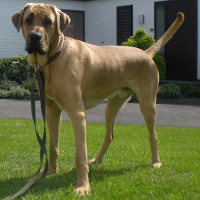
| A Mastiff-type of dog of large size, rectangular and strongly built, with a composed and powerful movement. Its appearance is dominated by the powerful forequarters. The head is massive and wide, the neck is sturdy with some loose skin, the chest is broad and deep. The dogs must show a distinct gender identity. The males must be distinctly masculine and the females distinctly feminine. At rest the head is carried rather low and stooping, and the tail is hanging down sabre-like. When moving, the tail is carried higher, but not over the topline. When the dog is attentive or aroused, the head is carried higher and the tail is raised above horizontal. |
Important proportions |
| Rectangular. The height from the withers to the elbow and from the elbow to the ground is 1:1. |
Behaviour / temperament |
| Calm, good tempered, friendly, yet watchful. Must show great self-confidence. |
Head |
||
| Rather big and wide, with a heavy appearance. | ||
Cranial region |
||
Skull |
Broad and rather flat. Topline of skull is parallel to topline of muzzle and set a little higher. | |
Stop |
Not too pronounced. | |
Facial region |
||
Nose |
Full and black. | |
Muzzle |
Massive; looking rather short due to the heavy head. Upper and lower jaw are of equal length. | |
Lips |
Pendulous, but not excessively so. | |
Jaws and teeth |
Powerful jaws with well developed muscles. Scissor- or pincer bite. | |
Eyes |
Round, not too big, or deep-set and not too slanted. The eye rims are tightly fitting. Colour from light to dark amber. Expression should show great self-confidence. | |
Ears |
Medium sized, rather high set. Carried hanging close to cheeks. | |
Neck |
| Very powerful and muscular with some throatiness, yet not excessive. |
Body |
||
Topline |
Straight. | |
Withers |
Strong and clearly defined. | |
Back |
Rather long. | |
Croup |
Medium length, slightly sloping. | |
Chest |
Powerful and deep, with well a developed forebreast. | |
Tail |
| Set on rather low, broad at base. It is carried drooping and has no flag or feathering. When moving the tail is raised to a horizontal position, preferably not higher. It should never be carried over the back or in a curl. |
Limbs |
Forequarters |
||
Generality |
Strong, straight and powerful forelegs with muscular upper arms. The length and angulation of the bones should produce a free movement with good reach walking or trotting. | |
Upper arm |
Very muscular. | |
Elbows |
Moving close to the body. | |
Forearm |
Straight and powerufl. | |
Pastern |
Not too long. | |
Forefeet |
Rounded and tight fitting. | |
Hindquarters |
||
Generality |
Powerful and muscular hindlegs with angulation able to produce good driving power. Seen from behind the hindlegs are straight and parallel. | |
Upper thigh |
Powerful, broad and muscular. Distinct knee angulation. | |
Metatarsus |
Not too long. | |
Hind feet |
Tight fitting and of the same length as the front feet. | |
Gait and movement |
| Composed and stooping with a long stride. Natural gaits are walking and trotting. |
Skin |
| Well pigmented and thick; generally profuse, especially at the neck. |
Coat |
||
Hair |
Short and close lying, with a thick undercoat. | |
Colour |
Yellow with or without a black mask. Red with or without a black mask. The mask should only be seen on the muzzle. Black. White markings on chest, feet and tip of tail are optional. | |
Size and weight |
||
Height at withers |
Male ca 75 cm, bitch ca 70 cm. | |
Weight |
Male 50 - 70 kg, bitch 40 - 60 kg. | |
Faults |
| • Any departure from the foregoing points should be considered a fault and the seriousness with which the fault should be regarded should be in exact proportion to its degree and its effect upon the health and welfare of the dog and its ability to perform its traditional work. • Faults listed should be in degree of seriousness. |
General faults |
 Square proportions. Insufficient in substance. Lacking substance. Too light and elegant in head and body. Stop too marked; muzzle too light; corners of the mouth pendulous. Ears too big or too small. Rose ears. Tail set on too high or too low. Hook or kink tail. Long and weak in pasterns; splayed feet. Cow hocked. Pacing. Movement too elegant. Fringes/flag on buttocks and tail. White markings elsewhere than on chest, feet and tip of tail. Sooty. Square proportions. Insufficient in substance. Lacking substance. Too light and elegant in head and body. Stop too marked; muzzle too light; corners of the mouth pendulous. Ears too big or too small. Rose ears. Tail set on too high or too low. Hook or kink tail. Long and weak in pasterns; splayed feet. Cow hocked. Pacing. Movement too elegant. Fringes/flag on buttocks and tail. White markings elsewhere than on chest, feet and tip of tail. Sooty. |
Disqualifying faults |
| Aggressive or overly shy dogs. Nervous, sharp or aggressive. Squarely built, definitely insufficient in substance. Nose other than black. Overshot or undershot mouth. Eyes of different colour. Erect ears. Tail curled up. Colour faulty; long-haired. |
NB : |
| • Any dog clearly showing physical or behavioural abnormalities shall be disqualified. • The above mentioned faults when occurring to a highly marked degree or frequently are disqualifying. • Male animals should have two apparently normal testicles fully descended into the scrotum. • Only functionally and clinically healthy dogs, with breed typical conformation should be used for breeding. |
Bibliography |
| https://www.fci.be/ |



 English (United Kingdom)

Comments