 |
French white and orange hound |
|
FCI standard Nº 316 |
||
Origin |
France | |
Translation |
Mrs Peggy Davis | |
Group |
Group 6 Scenthounds and related related breeds | |
Section |
Section 1.1 Large-sized Hounds | |
Working |
With working trial | |
Acceptance on a definitive basis by the FCI |
Monday 01 February 1982 | |
Publication of the official valid standard |
Monday 01 February 1982 | |
Last update |
Tuesday 18 June 1996 | |
En français, cette race se dit |
 |
Français blanc et orange |
Diese Norm ist in deutscher Sprache sichtbar |
 |
Französischer Weiss-oranger Laufhund |
En español, esta raza se dice |
 |
Sabueso francés blanco y naranja |
In het Nederlands, wordt dit ras gezegd |
 |
Franse witte en oranje |
Usage |
| Scenthound. |
General appearance |
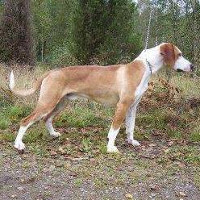
| Typical French hound, distinguished, giving an impression of being rustic. |
Head |
||
Cranial region |
||
Head |
Quite large, moderately elongated. | |
Skull |
Slightly domed, occipital crest barely marked. Without prominent superciliary arches. | |
Stop |
Well marked. | |
Facial region |
||
Nose |
Well developed, black, brown-orange. | |
Muzzle |
Of almost equal length to that of the skull. | |
Lips |
Quite pronounced giving the muzzle a certain squareness. | |
Eyes |
Large, brown and dark. | |
Ears |
Set slightly below eye level, supple, fine, slightly twisted and reaching to about to two fingers from the on-set of the nose. | |
Neck |
| Straight, quite long, slight dewlap. |
Body |
||
Back |
Broad and straight. | |
Loin |
Normally arched. | |
Croup |
Round without falling away. | |
Chest |
Broad. Ribs rounded. | |
Side |
Well filled. | |
Tail |
| Long. |
Limbs |
Forequarters |
||
Generality |
Strong and broad. | |
Shoulders |
Sloping and well muscled. | |
Hindquarters |
||
Upper thigh |
Very muscular. | |
Hock |
Near to the ground and slightly bent. | |
Feet |
| Hare-feet. |
Gait and movement |
| Rather easy, gallop light and sustained. |
Skin |
| White with yellow or orange markings; the palate can be yellow. Scrotum white or yellow. |
Coat |
||
Hair |
Short and fine. | |
Colour |
White-lemon or white and orange on condition that the orange is not too dark going on to red. | |
Size and weight |
||
Height at withers |
62-70 cm with 2 cm tolerance for the maximum size. | |
Faults |
| • Any departure from the foregoing points should be considered a fault and the seriousness with which the fault should be regarded should be in exact proportion to its degree and its effect upon the health and welfare of the dog and its ability to perform its traditional work. • Faults listed should be in degree of seriousness. |
General faults |
 Faulty conformation. Muzzle thin or too long. Overshot or undershot mouth. Light eyes. Tail curved up or deviated. Colours of the coat other than those previously mentioned, particularly black or red hair. Depigmentation. Faulty conformation. Muzzle thin or too long. Overshot or undershot mouth. Light eyes. Tail curved up or deviated. Colours of the coat other than those previously mentioned, particularly black or red hair. Depigmentation. |
Disqualifying faults |
| Aggressive or overly shy dogs. |
NB : |
| • Any dog clearly showing physical or behavioural abnormalities shall be disqualified. • The above mentioned faults when occurring to a highly marked degree or frequently are disqualifying. • Male animals should have two apparently normal testicles fully descended into the scrotum. • Only functionally and clinically healthy dogs, with breed typical conformation should be used for breeding. |
Bibliography |
| https://www.fci.be/ |



 English (United Kingdom)

Comments