 |
Kai |
|
FCI standard Nº 317 |
||
Origin |
Japan | |
Group |
Group 5 Spitz and primitive type | |
Section |
Section 5 Asian Spitz and related breeds | |
Working |
Without working trial | |
Acceptance on a definitive basis by the FCI |
Monday 01 February 1982 | |
Publication of the official valid standard |
Sunday 30 October 2016 | |
Last update |
Thursday 09 February 2017 | |
En français, cette race se dit |
 |
Kai |
Diese Norm ist in deutscher Sprache sichtbar |
 |
Kai |
En español, esta raza se dice |
 |
Kai |
In het Nederlands, wordt dit ras gezegd |
 |
Kai |
Usage |
| Hunting dog, companion. |
Brief historical summary |
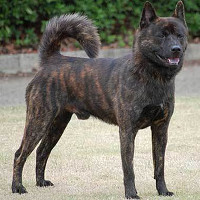
| This breed originated from medium-sized dogs that existed in Japan in the ancient times. It became established as a breed in the Kai district (Yamanashi Prefecture), which is surrounded by mountains. Another name for this breed is « Kai tora-ken ». A distinguishing feature in this dog is its brindled coat. These dogs are used mainly for hunting wild boar and deer. Their strong inclination to form a pack is thought to contribute towards maintaining the purity of the breed. The breed was designated as a « natural monument » in 1934. |
General appearance |
| Medium-sized dog, well balanced, sturdily built, muscles well developed. The dog has the characteristics of a dog living in mountainous districts of Japan. Limbs strong and hocks remarkably developed. |
Important proportions |
| The ratio of height at withers to length of body is 10 : 11, but the body can be slightly longer in bitches. |
Behaviour / temperament |
| The temperament is keen and very alert. |
Head |
||
Cranial region |
||
Skull |
Forehead broad. | |
Stop |
Abrupt with slight furrow. | |
Facial region |
||
Nose |
Black, nasal bridge straight. | |
Muzzle |
Pointed, not very long, but moderately thick. | |
Lips |
Tight. | |
Jaws and teeth |
Strong with a scissor bite. | |
Cheeks |
Well developed. | |
Eyes |
Nearly triangular and dark brown in colour. The outer corners of the eyes are slightly upturned. | |
Ears |
Triangular, slightly inclining forward and firmly pricked. | |
Neck |
| Thick, powerful and muscular. |
Body |
||
Withers |
High. | |
Back |
Straight and short. | |
Loin |
Broad and muscular. | |
Chest |
Deep, ribs moderately sprung. | |
Underline and belly |
Slightly tucked up. | |
Tail |
| Set on high, thick, vigorously curled or carried curved like a sickle over the back. Tip nearly reaching the hocks when let down. |
Limbs |
Forequarters |
||
Shoulders |
Moderately sloping with developed muscles. | |
Upper arm |
Forming a moderate angle with shoulder blade. | |
Elbows |
Close to the body. | |
Forearm |
Straight, heavy and muscular. | |
Pastern |
Slightly oblique. | |
Hindquarters |
||
Generality |
Well developed, strong and moderately angulated. | |
Hock |
Tough and elastic. | |
Feet |
| Toes well arched and tightly knit; pads thick and elastic; nails hard and preferably dark in colour. |
Gait and movement |
| Light and resilient. |
Coat |
||
Hair |
Outer coat harsh and straight; undercoat soft and dense. The hair on the tail is fairly long and off-standing. | |
Colour |
Black brindle, red brindle and brindle. As a feature of this breed, solid colour in puppyhood may turn brindle as the dog grows. | |
Size and weight |
||
Height at withers |
Males 50 cm. Females 45 cm. There is a tolerance of ± 3 cm. | |
Faults |
| • Any departure from the foregoing points should be considered a fault and the seriousness with which the fault should be regarded should be in exact proportion to its degree and its effect upon the health and welfare of the dog and its ability to perform its traditional work. • Faults listed should be in degree of seriousness. |
General faults |
 Lack of sexual dimorphism. Light-coloured nose. Slightly overshot or undershot mouth. Light-coloured eyes. Long or short hair. Shyness. Lack of sexual dimorphism. Light-coloured nose. Slightly overshot or undershot mouth. Light-coloured eyes. Long or short hair. Shyness. |
Disqualifying faults |
| Aggressive or overly shy. Extremely overshot or undershot mouth. Ears not pricked. Hanging tail, short tail. Faded colour. Coat with many white spots. Pinto colour. |
NB : |
| • Any dog clearly showing physical or behavioural abnormalities shall be disqualified. • The above mentioned faults when occurring to a highly marked degree or frequently are disqualifying. • Male animals should have two apparently normal testicles fully descended into the scrotum. • Only functionally and clinically healthy dogs, with breed typical conformation should be used for breeding. |
Bibliography |
| https://www.fci.be/ |



 English (United Kingdom)

Comments