 |
Great anglo-french white and black hound |
|
FCI standard Nº 323 |
||
Origin |
France | |
Translation |
Revised by J. Mulholland (2008) in collaboration with R. Triquet | |
Group |
Group 6 Scenthounds and related breeds | |
Section |
Section 1.1 Large sized Hounds | |
Working |
With working trial | |
Acceptance on a definitive basis by the FCI |
Thursday 27 January 1983 | |
Publication of the official valid standard |
Tuesday 04 November 2008 | |
Last update |
Monday 12 January 2009 | |
En français, cette race se dit |
 |
Grand anglo-français blanc et noir |
Diese Norm ist in deutscher Sprache sichtbar |
 |
Grosser Anglo-französischer Weiss-schwarzer Laufhund |
En español, esta raza se dice |
 |
Gran sabueso anglo-francés blanco y negro |
In het Nederlands, wordt dit ras gezegd |
 |
Grote zwart-wit Anglo-Franse |
Usage |
| Pack Hound for big game. |
Brief historical summary |
| This breed originates from the “Bâtard Anglo-Saintongeois”, a type which appeared in the middle of the XIXth century and which was the result of crossing between the Saintongeois and the Foxhound. The breed presently counts approximately 2000 subjects with around 200 births per year. It makes up the packs of twenty or more deer hunts and one stag hunt. The 2007 text was drafted by M. Pierre Astié, President of the “Club du chien d’ordre” and his committee, in collaboration with Mr. Raymond Triquet. |
General appearance |
| Big, rather powerful dog, resistant and robust with strong bone which is a reminder of his Gascon-Saintongeois origins. |
Important proportions |
| The muzzle is slightly shorter than the skull. The length of the body, from the point of the shoulder to the point of buttock, is equal to the height at the withers. |
Behaviour / temperament |
| Excels in hunting stag and deer on damp or bushy terrain. It is a friendly dog, close to humans and easy to manage in the kennels. |
Head |
||
Cranial region |
||
Head |
Strong, rather short with skull/muzzle lines parallel. | |
Skull |
Rather flat and broad, occipital protuberance hardly marked, superciliary arches prominent. | |
Stop |
Well defined. | |
Facial region |
||
Nose |
Black, developed and rather raised. Nostrils well open. | |
Muzzle |
Straight and a little less long than the skull. | |
Lips |
The flews are distinctly square, seen from the side; the upper lip overlaps the lower lip well. | |
Eyes |
Brown, relatively deep-set but not excessively. | |
Ears |
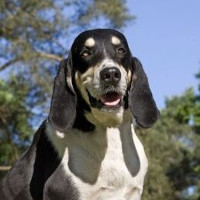
Set-on rather broad and at eye level; relatively flat at set-on then curling towards the end; of medium length. When pulled forward, they should not reach further than two fingers before the base of the nose leather. The tips are rather pointed. | |
Neck |
| Strong, rather short. A slight dewlap is tolerated. |
Body |
||
Back |
Straight and wellsustained. | |
Loin |
Quite broad, rather short. | |
Croup |
Slightlysloping; hips quite broad. | |
Chest |
Broad and well let down to the point of the elbow. | |
Ribs |
Moderately rounded. | |
Side |
Well filled. | |
Underline and belly |
Slightly tucked up. | |
Tail |
| Strong at its root, tapering to a slender point, long and straight; in action, it is carried above the topline but not vertical. |
Limbs |
Forequarters |
||
Generality |
In line with the body; more round than flat. | |
Shoulders |
Long and well muscled. | |
Elbows |
Close to the body. | |
Forearm |
Upright. | |
Pastern |
Very slightly sloping, seen from the side. | |
Hindquarters |
||
Generality |
Parallel, seen from behind. | |
Upper thigh |
Well let down, muscled but not over developed. | |
Hock |
Only slightly bent , seen from the side. | |
Feet |
| Thick and big, rather round. |
Gait and movement |
| Effortless. Preferred gait: supple and extended gallop. |
Skin |
| White under white hair, black under black hair with sometimes patches on the belly and inner thighs of blue or pale blue colour. |
Coat |
||
Hair |
Short, quite strong and dense. | |
Colour |
Obligatory white and black, with a black mantle and black markings more or less spread out which may show black or bluish speckles, or even tiny tan freckles but the latter only on the limbs. A pale tan dot above each eye as well as pale tan on the cheeks, below the eyes, below the ears. The “roebuck mark” on the thigh is rather frequent. | |
Size and weight |
||
Height at withers |
Males: 65 to 72 cm. Females: 62 to 68 cm. With tolerance of +/- 1 cm. | |
Faults |
| • Any departure from the foregoing points should be considered a fault and the seriousness with which the fault should be regarded should be in exact proportion to its degree and its effect upon the health and welfare of the dog and its ability to perform its traditional work. • Faults listed should be in degree of seriousness. |
Serious faults |
 Nose : Important lack of pigmentation. Jaws : Overshot or undershot. Eyes : Too light in colour. Ears : Dictinctly curled, too long. Dewlap : Excessive. Colour : On the cheeks, black extending to the lips. Nose : Important lack of pigmentation. Jaws : Overshot or undershot. Eyes : Too light in colour. Ears : Dictinctly curled, too long. Dewlap : Excessive. Colour : On the cheeks, black extending to the lips. |
Disqualifying faults |
| Aggressive or overly shy dogs. Limbs : Frail. Severe deviation of limbs. Feet : Long. Colour : Tricolour coat. |
NB : |
| • Any dog clearly showing physical or behavioural abnormalities shall be disqualified. • The above mentioned faults when occurring to a highly marked degree or frequently are disqualifying. • Male animals should have two apparently normal testicles fully descended into the scrotum. • Only functionally and clinically healthy dogs, with breed typical conformation should be used for breeding. |
Bibliography |
| https://www.fci.be/ |



 English (United Kingdom)

Comments