
 |
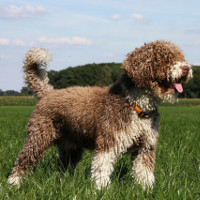
Spanish Water dog |
|
FCI standard Nº 336 |
||
Origin |
Spain | |
Translation |
Mrs. Peggy Davis Revised by the FCI Head Office Official language (ES) |
|
Group |
Group 8 Retrievers - Flushing Dogs - Water Dogs | |
Section |
Section 3 Water Dogs | |
Working |
Working trial optional. | |
Acceptance on a definitive basis by the FCI |
Sunday 30 May 1999 | |
Publication of the official valid standard |
Tuesday 01 October 2019 | |
Last update |
Friday 11 October 2019 | |
En français, cette race se dit |
 |
Chien d'eau espagnol |
Diese Norm ist in deutscher Sprache sichtbar |
 |
Spanischer Wasserhund |
En español, esta raza se dice |
 |
Perro de Agua Español |
In het Nederlands, wordt dit ras gezegd |
 |
Spaanse Water Hond |
Usage |
| Used as shepherd dog, hunting dog and assistant to the fisherman. |
Brief historical summary |
| The presence of this dog in the Iberian Peninsula is most ancient. His origin is the same like that of the old « Barbet ». His most dense population is in Andalusia where he is used as a shepherd dog, and where he has been known for centuries as the « Turkish dog ». His characteristics, most particularly the quality of his coat, are adapted to the variation of humidity and drought of the marshy regions, which qualifies him as a shepherd dog and as a helper to the hunters of waterfowl and fishermen in those regions. |
General appearance |
| Rustic dog, well proportioned (medium weight), dolichocephalic, of rather elongated harmonious shape and attractive appearance, of an athletic nature with well developed muscles owing to his regular exercise; the profile is rectilinear; his sight, hearing and scent are well developed. |
Important proportions |
| - Length of body / size (height at withers) = 9 / 8. - Depth of chest / size (height at withers) = 4 / 8. - Length of muzzle / length of skull = 2 / 3. |
Behaviour / temperament |
| Faithful, obedient, gay, hard working, watchful and well balanced. Learning ability is outstanding owing to his extraordinary mental grasp; he adapts to all situations and conditions. |
Head |
||
Cranial region |
||
Head |
Strong, carried with elegance. | |
Skull |
Flat with only slightly marked occipital crest. Axes of skull and muzzle parallel. | |
Stop |
Facial-cranial depression gentle, only slightly marked. | |
Facial region |
||
Foreface |
Profile is rectilinear. | |
Nose |
Nostrils well defined. Nose is of the same colour or slightly darker than the darkest tone of the coat. | |
Lips |
Well fitting; labial corners well defined. | |
Jaws and teeth |
Well formed, white, with well developed canines. | |
Eyes |
Slightly oblique position, very expressive; of a hazel to chestnut colour, should harmonize with the colour of the coat. The conjunctiva is not apparent. | |
Ears |
Set at medium height, triangular and drooping. | |
Neck |
| Short, well muscled, without dewlap, well set into the shoulders. |
Body |
||
Body |
Robust. | |
Topline |
Straight. | |
Withers |
Hardly marked. | |
Back |
Straight and powerful. | |
Croup |
Slightly sloping. | |
Chest |
Broad and well let down - ribs well arched; diameter of thorax ample indicating considerable respiratory capacity. | |
Underline and belly |
Belly slightly tucked up. | |
Tail |
| Set at medium height. Docking must be done at the height of the 2nd to the 4th caudal vertebra. Certain subjects show a congenital shortened tail (brachyouria). |
Limbs |
Forequarters |
||
Generality |
Strong and vertical. | |
Shoulders |
Well muscled and oblique. | |
Upper arm |
Sturdy. | |
Elbows |
Close to the chest and parallel. | |
Forearm |
Straight and sturdy. | |
Carpal |
Straight, rather short. | |
Hindquarters |
||
Generality |
Perfectly vertical with not too pronounced angulations and muscles capable of transmitting to the body a very energetic impulsion and the spring necessary for easy and elegant jumping. | |
Upper thigh |
Long and well muscled. | |
Lower thigh |
Well developed. | |
Metatarsus |
Short, lean and perpendicular to the ground. | |
Hock |
Well let down. | |
Feet |
| Rounded, toes tight, nails of varied colours; resistant pads. |
Gait and movement |
| The preferred gait is the trot. |
Skin |
| Supple, fine and well adhering to the body. Can be pigmented brown or black, or be without pigment according to the colour of the coat. The same applies to the mucous membranes. |
Coat |
||
Hair |
Always curly and of a woolly texture. Curly when short, can form cords when long. Clipped subjects are admitted; the clipping, always complete and even, must never become an « aesthetic » grooming. The recommanded maximum length of the hair for shows is 12 cm (15 cm extending the curl) and the minimum is 3 cm to see the quality of the curl. The puppies always are born with curly hair. |
|
Colour |
• Solid : White, black and chestnut in their different shades. • Bicoloured : White and black or white and brown in their different shades. Tricoloured subjects, and black and tan as well as hazelnut and tan dogs are not admitted. |
|
Size and weight |
||
Height at withers |
Males 44 to 50 cm, females 40 to 46 cm. 2 cm maximum deviation are admitted in both sexes whenever the subject maintains balance according to his height at withers. | |
Weight |
Males 18 - 22 kg, females 14 - 18 kg. | |
Faults |
| • Any departure from the foregoing points should be considered a fault and the seriousness with which the fault should be regarded should be in exact proportion to its degree and its effect upon the health and welfare of the dog and its ability to perform its traditional work. • Faults listed should be in degree of seriousness. |
Serious faults |
 Dorso-lumbar region distinctly saddle-backed. Limbs incorrect. Belly let down or excessively tucked up. Dorso-lumbar region distinctly saddle-backed. Limbs incorrect. Belly let down or excessively tucked up. |
Disqualifying faults |
| Aggresive or overly shy. Inferior or superior prognathism. Presence of dewclaws. Smooth or wavy coat. Albinism. Spotty or flecked coat, black and tan or chestnut and tan coat. Lack of balance in character. |
NB : |
| • Any dog clearly showing physical or behavioural abnormalities shall be disqualified. • The above mentioned faults when occurring to a highly marked degree or frequently are disqualifying. • Male animals should have two apparently normal testicles fully descended into the scrotum. • Only functionally and clinically healthy dogs, with breed typical conformation should be used for breeding. |
Bibliography |
| https://www.fci.be/ |



 English (United Kingdom)

Comments