 |
Saint Miguel Cattle Dog |
|
FCI standard Nº 340 |
||
Origin |
Portugal | |
Translation |
Mrs Pamela Jeans-Brown, revised in 2006 by R. Triquet in collaboration with Jennifer Mulholland | |
Group |
Group 2 Pinschers and Schnauzers, Molossoid breeds, Swiss Mountain and Cattle dogs | |
Section |
Section 2.1 Molossoid, Dogue type | |
Working |
Without working trial | |
Acceptance on a definitive basis by the FCI |
Monday 21 May 2007 | |
Acceptance on a provisional basis by the FCI |
Friday 10 March 1995 | |
Publication of the official valid standard |
Monday 21 May 2007 | |
Last update |
Wednesday 20 June 2007 | |
En français, cette race se dit |
 |
Fila de Saint Miguel |
Diese Norm ist in deutscher Sprache sichtbar |
 |
Cão Fila de São Miguel |
En español, esta raza se dice |
 |
Fila de San Miguel |
In het Nederlands, wordt dit ras gezegd |
 |
Cão Fila de São Miguel |
Usage |
| Cattle dog. |
Brief historical summary |
| A cattle dog originating in the island of Saint Miguel in the Azores, also known as the « Cow Dog ». Its history is linked to that of the now extinct Terceira Dog. The existence of the Saint Miguel Cattle Dog has been documented since the beginning of the 19th century. |
General appearance |
| Robust and hardy. |
Important proportions |
| Slightly longer than high. |
Behaviour / temperament |
| A cattle dog par excellence, it is equally a good guard dog for properties and people. A very determined character towards strangers but docile with its owner. Very intelligent and very receptive. While carrying out its duties driving dairy herds it bites low to avoid harming the cows’ udders. However when dealing with stray cattle it may bite higher. |
Head |
||
Cranial region |
||
Head |
Strong, with parallel longitudinal axes of skull and muzzle. | |
Skull |
Broad, square-shaped, top slightly convex, only slightly visible occipital protuberance. | |
Stop |
Pronounced. | |
Facial region |
||
Nose |
Wide, black in colour. | |
Muzzle |
Straight top line, a little shorter in length than the skull. Slightly rounded lateral faces. | |
Lips |
Well-pigmented, overlapping and firm. Lower profile slightly rounded. | |
Jaws and teeth |
Very powerful and well-developed, correctly fitting. Good wide mouth. Complete dentition with either scissor or pincer bite. | |
Eyes |
Oval shape, expressive, set slightly sunken and horizontal, of medium size. Dark brown in colour. | |
Ears |
Set above the level of the eyes; when not cropped they are of medium size, triangular and dropping but not touching to the cheeks. They are cropped with rounded tips in countries where ear cropping is not forbidden. | |
Neck |
| Straight, strong and of medium length, well set into the shoulders. No dewlap. |
Body |
||
Body |
Strong, well muscled with ample forechest. | |
Back |
Straight. | |
Loin |
Medium length, broad and well muscled. | |
Croup |
Medium length in relation to body, slightly higher than the withers. | |
Chest |
Broad and well let down. | |
Underline and belly |
Lower profile rising, belly and flanks well-proportioned in relation to body. | |
Tail |
| High set, thick, medium length and slightly curved. Docked at the 2nd or 3rd vertebra in countries where tail docking is not forbidden. |
Limbs |
Forequarters |
||
Generality |
Strong, set reasonably apart and upright. | |
Shoulders |
Slightly open scapular-humeral angle. | |
Upper arm |
Strong, medium length, well muscled. | |
Forearm |
Thick and well muscled. | |
Carpal |
Strong. | |
Pastern |
Strong, medium length. | |
Forefeet |
Oval with strong nails and toes. | |
Hindquarters |
||
Generality |
Strong, set reasonably apart. | |
Upper thigh |
Long, muscled; coxo-femoral angle open. | |
Lower thigh |
Medium length, muscled. | |
Metatarsus |
Medium length. Dewclaws permissible. | |
Hind feet |
Oval, with strong toes, not too arched. Strong nails. | |
Gait and movement |
| Free and easy. On the move the dog rolls slightly at the rear. |
Skin |
| Thick and pigmented. |
Coat |
||
Hair |
Short, smooth, dense, of harsh texture, lightly fringed on the tail, in the anal region and the back of the thighs. | |
Colour |
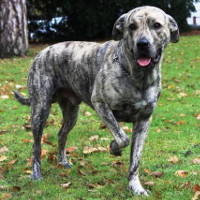
Fawn, pale fawn with black overlay, grey, going from light tones to dark; always brindled; white mark permissible on the forehead and from chin to chest; can have small white marks on both front feet or both hind feet or on all four feet. | |
Size and weight |
||
Height at withers |
Males : 50 - 60 cm. Females : 48 - 58 cm. | |
Weight |
Males : 25 - 35 kg. Females : 20 - 30 kg. | |
Faults |
| • Any departure from the foregoing points should be considered a fault and the seriousness with which the fault should be regarded should be in exact proportion to its degree and its effect upon the health and welfare of the dog and its ability to perform its traditional work. • Faults listed should be in degree of seriousness. |
Serious faults |
 Head : Converging axes of skull and muzzle. Jaws: Slightly over or undershot mouth. Head : Converging axes of skull and muzzle. Jaws: Slightly over or undershot mouth. |
Disqualifying faults |
| Aggressive or overly shy. Diverging axes of skull and muzzle. Seriously over or undershot mouth. |
NB : |
| • Any dog clearly showing physical or behavioural abnormalities shall be disqualified. • The above mentioned faults when occurring to a highly marked degree or frequently are disqualifying. • Male animals should have two apparently normal testicles fully descended into the scrotum. • Only functionally and clinically healthy dogs, with breed typical conformation should be used for breeding. |
Bibliography |
| https://www.fci.be/ |



 English (United Kingdom)

Comments