 |
Cimarrón Uruguayo |
|
FCI standard Nº 353 |
||
Origin |
Uruguay | |
Translation |
Jorge Nallem, in collaboration with Raymond Triquet, Renée Sporre-Willes and Jennifer Mulholland. (Official language: ES) | |
Group |
Group 2 Pinschers and Schnauzers, Molossoid breeds, Swiss Mountain- and Cattle dogs | |
Section |
Section 2.1 Molossoid, Dogue type | |
Working |
Without working trial | |
Acceptance on a definitive basis by the FCI |
Tuesday 07 November 2017 | |
Publication of the official valid standard |
Thursday 16 June 2022 | |
Last update |
Friday 08 July 2022 | |
En français, cette race se dit |
 |
Cimarron Uruguayen |
Diese Norm ist in deutscher Sprache sichtbar |
 |
Uruguayischer Cimarron |
En español, esta raza se dice |
 |
Cimarrón Uruguayo |
In het Nederlands, wordt dit ras gezegd |
 |
Cimarrón Uruguayo |
Usage |
| Excellent for herding, big game hunting and guard. |
Brief historical summary |
| The origin of the Cimmarón Uruguayo is uncertain. It is known to be descended from the dogs introduced by the Spanish and Portuguese conquerors. These dogs left in the country crossed among themselves. Natural selection had as a result that only the fitter, the stronger and more clever individuals survived. This is how the Cimarrón was born. The inhabitants of the time, recognizing the value of these dogs, domesticated them and progressively began to use them successfully as guards of their estates and as herding dogs in their daily work with cattle. |
General appearance |
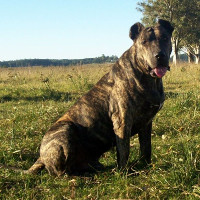
| The Cimmarón Uruguayo is a medium sized dog of dogue type, strong, compact, with good bone, well muscled and agile. |
Important proportions |
| - Height at the withers : length = 10 : 11. - Height at the withers is equal to the height at the croup. - Muzzle slightly shorter than skull. - Height to elbow same as from elbow to the withers. |
Behaviour / temperament |
| Balanced, intelligent and of great courage. |
Head |
||
Cranial region |
||
Skull |
Wider than long. Occiput slightly pronounced. | |
Stop |
Moderate. | |
Facial region |
||
Nose |
Broad, black or in accordance with coat colour. | |
Muzzle |
Powerful. Medium width, slightly shorter than skull. | |
Lips |
Upper lip covers lower lip but is not hanging. | |
Jaws and teeth |
Jaws strong, powerful. Teeth strong, well aligned, preferably complete bite, allowing absence of PM1. Scissor bite, i.e. upper incisors closely overlapping the lower incisors and set square to the jaws. | |
Cheeks |
Well developed, not bulging. | |
Eyes |
Medium size, almond shape, with inquisitive expression. Any shade of brown and in accordance with coat color, the darker the better. Eyelids tightly fitting eyeball and fully pigmented. | |
Ears |
Medium size, set neither too high nor too low, triangular, drooping but not close to the cheeks or in rose shape. Traditionally cropped in country of origin. | |
Neck |
| Strong, well muscled, not too long. |
Body |
||
Topline |
Level or with a slight depression behind the withers. | |
Withers |
Well defined. | |
Loin |
Short, strong, slightly arched. | |
Croup |
Of good length, broad, sloping at 30º on the horizontal. | |
Chest |
Deep, reaching at least to the elbow. Broad and well developed. Ribs well sprung, but not barrel shaped. Forechest well defined. | |
Tail |
| Thick, medium set. Reaching to the hock. At rest carried low. In motion carried horizontally or slightly upward. |
Limbs |
Forequarters |
||
Generality |
Viewed from the front, straight and parallel. | |
Shoulders |
Shoulderblade is well laid back. | |
Upper arm |
Same length as the shoulder blade. | |
Elbows |
Neither turned in nor out. | |
Forearm |
Straight. Strong bone. | |
Pastern |
Seen from the side, slightly sloping. | |
Forefeet |
Oval shaped, well-knit toes. With strong pads. | |
Hindquarters |
||
Generality |
Well muscled and powerful, seen from behind straight and parallel. | |
Upper thigh |
Well developed. | |
Stifle |
Well angulated. | |
Metatarsus |
Firm, of medium length. | |
Hind feet |
Cat feet, strong pads. | |
Gait and movement |
| Effortless. With good reach in front and good drive behind. In movement, seen from the front and from behind, the legs are parallel, single tracking when speed increases. |
Skin |
| Thick and supple. |
Coat |
||
Hair |
Short, smooth, close to the body, with undercoat. | |
Colour |
Brindle or all shades of fawn, the latter may have black shadings. Also bluish brindle and bluish fawn, all with or without mask. White marks are allowed in the following places: under jaw, the throat, fore chest, abdomen and lower part of legs not exceeding up the wrist or half way up the metatarsus. | |
Size and weight |
||
Height at withers |
Males: 58–61cm. (2 cm tolerance). Females: 55–58 cm. (2 cm tolerance). | |
Weight |
Males: 38–45 kg. Females: 33–40 kg. | |
Faults |
| • Any departure from the foregoing points should be considered a fault and the seriousness with which the fault should be regarded should be in exact proportion to its degree and its effect upon the health and welfare of the dog and its ability to perform its traditional work. • Faults listed should be in degree of seriousness. |
General faults |
 Lips excessively pendulous at corners. Excessive dewlap. Cheeks too prominent. Lips excessively pendulous at corners. Excessive dewlap. Cheeks too prominent. |
Serious faults |
| White markings with the exception of those mentioned above. Clear departure from the important proportions. Absence of sexual dimorphism. Size under or over the stipulated height (including the tolerance). Sloping topline. |
Disqualifying faults |
| Aggressive or overly shy dogs. Clear lack of type. Undershot. Overshot. Unpigmented nose. Long hair. Genetic brown (chocolate) coat colour, in fawns or brindles with nose and gums brown and light eyes. Any colour not mentioned. |
NB : |
| • Any dog clearly showing physical or behavioural abnormalities shall be disqualified. • The above mentioned faults when occurring to a highly marked degree or frequently are disqualifying. • Male animals should have two apparently normal testicles fully descended into the scrotum. • Only functionally and clinically healthy dogs, with breed typical conformation should be used for breeding. |
Bibliography |
| https://www.fci.be/ |



 English (United Kingdom)

Comments