 |
Russian Toy |
|
FCI standard Nº 352 |
||
Origin |
Russia | |
Translation |
Anna Samsonova. Edited by Dr. Eugene Yerusalimsky | |
Group |
Group 9 Companion and Toy dogs | |
Section |
Section 9 Continental Toy Spaniels and Russian Toys | |
Working |
Without working trial | |
Acceptance on a definitive basis by the FCI |
Tuesday 07 November 2017 | |
Acceptance on a provisional basis by the FCI |
Tuesday 21 February 2006 | |
Publication of the official valid standard |
Tuesday 07 November 2017 | |
Last update |
Tuesday 05 December 2017 | |
En français, cette race se dit |
 |
Petit chien russe |
Diese Norm ist in deutscher Sprache sichtbar |
 |
Russischer Toy |
En español, esta raza se dice |
 |
Pequeño perro ruso |
In het Nederlands, wordt dit ras gezegd |
 |
Russian Toy |
In his country of origin, his name is |
Russkiy Toy |
Usage |
| Companion Dog. |
Brief historical summary |
| At the beginning of the 20th century, the English Toy Terrier was one of the most popular toy dogs in Russia. However, in the period 1920 - 1950 the breeding of pure toy terriers was almost stopped and the number of dogs fell to a critical level. Only in the mid-fifties did Russian dog-breeders begin the revival of the breed. Practically all dogs which were used for breeding had no pedigrees; many of them were not pure blood. The Standard drafted for Toy Terriers significantly differed from that of the English Toy Terrier in many aspects. From this moment, the evolution of the breed in Russia went its own way. On the 12th of October, 1958 two smooth-haired dogs, one of which had slightly longer hair, gave birth to a male dog with a spectacular fringes on ears and limbs. It was decided to keep this feature. The male was mated with a female which also had slightly long hair. Thus the longhaired variety of the Russian Toy appeared. It was called Moscow Longhaired Toy Terrier. A dog breeder from Moscow, Yevgueniya Fominichna Zharova, played an important role in the creation of this breed variant. It was during a long period of development, in an isolated context, along with a specifically conducted selection that a new breed was created : the Russian Toy with two varieties : Longhaired and smooth-haired. |
General appearance |
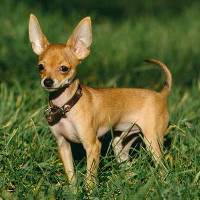
| A small elegant dog, lively, long-legged, with fine bone and lean muscles. Sexual dimorphism only slightly defined. |
Important proportions |
| Square build. The height at elbows is only slightly more than half of the height at withers ; the chest is sufficiently deep. |
Behaviour / temperament |
| Active, very cheerful, neither cowardly nor aggressive. The behaviour is significantly different between males and females. |
Head |
||
Cranial region |
||
Head |
Small compared to the body. | |
Skull |
High but not too wide (width at the level of zygomatic arches does not exceed the depth of the skull). | |
Stop |
Clearly pronounced. | |
Facial region |
||
Nose |
Small, black or matching the coat colour. | |
Muzzle |
Lean and pointed, slightly shorter than the skull. | |
Lips |
Thin, lean, tight- fitting and dark or matching the coat colour. | |
Jaws and teeth |
Small, white. Scissor bite. Absence of 2 incisors permitted in each jaw. | |
Cheeks |
Only slightly pronounced. | |
Eyes |
Quite large, rounded, dark, slightly prominent, set well apart and looking straight ahead. Eyelids are dark or matching the coat colour, tightly fitting. | |
Ears |
Big, thin, set high, erect. | |
Neck |
| Long, lean, carried high, slightly arched. |
Body |
||
Topline |
Gradually sloping from the withers to the root of the tail. | |
Withers |
Slightly pronounced. | |
Back |
Strong and straight. | |
Loin |
Short and slightly arched. | |
Croup |
The croup is somewhat rounded and slightly sloping. | |
Chest |
The chest is oval, sufficiently deep and not too wide. | |
Underline and belly |
Tucked up belly and drawn up flanks, forming a nicely curved line from the chest to the flanks. | |
Tail |
| Docked (only two or three vertebrae are left), carried high. In countries where tail docking is prohibited by law, it is left in its natural state. Undocked: sickle tail. It should not be carried lower than back level. |
Limbs |
Forequarters |
||
Generality |
Thin and lean; seen from the front, the front legs are straight and parallel. | |
Shoulders |
The shoulder blades are moderately long and not too sloping. | |
Upper arm |
Forming an angle of 105 degrees with the shoulder blade. The length of upper arm is approximately equal to the length of shoulder. | |
Elbows |
In line with the body. | |
Forearm |
Long, straight. | |
Carpal |
Lean. | |
Pastern |
Almost vertical. | |
Forefeet |
Small, oval, turning neither in nor out. Toes well-knit and arched. Nails and resilient pads are black or match the coat colour. | |
Hindquarters |
||
Generality |
Seen from the rear, the hind legs are straight and parallel, but standing a little bit wider than the forelegs. Stifles and hocks are sufficiently bent. | |
Upper thigh |
Muscles are lean and developed. | |
Lower thigh |
The upper and lower thighs are of the same length. | |
Metatarsus |
Vertical. | |
Hock |
Sufficiently angulated. | |
Hind feet |
Arched , a little bit narrower than forefeet. Nails and pads are black or match the coat colour. | |
Gait and movement |
| Easy, straightforward, fast. No noticeable change in the topline when moving. |
Skin |
| Thin, dry and tight-fitting. |
Coat |
||
Hair |
There exists two types for the breed: smooth-haired and longhaired. . Smooth-haired: short, close-lying, shiny hair, without undercoat or bald patches. . Longhaired: body is covered with moderately long (3-5 cm), straight or slightly wavy hair, close-lying, which does not hide the natural outline of the body . Hair on the head and on the front part of limbs is short and close -lying. Distinct feathers on rear side of limbs. The feet have long, silky hair which completely hides the nails. Ears are covered with thick, long hair forming a fringe. Dogs of more than 3 years have such a fringe, which should completely hide the outer edges and tips of the ears. Body hair should not look tousled nor be too short (less than 2 cm.). |
|
Colour |
Black and tan, brown and tan, blue and tan. Also red of any shade with or without black or brown overlay. Richer shades are preferable for all colours. | |
Size and weight |
||
Height at withers |
Dogs and bitches: 20 - 28 cm (tolerance +/- 1 cm). | |
Weight |
Dogs and bitches: up to 3 kg. | |
Faults |
| • Any departure from the foregoing points should be considered a fault and the seriousness with which the fault should be regarded should be in exact proportion to its degree and its effect upon the health and welfare of the dog and its ability to perform its traditional work. • Faults listed should be in degree of seriousness. |
General faults |
 Timid behaviour. Level bite or incisors sloping forward. Semi-pricked ears; this condition in longhaired dogs with heavy fringes is permissible but not desirable. Low set tail. Presence of bald patches in smooth-haired dogs. Too long or too short hair on body of longhaired dogs. Small white spots on chest and toes. Solid black, brown and blue colours. Tan markings too large or with dark shadings. Timid behaviour. Level bite or incisors sloping forward. Semi-pricked ears; this condition in longhaired dogs with heavy fringes is permissible but not desirable. Low set tail. Presence of bald patches in smooth-haired dogs. Too long or too short hair on body of longhaired dogs. Small white spots on chest and toes. Solid black, brown and blue colours. Tan markings too large or with dark shadings. |
Disqualifying faults |
| Aggressive, overly shy. Overshot, pronounced undershot. Absence of 1 canine; absence of more than 2 incisors in either jaw. Hanging ears. Short legs. Many bald patches in short-haired dogs. Longhaired dogs: absence of fringes on ears and presence of curly hair. White coat, white spots on the head, abdomen and above metacarpus; large white patches on chest and throat, presence of brindle markings. Size over 30 cm or under 18 cm. Weight less than 1 kg. |
NB : |
| • Any dog clearly showing physical or behavioural abnormalities shall be disqualified. • The above mentioned faults when occurring to a highly marked degree or frequently are disqualifying. • Male animals should have two apparently normal testicles fully descended into the scrotum. • Only functionally and clinically healthy dogs, with breed typical conformation should be used for breeding. |
Bibliography |
| https://www.fci.be/ |



 English (United Kingdom)

Comments