
 |
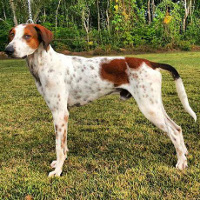
Brazilian Tracker |
|
FCI standard Nº 275 |
||
Origin |
Brazil | |
Translation |
Ricardo Torre Simões Revised by Claudio Nazaretian Rossi Official language (EN) |
|
Group |
Group 6 Scent hounds and related breeds | |
Section |
Section 1.1 Large-sized hounds | |
Working |
Without working trial | |
Acceptance on a definitive basis by the FCI |
Friday 01 September 1967 | |
Publication of the official valid standard |
Wednesday 04 September 2019 | |
Last update |
Friday 27 November 2020 | |
En français, cette race se dit |
 |
Pisteur Brésilien |
Diese Norm ist in deutscher Sprache sichtbar |
 |
Brasilianischer Laufhund |
En español, esta raza se dice |
 |
Rastreador Brasileño |
In het Nederlands, wordt dit ras gezegd |
 |
Braziliaanse tracker |
In his country of origin, his name is |
Rastreador Brasileiro |
Usage |
| Hunting dog used for flushing and corner prey animals. |
Brief historical summary |
| This breed, contrary to others originated from interracial crossings, was developed by means of genetic selection based on the American Foxhound, with the aim of adjusting its functional characteristics and its adaptation to the Brazilian climate. The breed was developed by the Brazilian breeder Osvaldo Aranha Filho, bearing the name of Brazilian Tracker because of its proven hunting qualities. This breed is the evolution of the old "URRADOR BRASILEIRO" (Brazilian Howler), with physical characteristics fitting the life in Brazilian countryside. The breed was first recognized by FCI on September 1, 1967, suffering a major setback from the 70s to the year 2000 when its breeding was resumed. Widely bred in rural areas, mainly in the north of Brazil, the Brazilian Hound is an important auxiliary to man in his several activities. |
General appearance |
| Strong, rustic, cheerful, lively without being aggressive, he has a privileged sense of smell and ability to hunt. It is very resistant and persistent, able to run for hours in rough terrain under high temperatures, without much difficulty. Excellent hunter, large in size, with smooth coat and long ears. |
Important proportions |
| Body length ratio to its height is 10:9. The ratio length of the muzzle to length of the skull is 1:1. |
Behaviour / temperament |
| Quiet and balanced, attached to its owner, self-confident, intrepid and docile, without being shy or aggressive. Because of their work they should behave calmly, since they hunt in pairs, trios and packs, or even alone as a scent dog. |
Head |
||
Cranial region |
||
Head |
Mesocephalic, triangular and slightly elongated. | |
Skull |
Triangular in shape, skull and muzzle of similar length. | |
Stop |
Moderate. | |
Facial region |
||
Nose |
Slightly turned downwards, completely black in colour. | |
Muzzle |
Straight and long. | |
Lips |
Thin, dry and adherent, well pigmented in black. | |
Jaws and teeth |
Strong jaws, scissor bite with complete teeth (42 teeth). | |
Cheeks |
Dry. | |
Eyes |
Almond-shaped, dark, with lively expression and well-pigmented black eyelid edges. Large eyes placed well apart, with a typical hound expression. Smooth, gentle and pleasant look. | |
Ears |
Long, low insertion, flexible and with rounded tips. The length, when pulled without effort, reaches the tip of the muzzle, without exceeding it. Almost lacking in erectile capacity, they hang close to the head. | |
Neck |
| Strong. It rises free and light on the shoulders, strong in substance, but not heavy, moderately long, throat clear, allowing a slight skin fold under the angle of the jaw, with slight dewlap. |
Body |
||
Topline |
Well defined, descending in a gentle curve by the neck, passing by strong and high withers, continuing towards the slightly oblique croup, placed a little lower to the height of the withers. | |
Withers |
Strong, higher than the croup. | |
Back |
Strong, firm, slightly long, muscular and straight. | |
Loin |
Wide and strong. | |
Croup |
Slightly oblique, inclined 30° to the horizontal. | |
Chest |
Of good size and depth reaching the elbows, with broad and well-developed thorax. | |
Underline and belly |
Slightly tucked up. | |
Tail |
| Sabre shaped, carried without deviating sideways, inserted in the croup extension, carried low at rest and above the back line when alert or in motion. Long size, reaching or exceeding the hock. Tail coat has the same texture as the body, smooth, seated and short. |
Limbs |
Forequarters |
||
Generality |
Shoulders with strong, parallel bones, muscular, with broad legs. | |
Shoulders |
Robust, with good inclination (about 45°, and the scapula humeral joint with an angle of approximately 105°). | |
Upper arm |
Strong and robust, the same length as the shoulder blades. | |
Elbows |
Close to body and firm. | |
Forearm |
Strong bone structure. | |
Carpal |
Straight, parallel and strong. | |
Pastern |
Straight, parallel and strong. | |
Forefeet |
Wide and powerful, with very resistant and elastic pads. Pads and nails should be dark. | |
Hindquarters |
||
Generality |
Muscular and well angled, firm hock, with symmetrical and moderate angles, wide pawns. | |
Upper thigh |
Strong and muscular. | |
Lower thigh |
Moderate angulation with the femur. | |
Stifle |
Strong and of moderate curvature. | |
Metatarsus |
Straight, parallel to each other. | |
Hock |
Strong, short and firm, with moderate angulation. | |
Hind feet |
Wide and powerful, with very resistant and elastic pads. Pads and nails should be dark. | |
Gait and movement |
| It must be fluid, agile and firm, showing good ground coverage, with wide and balanced steps. When trotting, the tail can be carried just above the top line. Very important for the dog's work is that the upper line remains level and firm. |
Skin |
| Dark and adjusted to the body. |
Coat |
||
Hair |
Short, smooth, very close to the body, dense and a little hard to the touch. | |
Colour |
Fully mottled black and white, giving a slate blue colouring effect, with or without fawn and/or black markings on any part of the body; bicolor (white with fawn or black markings; or black and fawn, totally black with fawn markings); tricolor (white and black with fawn markings). All colours with or without fawn markings on the head, on the chest, belly, on the front and back limbs and tail. | |
Size and weight |
||
Height at withers |
Males: 60-65 cm, females: 56-63 cm. Tolerance: aprox. 1 cm. | |
Weight |
Males: 26 to 33 kg, females: 21 to 30 kg. Size and weight should be in harmony with the structure of the animal. |
|
Faults |
| • Any departure from the foregoing points should be considered a fault and the seriousness with which the fault should be regarded should be in exact proportion to its degree and its effect upon the health and welfare of the dog and its ability to perform its traditional work. • Faults listed should be in degree of seriousness. |
General faults |
 Rose ears. Flat ribs. Rose ears. Flat ribs. |
Serious faults |
| Weak appearance. Very light fawnmarkings in black and fawn dogs. Any deviation of scissor bite and correct dental formation, as long as they are not eliminating faults. |
Disqualifying faults |
| Aggressive or overly shy. Short or butterfly shaped ears. Curly tail. Bones too light. Pronounced stop. Under or overshot. |
NB : |
| • Any dog clearly showing physical or behavioural abnormalities shall be disqualified. • The above mentioned faults when occurring to a highly marked degree or frequently are disqualifying. • Male animals should have two apparently normal testicles fully descended into the scrotum. • Only functionally and clinically healthy dogs, with breed typical conformation should be used for breeding. |
Bibliography |
| https://www.fci.be/ |



 English (United Kingdom)

Comments