
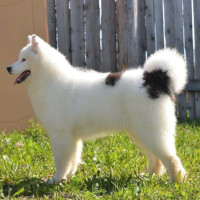
 |
Yakutian Laika |
|
FCI standard Nº 365 |
||
Origin |
Russia | |
Translation |
Russian Kynological Federation, revised by Raymond TRIQUET, May 2019 | |
Group |
Group 5 Spitz and primitive types | |
Section |
Section 1 Nordic Sledge Dogs | |
Working |
With work trial | |
Acceptance on a provisional basis by the FCI |
Wednesday 04 September 2019 | |
Publication of the official valid standard |
Wednesday 04 September 2019 | |
Last update |
Thursday 26 September 2019 | |
En français, cette race se dit |
 |
Laïka de Yakoutie |
Diese Norm ist in deutscher Sprache sichtbar |
 |
Yakutskaya Laika |
En español, esta raza se dice |
 |
Laika de Yakutia |
In het Nederlands, wordt dit ras gezegd |
 |
Laika van Yakutia |
Usage |
| Sledge and hunting dog. |
Brief historical summary |
| The Yakutian Laika is an ancient native dog breed which was naturally bred by aboriginal people of the North East of Russia as a sled dog and a hunting dog. Certain archaeological discoveries confirm that the local people used dogs for sledding and hunting as far back as 8000 years ago. The very first references about dogs in this region date back to 1633. The first published account of the Yakutian dogs was entitled “How Yakutians travel in winter” which was included in the book “Northern and Eastern Tartary” by Nicholas Witsen (Amsterdam, 1692). The first description of the Yakutian Laika appeared in the book “Geography of the Russian Empire” (Derpt, 1843), which announced it to be a “dog of a special breed”. The first mention of the Yakutian Laika’s total number found in the book “Statistical tables of the Russian Empire” (St. Petersburg, 1856): “There are 15157 dogs in the Yakut region used for sled work”. The first Breed Standard for the North-East Sled Dog was adopted in 1958 and it formed the basis for the Yakutian Laika Breed Standard published in 2005 by the Russian Kynological Federation. For many centuries, the Yakutian Laika accompanied the northern man in everyday life, helping him to hunt, vigilantly watch his home, herd reindeers and transport goods in the severe conditions of the Far North. These skills have glorified the Yakutian Laika as a versatile breed not only in Russia but also in many countries on different continents. |
General appearance |
| Yakutian Laika is a dog of medium size, strong, compact, well-muscled, with moderately long legs and thick skin with no signs of looseness. The coat is well developed and should be sufficient for living and working in severe Arctic conditions. Sexual dimorphism is clearly pronounced, males are stronger and more powerful than females. |
Important proportions |
| The length of body from the point of shoulder to the point of buttocks exceeds the height at withers by 10–15%. The length of the head is a bit less than 40% of the height at withers. The length of the muzzle is 38–40% of the length of the head. The length of the foreleg to the elbow is 52–54% of the height at withers. |
Behaviour / temperament |
| Yakutian Laika is a bold, lively, close to man, friendly, sociable and energetic dog. |
Head |
||
Cranial region |
||
Head |
Wedge-shaped, moderately pointed, proportional to dog’s size. | |
Skull |
Moderately broad, slightly rounded, with a sufficiently high forehead. | |
Stop |
Well pronounced. | |
Facial region |
||
Nose |
Of big size, with wide nostrils, black or brown in colour. | |
Muzzle |
Well filled under the eyes, wedge-shaped, gradually tapering towards the tip of the nose. | |
Lips |
Dry, tight-fitting, well pigmented. | |
Jaws and teeth |
Teeth are strong, white, preferably in a complete set (42 teeth according to the dental formula). Scissors bite or level bite. A tight undershot (without a gap) is acceptable for dogs older than 3 years. | |
Cheeks |
Moderately pronounced. | |
Eyes |
Set straight and wide, but not deep; almond-shaped. Eyes colour is dark brown, or blue as well as odd eyes (one brown, one blue) or blue segments on brown iris. Dry, tight fitting eye rims matching the colour of nose. Depigmentated eye rim against white background permissible. | |
Ears |
Of triangular shape, set high, wide at the base, thick, erect or half-pricked. Ears covered with thick, short hair. Ears laid back while moving. | |
Neck |
| Of moderate set and length, muscular. |
Body |
||
Body |
Compact. | |
Topline |
Straight and firm, with a very slight slope from moderately pronounced withers to the base of the tail. | |
Back |
Firm, wide, straight, muscular. | |
Loin |
Short, wide, muscular. | |
Croup |
Wide, muscular, long, rounded, almost horizontal. | |
Chest |
Broad, with well sprung ribs, long enough, moderately deep. | |
Underline and belly |
Slightly tucked up. | |
Tail |
| Set high, covered with a thick furry coat, curled up as semi-circle on the dog’s back, sickle curve tail allowed. At rest or in long distance movement tail may hang loosely. |
Limbs |
| Strong, muscular, straight, parallel. | ||
Forequarters |
||
Generality |
Straight, parallel, strong, very well-muscled. | |
Shoulders |
Shoulder blade sloping, of moderate length. | |
Upper arm |
Muscular, sloping, of moderate length. | |
Elbows |
Set well to body, placed backward. | |
Forearm |
Rather long, parallel. | |
Pastern |
Short, strong, slightly sloping. | |
Forefeet |
Well arched, with tight fitting toes and very hard pads. Thick coat (brush) between toes. | |
Hindquarters |
||
Generality |
Strong-boned and well-muscled. Seen from the rear : straight and parallel. | |
Upper thigh |
Broad and muscular. | |
Lower thigh |
Of medium length, strong. | |
Stifle |
Well defined. | |
Metatarsus |
Strong, vertical. | |
Hock |
Hock joints angulation is well defined. | |
Hind feet |
Well arched, with tight fitting toes and very hard pads. Thick coat (brush) between toes. Slightly bigger than the front feet. | |
Gait and movement |
| Fast, elastic. Characteristic gaits are brisk trot and gallop. |
Coat |
||
Hair |
Thick, glossy, straight, coarse, of medium length, with very well developed thick and dense undercoat. On the neck it forms a mane, especially clearly pronounced in males; thick feathers on the back sides of the front and hind legs; the tail feathered with a small fringe. Coat is shorter on the head and front sides of the legs. | |
Colour |
White and any patching (bicolour or tricolour). | |
Size and weight |
||
Height at withers |
Males: 55–59 cm. Females: 53–57 cm. | |
Faults |
| • Any departure from the foregoing points should be considered a fault and the seriousness with which the fault should be regarded should be in exact proportion to its degree and its effect upon the health and welfare of the dog and its ability to perform its traditional work. • Faults listed should be in degree of seriousness. |
Serious faults |
 A strong deviation from the type, short-legged dog. Square in body. Flat-ribbed, shallow or barrel chest. Poorly balanced, sluggish movements. Wavy, soft, too short hair with a poorly developed undercoat. A strong deviation from the type, short-legged dog. Square in body. Flat-ribbed, shallow or barrel chest. Poorly balanced, sluggish movements. Wavy, soft, too short hair with a poorly developed undercoat. |
Disqualifying faults |
| Aggressive or overly shy dogs. Males in feminine type. Overshot, undershot with a gap (any gap is unacceptable), wry jaw. Total depigmentation of nose, eye rims or lips. Any solid colour except of white. Short (smooth) hair. |
NB : |
| • Any dog clearly showing physical or behavioural abnormalities shall be disqualified. • The above mentioned faults when occurring to a highly marked degree or frequently are disqualifying. • Male animals should have two apparently normal testicles fully descended into the scrotum. • Only functionally and clinically healthy dogs, with breed typical conformation should be used for breeding. |
Bibliography |
| https://www.fci.be/ |



 English (United Kingdom)

Comments