 |
German Miniature Spitz |
|
FCI standard Nº 97_2 |
||
Origin |
Germany | |
Translation |
C. Seidler / Gabriele Dulling Original version : (DE) | |
Group |
Group 5 Spitz and primitive types | |
Section |
Section 4 European Spitz | |
Working |
Without working trial | |
Acceptance on a definitive basis by the FCI |
Tuesday 01 January 1957 | |
Publication of the official valid standard |
Tuesday 03 September 2024 | |
Last update |
Friday 20 September 2024 | |
En français, cette race se dit |
 |
Spitz Miniature |
Diese Norm ist in deutscher Sprache sichtbar |
 |
Mittelspitz |
En español, esta raza se dice |
 |
Spitz miniatura |
In het Nederlands, wordt dit ras gezegd |
 |
Miniatuur Spitz |
Standard valid for German Giant Spitz, German Medium Size Spitz, German Miniature Spitz |
Usage |
| Watch and Companion dog. |
Brief historical summary |
| German Spitz dogs are descendants of the stoneage «Peat Dogs» (Torfhunde) «Canis familiaris palustrisRütimeyer» and the later Lake Dwelling Spitz(Pfahlbauspitz); it is the oldest breed of dog in Central Europe. Numerous other breeds have been developed from them. |
General appearance |
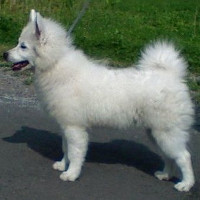
| Spitz breeds are captivating on account of their beautiful coats, made to stand off by plentiful undercoat. Particularly impressive are the strong, mane-like collar round the neck (ruff) and the bushy tail carried boldly over the back. The foxy head with alert eyes and the small pointed, closely set ears give the Spitz its unique characteristic, cheeky appearance. |
Important proportions |
| The ratio of height at withers to body length is 1 : 1. The ratio length of the muzzle to length of the skull of Giant Spitz, Medium Size Spitz and Miniature Spitz is approximately 2 : 3. |
Behaviour / temperament |
| The German Spitz is always attentive, lively and extraordinarily attachedto its owner. It is very teachable and easy to train. Its natural distrust of strangers and lack of hunting instinct make it the ideal companion and family dog and watch dog for home and farm. It is neither timid nor aggressive. Indifference to weather, robustness and longevity are its most outstanding attributes. |
Head |
||
Cranial region |
||
Skull |
The Spitz’s medium-sized head, seen from above, appears broadest at the back and tapers wedge-shaped to the tip of the nose. | |
Stop |
Moderate to marked, never abrupt. | |
Facial region |
||
Nose |
The nose is round, small and pure black. The nose of brown Spitz dogs is dark brown. | |
Muzzle |
The muzzle is not overlong and stands in pleasing proportion to the skull (approximately 2:3). | |
Lips |
The lips are not exaggerated, close fitting to the jaws and do not form any folds to the corner of the mouth. They are completely black. The lips of brown Spitz dogs are brown. | |
Jaws and teeth |
The jaws are normally developed and show a complete scissor bite with 42 teeth, corresponding to the dental formula of the dog, i. e. the upper incisors closely overlapping the lower onesand set square to the jaws. Strong canines fitting exactly into each other. The lack of a few premolars shall be tolerated in Medium Size Spitz and Miniature Spitz. Pincer bite is permissible. | |
Cheeks |
The cheeks are gently rounded, not protruding. | |
Eyes |
The eyes are of medium size, almond-shaped, slightly slanting and dark. The eyelids are black. Brown Spitz dogs have dark brown eyelids. | |
Ears |
The small ears are set high and relatively close to each other, triangular pointed; they are always carried upright, stiff at the tips. | |
Neck |
| The medium length neck is set broadly on the shoulders, slightly arched without dewlap and covered by a thick, profuse coat, forming a large ruff. |
Body |
||
Topline |
Merges in a gentle curve with the short, straight back. The bushy, sweeping tail, which partially covers the back, rounds off the silhouette. | |
Withers |
The high withers drops imperceptibly. | |
Back |
As short as possible, straight, firm. | |
Loin |
Short, broad and strong. | |
Croup |
The croup is broad and short, not falling away. | |
Chest |
The deep chest is well sprung, the forechest well developed. | |
Underline and belly |
The chestreaches back as far as possible ; the belly has only a slight tuck up. | |
Tail |
| The tail is set on high and of medium length. It reaches upwards and rolls forward over the back, straight from the root. It lies firmly over the back and is covered with very bushy hair. A double curl at tip of tail is tolerated. |
Limbs |
Forequarters |
||
Generality |
Straight, rather broad front with well-developed bone strength. | |
Shoulders |
The shoulder is well muscled and firmly connected to the chest. The shoulder blade is long and well laid back. | |
Upper arm |
The upper arm, which is approximately the same length as the shoulder blade, forms an angle of 90 degrees to the shoulder blade. | |
Elbows |
The elbow joint is strong, close fitting to the chestand turns neither in nor out. | |
Forearm |
The forearm is of medium length in relation to the body, sturdy and completely straight. The back of the forearm is well feathered. | |
Pastern |
The strong, medium length front pastern stands at an angle of 20 degrees from the vertical. | |
Forefeet |
The forefeet are as small as possible, round and closed, with well arched and tight nails, so called cat feet. The colour of nails and pads is as dark as possible. | |
Hindquarters |
||
Generality |
The hindquarters are very muscular and abundantly feathered to the hocks. The hind legs stand straight and parallel. | |
Upper thigh |
Thigh and lower leg are of about equal length. | |
Stifle |
The stifle joint is strong with only moderate angulation and is turned neither in nor out in movement. | |
Hock |
The hock is of medium length, very strong and vertical to the ground. | |
Hind feet |
The hindfeet are as small as possible, round and closed, with well arched and tightnails, so called cat feet. The pads are coarse. The colour of nails and pads is as dark as possible. | |
Gait and movement |
| German Spitz dogs move straight ahead with good drive, fluidly and springy. |
Skin |
| The skin covers the body tightly without any wrinkles. |
Coat |
||
Hair |
German Giant Spitz, Medium Size Spitz and Miniature Spitz dogs have a double coat: Long, straight andfirmstanding off top coat and short, thick, cotton-wool-like undercoat. Head, ears, front side of front and hind legs and the paws are covered by short, thick (velvety) hair. The rest of the body has a long, rich, hairy coat. Not wavy, curly or shaggy, not parted along the back. Neck and shoulders are covered by a thick mane. The backside of the front legs is well feathered, the hind legs have ample feathering from croup to hocks. The tail is bushy. Hair must not look like being modelled. |
|
Colour |
German Giant Spitz : White, black, brown.In black and brown Spitz dogs, white spots on the chest, the paws and the tip of the tail are permissible. German Medium Spitz : White, black, brown, orange, grey-shaded, other colours. German Miniature Spitz : White, black, brown, orange, grey-shaded, other colours. White Spitz : The coat should be pure white. Little trace of yellow, which often occurs, especially on the ears, is tolerated. Black Spitz : Black Spitz dogs must have a black undercoat and a black skin. The colour on top must be a shining black without any white or other markings. Brown Spitz : The brown Spitz should be uniformly dark brown. Orange Spitz : The orange Spitz should be evenly coloured in the medium colour range. Lightening up of the orange colour on the chest, the tail and the trousers is permitted. Grey-shaded Spitz : Grey-shaded is a silver-grey with black hair-tips. Muzzle and ears are dark in colour, round the eyes well defined shown as a delicately pencilled black line slanting from outer corner of eye to lower corner of ear, coupled with distinct markings and shading forming short but expressive eyebrows; mane and ring on shoulder lighter; fore- and hind legs silver-grey without any black markings under the elbows or stifles, except slight pencilling on the toes; black tip of tail; underside of tail and trousers pale silver-grey. Other coloured Spitz : The term applies to the following colours : cream, cream-sable, orange-sable, black and tan and particolour. Particoloured dogs must have white always as basic colour. The patches must be uniformly in one colour either black or brown or grey-shaded or orange or orange-sable or cream or cream-sable. They should preferably be distributed over the whole body. |
|
Size and weight |
||
Height at withers |
German Giant Spitz : 45 cm ± 5 cm. German Medium Size Spitz : 35 cm ± 5 cm. German Miniature Spitz: 27 cm ± 3 cm. |
|
Weight |
Each variety of the German Spitz should have a weight corresponding to its size. | |
Faults |
| • Any departure from the foregoing points should be considered a fault and the seriousness with which the fault should be regarded should be in exact proportion to its degree and its effect upon the health and welfare of the dog and its ability to perform its traditional work. • Faults listed should be in degree of seriousness. |
Serious faults |
 Faults in construction. Head too flat. Distinct apple head. Flesh-coloured nose, eyelids and lips. Dentition faults, missing incisors. Too large and too bright eyes. Prodtruding eyes. Ingrey-shaded Medium Size Spitz and Miniature Spitz missing of distinct markings of the face. Faults in movement. Faults in construction. Head too flat. Distinct apple head. Flesh-coloured nose, eyelids and lips. Dentition faults, missing incisors. Too large and too bright eyes. Prodtruding eyes. Ingrey-shaded Medium Size Spitz and Miniature Spitz missing of distinct markings of the face. Faults in movement. |
Disqualifying faults |
| Aggressive or overly shy dogs. Gap in fontanel. Overbite, underbite, crossbite. Ectropion or entropion. Ears not fully erected. Definite white markings or spots in all non-white Spitz dogs, Giant Spitz dogs are excepted. Any colour not mentioned in section “Colours”. |
NB : |
| • Any dog clearly showing physical or behavioural abnormalities shall be disqualified. • The above mentioned faults when occurring to a highly marked degree or frequently are disqualifying. • Male animals should have two apparently normal testicles fully descended into the scrotum. • Only functionally and clinically healthy dogs, with breed typical conformation should be used for breeding. |
Bibliography |
| https://www.fci.be/ |



 English (United Kingdom)

Comments