
 |
Andalusian Terrier |
|
FCI standard Nº 371 |
||
Origin |
Spain | |
Translation |
Revised by Benjamín Sánchez Official language : ES |
|
Group |
Group 3 Terriers | |
Section |
Section 1 Large and medium sized Terriers | |
Working |
Working trial optional | |
Acceptance on a provisional basis by the FCI |
Tuesday 3 September 2024 | |
Publication of the official valid standard |
Tuesday 3 September 2024 | |
Last update |
Thursday 12 September 2024 | |
This breed is also known as |
Andalusian Mouse-Hunting Dog
|
Usage |
| A good working Terrier with abilities to hunt rats, mice and all vermin. Can also be used for rabbit and hare hunting. |
Brief historical summary |
| This breed descends from old Smooth Fox Terrier lines, introduced by British wine import companies involved in wine commerce between the UK and Jerez (Spain) during the XIX century. These dogs blended in with native breeds from villages of that region. They were bred with a natural predisposition to hunt rodents which were abundant in commercial ports, wine cellars, warehouses, stables and tanneries. Right from their origin they were always considered as a pure breed and so they have been bred, developing a prominent homogeneity. Almost uniform white colour with black and tan patches was selected to be easily visible in the darkness of the above-mentioned places. Excellent examples of the breed can be easily found in sherry wine region in the surroundings of Jerez, but also all over Andalucia, and then they have been spread to rest of Spain. |
General appearance |
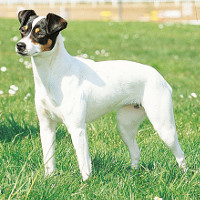
| Medium-sized dog of medium proportions. Female proportionally more elongated than male. White colour with black and tan patches on a thin and tight skin that allows to perceive an athletic but light appearance that allows him to express his restlessness and joy with agile and coordinated turns and jumps. The coat is very short. |
Important proportions |
| The ratio of length of the body (measured from point of shoulder to point of buttock) to height at withers is 1:1. Females somewhat mor elongated and graceful. Length of the head to length of skull is 8:5. Height at withers / Head length 5:2. Height at elbows / height at withers 1:2. |
Behaviour / temperament |
| Happy, inquisitive, affectionate, bold and brave, with excellent temperament. Outstanding functionalities, toughness and aptitude hunting rodents. This breed is also a loyal companion, an ideal pet, suitable for all types of climates, and extremely clean. |
Head |
||
Cranial region |
||
Cranial region |
Parallel axes of skull and muzzle. | |
Head |
Well balanced with the body. | |
Skull |
Flat or slightly domed, subconvex. Square, unmarked occipital protuberance. | |
Stop |
Defined but not very pronounced. | |
Facial region |
||
Facial region |
Straight nasal bridge. | |
Nose |
Black, round, medium sized with well open nostrils. | |
Muzzle |
Short, length in a proportion to skull length of 3:5. | |
Lips |
Thin and tight, pigmented. | |
Jaws and teeth |
Complete, strong and White, with a scissor bite. | |
Cheeks |
Muscular, well developed. | |
Eyes |
As dark as possible, small, slightly oblique and nonprotruding, with sharp and smart expression. Well pigmented eye rims. | |
Ears |
Triangular, wide implantation base and medium-high set on at the level of the occipital. In attention folded forward (Bottom-like). At rest, could be folded back as rose ears. | |
Neck |
| Moderately long, strong muscular development, clean without dewlap. |
Body |
||
Body |
Compact, but slender and graceful. | |
Withers |
Not very pronounced. | |
Back |
Straight, level topline slightly descending towards the croup. | |
Loin |
Short, muscled. | |
Croup |
Short, slightly rounded. | |
Chest |
Deep, wide and strongly muscled. Slightly arched ribs. Non pronounced forechest. | |
Underline and belly |
At the height of the elbow and softly tucked up. | |
Tail |
| Medium-high set, perpendicular to the croup, pricked. Tailless specimens or with variable length of tail are born. |
Limbs |
| Perfectly vertical and strong, medium thickness and noticeable muscular development. | ||
Forequarters |
||
Generality |
Straight and medium boned from every angle. | |
Shoulders |
Oblique. | |
Upper arm |
Adequate length to that of the shoulder. Angle of scapulohumeral joint close to 90º. | |
Elbows |
Closed to the body. | |
Forearm |
Long, thin but strong bone. | |
Carpal |
Short. Well developed. | |
Pastern |
Short, forming an angle of 35-40º with the vertical. | |
Forefeet |
Round shaped toes, well knit. Very strong nails and hard pads. | |
Hindquarters |
||
Generality |
Very strong and powerful, perfectly vertical from behind. | |
Upper thigh |
Long and powerful with a coxofemoral joint angle open 110º. | |
Lower thigh |
Similar length than thigh. Leg fairly vertical. | |
Stifle |
Angulation approximatively 110º. | |
Metatarsus |
Strong, developed and elongated. | |
Hock |
Dry, well developed tendon and open tibio-tarsal joint angle (130-150º). | |
Hind feet |
Feet with moderate extended phalanxes or preferable cat like, round and thigh, pads and nails similar to those in hands. | |
Gait and movement |
| Agile, elegant and coordinated, with great capacity to turn and jump. Trot is the preferred gait. |
Skin |
| Thin and very close to the body. |
Coat |
||
Hair |
Very short and dense coat, uniform and abundantly distributed over the whole body. | |
Colour |
Coat with predominance of pure white with black spots mainly situated on the head and beginning of the neck, which are complemented with tan points on the face, cheeks and above the eyes (for rest of body, the usual phenotypic distribution of the black and tan colour, is allowed together with black if it is located around the tail, perianal region or extremities). Colour of nose and pigmentation on eye rims, lip rims and pads black. |
|
Size and weight |
||
Height at withers |
Males : 37 to 43 cm, being ideal 40 cm. Females : 35 to 41 cm, being ideal 38 cm. Two more centimetres are tolerated in both sexes, but only if the dos is harmonious and free of faults. |
|
Faults |
| • Any departure from the foregoing points should be considered a fault and the seriousness with which the fault should be regarded should be in exact proportion to its degree and its effect upon the health and welfare of the dog and its ability to perform its traditional work. • Faults listed should be in degree of seriousness. |
General faults |
 Partially depigmented nose. Long body. Very short limbs. Very narrow croup. Absence of tan points on the cheeks or above the eyes. Shy temperament. Partially depigmented nose. Long body. Very short limbs. Very narrow croup. Absence of tan points on the cheeks or above the eyes. Shy temperament. |
Disqualifying faults |
| Aggressive or overly shy dogs. Untypical specimen. Monorchidism or cryptorchidism. Uniform white coat or presence of red or tan points in any other places than described as normal. Long, curly and wired hair. Other bite than scissor bite. Very long body. Full depigmented nose. Upright pricked ears. Hanging ears. Another coat colour than described. |
NB : |
| • Any dog clearly showing physical or behavioural abnormalities shall be disqualified. • The above mentioned faults when occurring to a highly marked degree or frequently are disqualifying. • Male animals should have two apparently normal testicles fully descended into the scrotum. • Only functionally and clinically healthy dogs, with breed typical conformation should be used for breeding. |
Bibliography |
| https://www.fci.be/ |



 English (United Kingdom)

Comments